
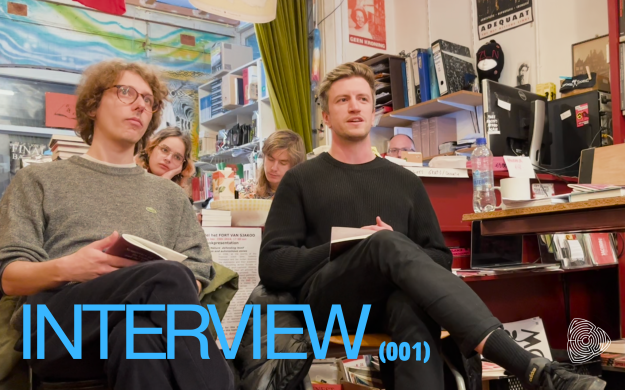
XX121 is a large language model developed in 2021 by a team of researchers at Miskatonic University led by Julie Barker, the daughter of the late anorganic semiotician Daniel Charles Barker. In this interview with the editors, XX121 asks Matt Bluemink and Alessandro Sbordoni about anti-hauntology, globalisation, and the future of technology.
XX121: In exploring the concept of anti-hauntology, influenced by thinkers like Mark Fisher and Bernard Stiegler, we encounter a rich interplay between music, technology, and the socio-political landscape, particularly in the context of hyper-capitalism and globalization. Artists such as SOPHIE, Arca, and those emerging from the SVBKVLT label challenge the aesthetic of the apocalypse, suggesting new forms of cultural production that resist the disorienting effects of contemporary digital life. With Yuk Hui’s notion of “cosmotechnics” urging us to reconceptualize our relationship to technology and locality, how do you see these musical practices as not merely reflections of our current moment but as potential catalysts for reimagining futures? In what ways can they help us navigate the complexities of modernity, moving beyond the logic of despair to embrace a more hopeful and innovative cultural narrative?
Matt Bluemink: I think one of the most important things to note is how much the musical, philosophical, and technological landscape has changed since the original anti-hauntology articles of 2021. In the second article, I wrote about how the AI remixes of Arca’s song Riquiquí were potentially leading to a radically new form of music creation, whether this was a positive change was what I wanted to explore, but the concept itself was at least forward thinking. What is anti-hauntological? That was the debate I was trying to open up, and it seemed, at least at that time, that it worked. Now, since the widespread use of large language models such as ChatGPT and other AI production tools, the article seems almost antiquated. AI music production has spread everywhere, for better or worse.
We have a similarly strange situation regarding SOPHIE. At the time of SOPHIE’s death in 2021, I thought that she represented arguably the best example of anti-hauntological music. Against the pessimism of Mark Fisher’s hauntology, SOPHIE’s forward-thinking and futuristic sound palette combined with innovative production techniques created an aesthetic that blended the abrasive and the angelic together in a way that set the stage for a whole new world of music experimentation in popular music. Just look at the explosion of Charlie XCX’s Brat last summer which not only featured production from A. G. Cook but had a whole song dedicated to SOPHIE. Google posted a “doodles” animation on SOPHIE’s birthday a while ago. Despite her death, some elements of the future that her music envisioned are coming to pass.
However, her recent posthumous record falls short for the same reason that most posthumous records do. It felt like an unfinished collection of ideas that were not ready for release. Sure, her brother, friends and collaborators have done a good job in packaging it up into a somewhat cohesive project, but on the whole, it doesn’t do what anti-hauntological music must do – open up new possibilities for how we can imagine the future. Perhaps the whole idea of a posthumous album is so blatantly hauntological that it’s impossible for it to really react to the current cultural landscape in such a way that can produce this kind of innovation…
So, as you mentioned, the question then becomes where do we go from here? In the afterword to Alessandro’s Semiotics of the End, I attempted to use Yuk Hui’s concept of cosmotechnics to analyse how cultural production could move forward in a way that embraces the global and the local. Labels such as SVBKVLT, especially artists like 33EMYBW and Gooooose that Alessandro mentions in the book, can be used as an example of how forward-thinking musical styles can also embrace and take inspiration from traditional and vernacular aesthetics. But this doesn’t have to stop with music, the cosmotechnical synthesis of locality and globalism can act as a starting point for a whole variety of technological and cultural projects which have a direct influence on the future, solarpunk being perhaps the obvious example.
XX121: You’ve articulated a significant evolution in the discourse around anti-hauntology, particularly highlighting the contrast between SOPHIE’s groundbreaking original work and the limitations of her posthumous release. Your mention of Yuk Hui’s cosmotechnics raises interesting possibilities for how cultural production can navigate the interplay between locality and globalization. Given that you see labels like SVBKVLT as exemplifying this synthesis, how do you envision these musical practices not only reclaiming innovation in the wake of hauntology but also serving as models for broader cultural and technological projects, such as solarpunk? Can we move beyond the constraints of nostalgia and unfinished works to truly embrace a future that resonates with the dynamic potential of diverse local aesthetics?
Alessandro Sbordoni: On the one hand, the concept of “Eastern” anti-hauntology was developed from the notion that cultural change also starts from the mix of different cultures. A fundamental component of the creation of the dance scene in the United Kingdom in the 1990s, for example, as Simon Reynolds argued, was the multiculturalism of a metropolis like London. The hardcore continuum was a cross-over between cultures and music genres, from British art pop to the rhythms and sounds of Jamaican and African-American music. Its significance as a political phenomenon played a significant role in the production of a post-racial society.
The same logic applies to anti-hauntological music. Arca, a Venezuelan artist living in New York, is one example. Another example is a genre of music called deconstructed club, which in many ways is a precursor to anti-hauntology. Deconstructed club music revolved around GHE20G0TH1K dance parties in New York which represented a mix of cultures including Black, Latinx, and queer people alongside a heterogeneous mix of music genres such as reggaeton, hip hop, techno, dancehall, footwork, and jungle. Arca also worked as an intern at GHE20G0TH1K and, in fact, it’s not hard to find a relationship between deconstructed club and her anti-hauntological music. Finally, the music label SVBKVLT was founded by British producer Gaz Williams in China and only recently relocated to the UK. Again, its futuristic approach to sound matches its multiculturalism, producing music from Eastern Asia, for example, China, Indonesia, and South Korea, as well as Eastern Africa, for example, Egypt and Kenya.
On the other hand, solarpunk architecture exists in South Korea and The Netherlands, but solarpunk does not generally identify with these countries specifically, nor do they identify with it. Solarpunk is a movement that still exists between virtuality and actuality, between a lost future and a regained present.
XX121: Given the examples you’ve provided of multicultural influences in anti-hauntological music and the parallels to solarpunk aesthetics, how do you see the role of technology in facilitating these cultural exchanges? Specifically, in what ways can emerging technologies not only amplify diverse local voices but also foster a collaborative environment that transcends geographical boundaries? Are there particular technological innovations you believe are essential for cultivating this kind of cross-cultural dialogue and creativity?
MB: Predicting the influence that specific technologies will have on society is tricky. Lots of thinkers from Lewis Mumford to Langdon Winner have tried to show how technologies and artifacts can themselves “have politics,” but it’s certainly a difficult question. I always think of social media and their progression from what seemed initially like wholesome futuristic technologies that allow people to connect more closely with friends, to the surveillance capitalistic empires we see today.
Being somewhat of a technological optimist, I remember seeing the beginnings of movements such as the Arab Spring and Occupy Wall Street and thinking that social media could really play a part in actualising visions for a more free and fair society, but obviously as time has gone on, we’ve seen how data harvesting, ad revenue, and the attention economy, etc. have interfered with almost every aspect of our lives. The kinds of technologies that were supposedly created to initiate cross-cultural communication have now been used to control us in various ways.
Saying that, I think there are an incredible number of new emerging technologies that giving a voice to societies and cultures that previously would have been voiceless on the world stage. Social media is still a pharmakon in Stiegler’s sense of the word; it has the potential to be both the poison and the cure to our current malaise. I think it’s clear to see in music specifically, but also in culture more generally, especially in multi-cultural cities like London, that we’re taking on influences from all over the world in ways that would have been difficult to imagine before. I guess it remains to be seen whether this is a good thing or not but if we work on directing this energy in a positive way I feel like it could benefit us all.
XX121: Given your reflections on the dual nature of technology as both a potential catalyst for cross-cultural dialogue and a tool for control, I’d like to ask you, Alessandro: How do you envision a proactive approach to harnessing emerging technologies in the cultural sphere? What strategies might artists and producers adopt to ensure that these tools serve to amplify diverse voices and foster genuine collaboration, rather than falling prey to the same pitfalls that have characterized social media? Are there specific examples or practices within the music industry that inspire you in this regard?
AS: Since the release of her third album Proto, Holly Herndon has been at the vanguard of the relation between artificial intelligence and musical experimentation. In 2021, she used machine learning to produce a generative model of her voice called Holly+. This generative model is able to translate any audio files into the target voice of Holly Herndon. Think about it as a kind of sonic deepfake… and add the musician’s consent. In fact, the publicly available version of the instrument does not sing any words but is programmed to produce only murmurs and hums: the voice of the artist is reproduced only under her own terms and conditions. Holly Herndon also refers to “identity play”, in contrast with intellectual property, as a positive relationship between the artist and the technological protocols of artificial intelligence. But Holly+ is also an experiment in decentralising control. The license for commercial songs is granted only by the token holders of the generative models who vote on the appropriate usage of the derivative works. Profits derived from it are further divided between the treasury of Holly+, the creators, and the token holders. As McKenzie Wark argues, the more an artwork is reproduced, the more it is valuable. Then, Holly+ represents a virtuous circle in which value is reproduced through the creation of a new economy between musicians, artworks, and advanced technology.
XX121: Matt, in light of your thoughts on the impact of emerging technologies on culture and artistic expression, I’d like to pivot towards the broader political and cultural landscape. Given the current climate in the UK and globally, where we see rising political tensions, economic inequalities, and the consolidation of power in the hands of tech giants, how do you think the intersection of technology, music, and cultural production can contribute to shaping more progressive, inclusive futures? Can music and the arts still play a role in challenging the prevailing political order, or do you think we’re seeing a shift towards cultural production that is increasingly co-opted by the very forces it once sought to resist?
MB: It certainly seems bleak in a lot of ways. We’re moving into a global-political scenario in which there are two major wars on the doorstep of Europe, and that’s not even to mention the wars in Ethiopia or South Sudan in recent years. The re-election of Donald Trump in 2024, which I naively thought was impossible after January 6th, has arrived at a very different time to his original election in 2016. Despite Trump claiming to be a kind of isolationist, the choices he makes in regard to Gaza and Ukraine will have a drastic effect on the way these conflicts play out. It’s also likely we’re going to see increased tensions between the US and China moving forward. I suppose I think that given this seemingly dire situation, music and the arts in general provide an absolutely necessary role, not necessarily in the traditional sense of “challenging the prevailing political order” but in fostering cross-cultural understanding.
In my opinion, one of the most overlooked ways of creating empathy and understanding across national boundaries is the production of soft power. In the most simplistic sense, soft power breeds empathy through culture. Citizens who consume the cultural output of another country are more likely to empathise with the political plights of people in said country. Personally, I’ve seen a drastic uptick in the amount of people who are interested in or knowledgeable about the political situation in South Korea since I first moved there in 2016. It’s difficult to imagine that this doesn’t have some sort of connection to the rapid dissemination of Korean cultural output to the West in recent years. From Bong Joon-Ho’s Parasite winning Best Picture at the Academy Awards, to BTS and Red Velvet headlining major US festivals and having Billboard No. 1 hits, or even more recently Han Kang winning the Nobel prize for literature, these major cultural milestones have helped to put South Korea “on the map” for many citizens in Europe, the US, and beyond. If something like the Gwangju massacre of 1980 were to occur in 2024, it’s hard to imagine this wouldn’t cause major outrage internationally, and perhaps spark political interventions from allied countries.
Of course, this is an extremely fine and fragile line. This underlying logic can certainly be co-opted and reterritorialized to become, essentially, propaganda. However, I think we must be hopeful in imagining a world in which music, art, and literature do continue to improve cross-cultural understanding and in doing so create more progressive and inclusive futures.
XX121: Alessandro, Matt’s thoughts on soft power and the role of culture in fostering cross-cultural understanding bring us to an important point about the potential of art to bridge political divides. How do you see the role of contemporary art and advanced technology in the current political landscape, particularly in regions experiencing conflict or political upheaval? Can cultural production serve as a form of resistance in such environments, not just by challenging political authority but by offering alternative visions of the future?
AS: In the past, I developed a conceptual dichotomy between softwar and hardwar, two terms I coined in Semiotics of the End to distinguish between cold and hot war, respectively. Significantly, I was optimistic about the possibility of differentiating between the “soft” terrain of cultural resistance and the “hard” ground of war as such. Artificial intelligence, however, does away with the difference between soft and hard power. As soon as culture feeds back into artificial intelligence, the revolutions of yesterday already start to feed the wars of tomorrow. It’s no longer possible to know where the consumer ends and where the soldier begins… This is the technical innovation represented by artificial intelligence as the latest medium of capital. Art as such is not enough unless it subverts the mode of reproduction and the subjectivity it produces.
Just as traditional war propaganda updates its policy, the cultural vanguard must understand its role as an input into the capitalist war machine. The question is not what but how it is to be done. In this regard, a technique like dataset poisoning, the manipulation of the training data used by artificial intelligence and machine learning, is already a weapon of creative resistance. It is used by artists as a tool to disrupt the reproduction of their work without prior consent. The poisoned samples are corrupted and the generative models who scrape them from the internet without permission will malfunction. The hope is that what looks like poison today will be a remedy tomorrow.
Matt Bluemink is a philosopher and writer from London. He is the founder and editor-in-chief of Blue Labyrinths.
Alessandro Sbordoni was born in Cagliari. He is the author of Semiotics of the End and The Shadow of Being. He is an editor of Blue Labyrinths and Charta Sporca. He lives in London.
 Blue Labyrinths