
Following the publication of his acclaimed book Of Enemies and Venison: First Materials for an Aztec Cosmotechnic, Matt and Alessandro talk to Lou Manuel Arsenault about Aztec war, technodiversity, and the role of imagination.
In his magnum opus The Accursed Share (1949), Georges Bataille comments upon the sacrifice and war of the Aztecs. In one of the most inflammatory chapters of the book, he writes:
“The Aztecs […] are poles apart from us morally. As a civilization is judged by its works, their civilization seems wretched to us. They used writing and were versed in astronomy, but all their important undertakings were useless: Their science of architecture enabled them to construct pyramids on top of which they immolated human beings. Their worldview is singularly and diametrically opposed to the activity-oriented perspective that we have. Consumption loomed just as large in their thinking as production does in ours. They were just as concerned about sacrificing as we are about working.”
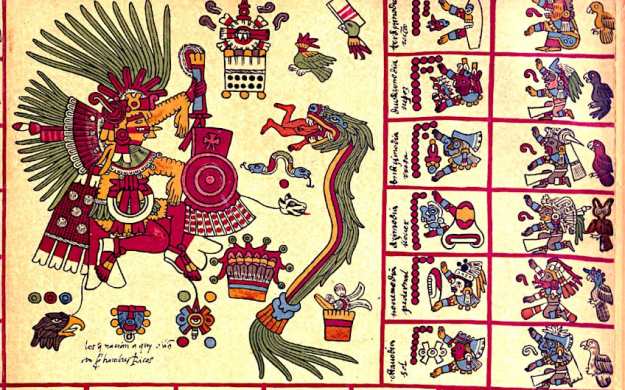
In Aztec culture, sacrifice represented an act of offering gifts to the heavens in the form of blood. According to Georges Bataille, sacrifice was not murder but redress; likewise, warfare was not conquest but consumption. Through the ritual death of prisoners of war and hunted prey, a relation of continuity was established between the sacrificer and the sacrificed. The priests would strike their victims with an obsidian knife, tear out their heart, and raise it to the sky, as a gift to Huitzilopochtli, the Aztec sun and god of war.
But what is the relationship between the Aztec worldview and their use of technology? In his new book, titled Of Enemies and Venison: First Materials for an Aztec Cosmotechnic (2026), Mexican-Canadian author Lou Manuel Arsenault argues that technics is a cornerstone of the Aztecs’ worldview. The ritual use of the tecpatl knife by sacrifice-priests is already a form of cosmology, encompassing the relationship between sacrificer and sacrificed, hunter and hunted, warrior and enemy. “Many recent technological developments, in the West and beyond,” Arsenault tells us in an interview recorded earlier this year, “are about the reification of human and non-humans alike.” For him, Aztec warfare and hunting represented a way to envision a relationship with technology that goes beyond the sphere of utility.
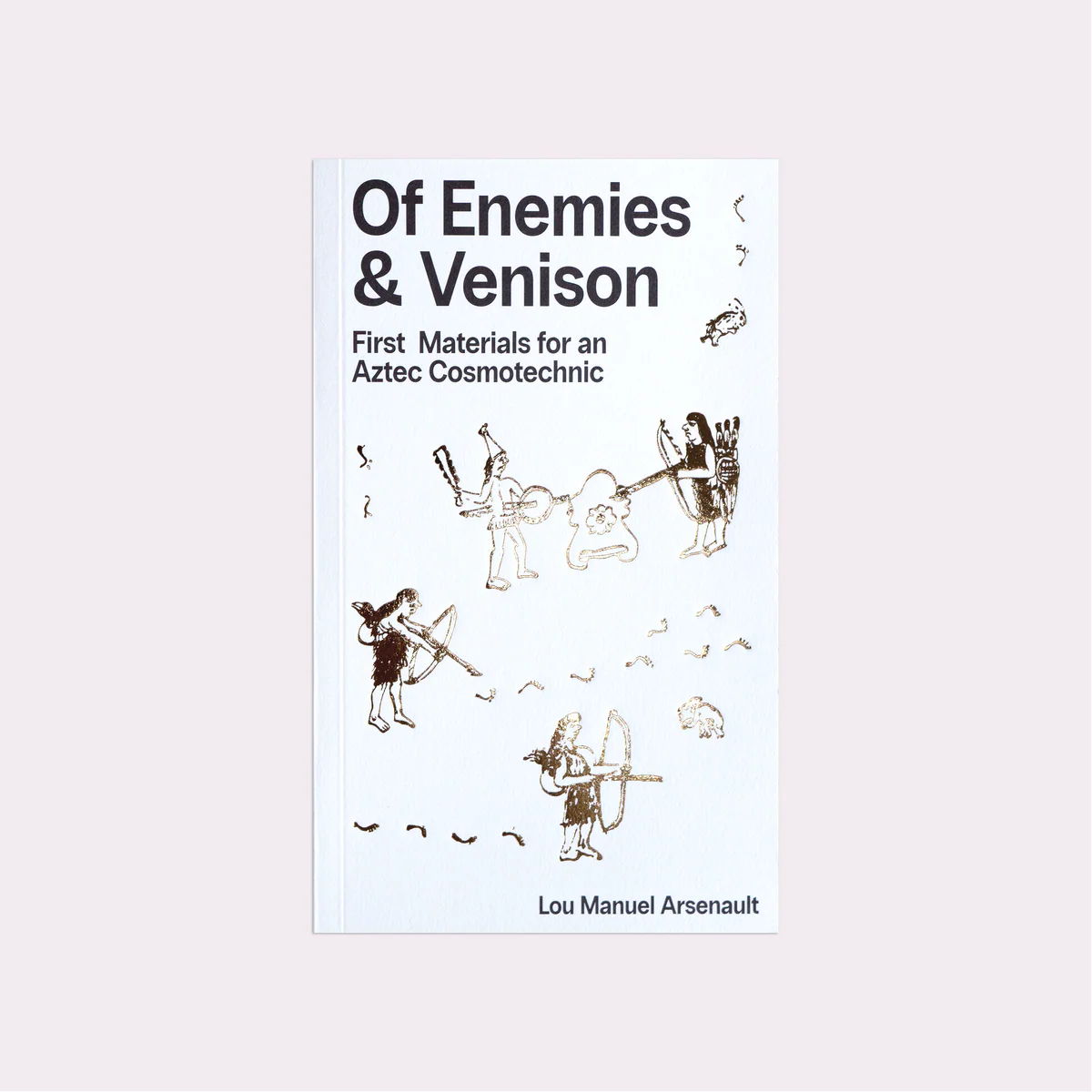
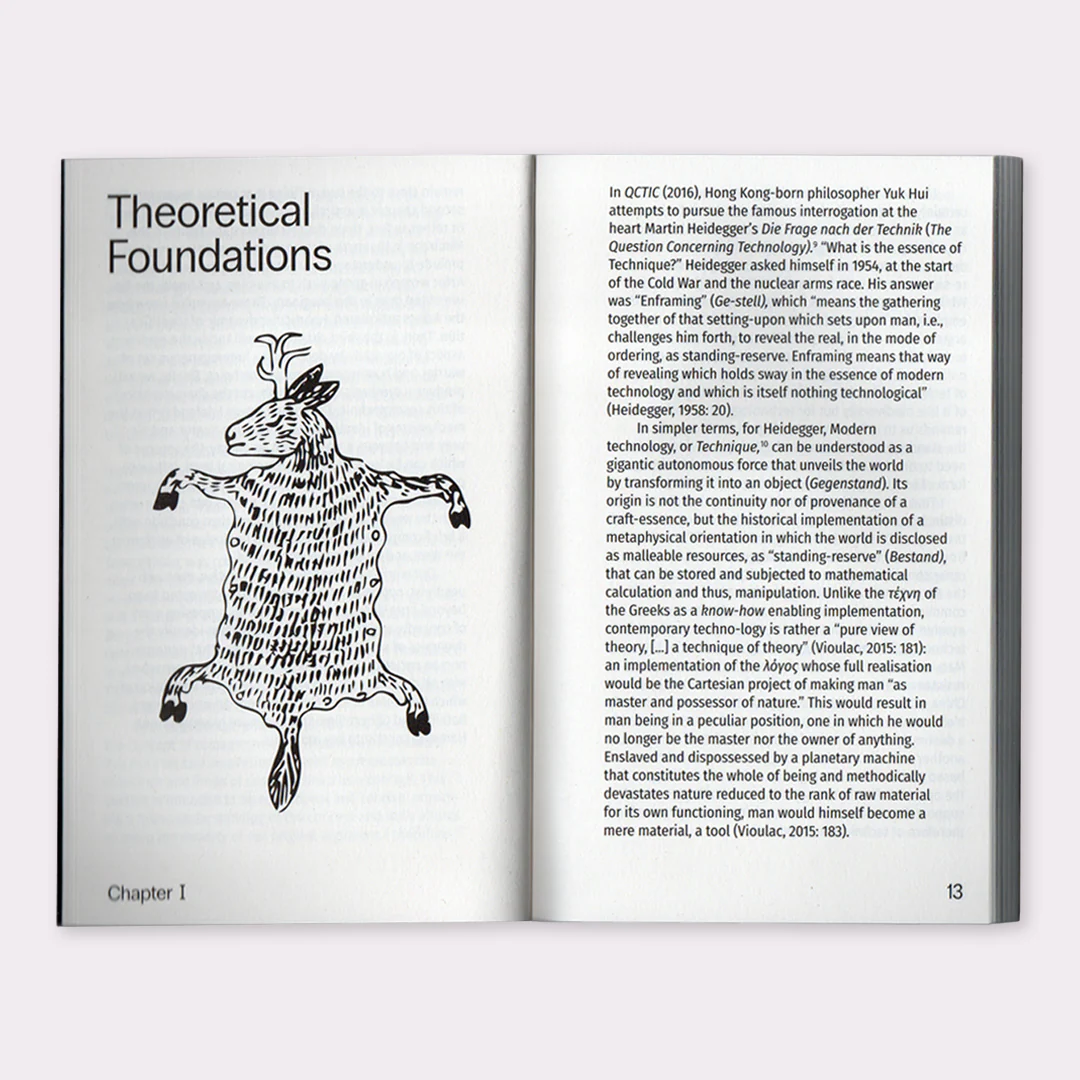
However, despite drawing a minor influence from Bataille’s work, Of Enemies and Venison operates within a different conceptual framework. The key thinker that serves as a point of departure for Arsenault is Yuk Hui and his notion of cosmotechnics. In The Question Concerning Technology in China (2016), Yuk Hui claims that there is not one universal conception of technology; each different locality has its unique cosmological understanding of the world that can serve as the basis for a local or vernacular form of technical practice. According to Arsenault, the methodology presented by Yuk Hui when looking at China and its technics could be applied to any number of cultures, especially those of Mesoamerica.
“Exploring the Aztecs for me was kind of – which elements from the past can be renewed? Which elements from a tradition can be integrated into modern practices? And I felt as though war and hunting, which are the same thing in ancient Mesoamerica, are very curious subjects for me because they tell us so much about technology. They tell us so much about how you consider other people. They tell us so much about the situation of the economy. They tell us so much about literally every aspect of the subject-world relationship.”
Here we see how Of Enemies and Venison approaches the idea of cosmotechnics from a radically different angle than Yuk Hui and Martin Heidegger. Arsenault tells us that he was hesitant to follow the traditional Heideggerian methodology, which is grounded in a deconstruction of Western metaphysics. While Yuk Hui uses this methodology to analyse the Chinese concepts of Qi and Dao, to Arsenault, “the Heideggerian reading of Western metaphysics is at the core of postmodern philosophy. It’s a reading that has often been put forward when in reality I think that Western thought and its relationship to technique is way more complex.”
This complexity is only increased when considering the idea of an Aztec cosmotechnic (on a par with Yuk Hui’s notion of Chinese cosmotechnics). War, hunting, sacrifice, and identification are key aspects of Arsenault’s analysis, yet he states emphatically, “I don’t mean to really suggest reintroducing sacrifice as a practice.” Instead, his work is more concerned with how different technical practices are able to shine a light on the life of a particular society, and how that could open up new forms of political organisation. “I feel that if people had some kind of political autonomy – like deciding which technology can be accepted by a political community – thinking through the lens of the necessity of identification and the refusal of othering technologies would change a lot of things.”
The question of locality and political organisation is also directly related to Arsenault’s own ethnicity. “I’m half Mexican and half French Canadian,” he tells us. “So it was a way to rediscover a part of my heritage […]. I give a lot of importance to what Mexico can be politically.” He continues, “The book has been written thinking about Mexico, but its scope is dual. It’s also a letter to the Western world on how we can integrate ethics. Is it even possible with the level of secularization and the scientific worldview that we have?” For Arsenault, the ontological turn in anthropology has been essential in opening up and developing new sensitivities to nature that, in turn, force us to question our current relationship with technology.
In fact, Of Enemies and Venison is not an attempt to return to the past but to learn from it in order to move forward. The question is instead how to use these ideas to reshape our own worldview, in which unilateral globalisation and the imposition of only one kind of technics and technology are dominant. “It is not a question of idealizing past and archaic forms that would be clearly out of step with the ethical demands of contemporary societies,” he writes in the introductory pages of the essay. But on the contrary, “to return to Mexico and war, a critical and nuanced look at the past can be creative. As Walter Benjamin saw it, history, and more specifically what he called ‘the tradition of the oppressed,’ can inspire new ways of doing things.”
At the core of this is the concept of technodiversity, which runs in parallel to Hui’s cosmotechnics. Towards the end of the book’s first chapter, Arsenault summarises how cosmotechnics and technodiversity provide the framing for the next chapters, which specifically analyse Aztec technical practices:
“Thinking about technodiversity, then, means putting forward the plurality of noetic dispositions and forms of thought that lie dormant within each culture and form-of-life. Reviving and reclaiming such technodiversity on a local basis opens up the possibility of a plural fragmentation of world history through a multitude of appropriation events, which are not necessarily made by ‘Being’, but under the aegis of other figures: nothingness, Qi and Dao, mana, and so on.”
Hunting, war, and the notion of identification at the centre of these practices act as the objects of study for Arsenault, just as Qi and Dao were for Hui. In Mesoamerican society, as Arsenault writes, “there was a strong identification between the Aztec warriors and the sacrificial victims, the vast majority of whom were enemy warriors captured as prisoners.” This identification also extends to the warrior and their enemy, and the hunter and their prey, and perhaps most curiously, the mother and their child. Identification, therefore, serves as the foundation of many technical practices in Aztec cosmology.
In our interview, Arsenault builds on this when he states,
“I feel like the question of identification with your enemies has something to offer. I think if I were to write a part two [of the book], it would be a naturalization working through Carl Schmitt, certainly. And maybe something about affordance and how technologies effectively create identification […]. Can technology create identification, under the current cosmotechnical configuration of the Western world?”

An affirmative answer to Arsenault’s provocative question is also a positive reply to an alternative future of technology. Here, we begin to see how analysing Mesoamerican technical practices allows for the development of a new form of imagination that can seek to move beyond the hegemony of the Western worldview:
“If I think about that big post-Mark Fisher moment where everybody on the left was like, ‘There are no alternatives. We need to find an alternative,’ – which is actually at the end of capitalist realism, where there’s an opening. […] I think that political imagination comes not only with immediate contact. You need to have that reflexive moment where you think about what’s happening.”
Against reflexive impotence and the pessimism of the will that plague Western culture, the value of Lou Manuel Arsenault’s book is to bolster the belief that the current technological system is not the only viable option; it is still possible to imagine an alternative to the present. In the words of another book by Becoming Press that includes a selection of essays by one of the writers of this article: “the future is not lost.” In our view, Arsenault’s work is part of this same project and a panacea to the lack of imagination in leftist thinking.
For Arsenault, technological change cannot be thought without a form of identification between theory and practice. “If somebody somewhere can read me, and if one person can put into question his political practice, that would be the greatest thing ever that I, or anyone who writes, can hope for,” he states. Therefore, Arsenault is reluctant to read too much into the future and to foresee how the conceptual system will change after the end of unilateral globalisation; nevertheless, this should not be read as a methodological deficiency but a product of his theoretical radicality. As he writes in a postscript to the book, which was in part spurred by our interview, “The question of technology, whether techno-determinists like it or not, is therefore not technological, but political.” The future of technology, which is also the future of war, in the West and beyond, is first and foremost a question of political autonomy. Whether this is a realistic or unrealistic project, tomorrow and only tomorrow will tell.
Alessandro Sbordoni is the author of Beyond the Image: On Visual Culture in the Twenty-First Century (Set Margins’, 2025), Semiotics of the End: Essays on Capitalism and the Apocalypse (Institute of Network Cultures, 2023; Becoming Press, 2024), and The Shadow of Being: Symbolic / Diabolic (Miskatonic Virtual University Press, 2023). He works for the Open Access publisher Frontiers.
Matt Bluemink is the author of The Future is Not Lost: On Music, Technology, and the Creation of New Worlds (Becoming Press, 2026). He is the founder and editor-in-chief of Blue Labyrinths. His research is focused on the relationship between the philosophy of technology, media theory and urbanism. He also writes on contemporary music, literature, and digital culture.

