
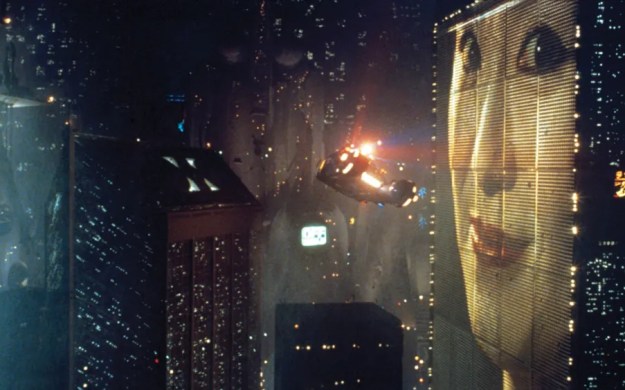
Ridley Scott’s 1982 Blade Runner is perhaps the best movie to represent a future that was once held, at least peripherally, possible but has failed to materialize itself. It is also notable that the 80s were filled with “futuristic” movies, often dystopian but still in the search for something “after” the present, the past by now. John Carpenter’s The Thing (1982), Robert Zemeckis’ Back To The Future (1985), Paul Verhoeven’s RoboCop (1987), James Cameron’s Terminator (1985), Steven Lisberger’s Tron (1982), Terry Gilliam’s Brazil (1985), and a plethora of other films foresaw a hyperdefined, science-fiction driven future that, probably due to the incoming turn of the century, presumably felt not like something one would actually see materialized but certainly something one now could effectively imagine. It is quite telling that the 80s pumped out this many sci-fi oriented movies, so much so that I was partly shocked at the amount of great films produced in that timeframe. Not only did these movies feel futuristic because the directors and the general plot would basically spell it out for the audience but also because of a certain visual geography that was without precedent, except for a couple of strays here and there. Generally, these are very genuinely new ideas that hadn’t been seen before. In terms of music, the 80s saw the rise of synth-pop; the synth as something inherently futuristic, not being limited to one particular signal output but being malleable to the needs of the musicians. Trent Reznor would go on to use synthesizers in a decidedly different way, let’s say, The Cure or Depeche Mode did, even if, in this case, he might’ve been borrowing from them. Speaking of, Depeche Mode’s 1986 Black Celebration, even in retrospect, feel like one of the more futuristic albums of that time, taking what Joy Division already spawned into a less desolated sonic landscape and turning it into something more ambiguous, something that wasn’t self-indulgent in its own depression but that saw this depression as a catalyst for experimentation (I am not implying that depression is a catalyst for creativity but rather that the depression of those times, less so in a personal sense, understood Joy Division’s approach to art and synth-pop as a start of something, for those times new, and then built onto it, perhaps feeling the same kind of alienation but with a different sense of direction).
But what is futurism even? It generally implies a concern for matters of the future, or perhaps even anticipating the future. Even more specifically, this future implies an obsolete past; something this future builds on and annuls in favor of a different mode of communication. In this sense, one should see this anticipation not as something literal but as metaphorical, just like Blade Runner’s replicants, a genetically engineered, bio-enhanced person with para-social capabilities, are not meant to foresee the rise of the lizard people but as apt descriptors of the way in which we now, in the twenty-first century, for example, interact with social media, presenting ourselves on it as only a facet, a fragment of what we actually are, which, in most case, is a better, happier, more productive (if you get this reference text me) version of ourselves. Many of these metaphors actually blossomed into our current society, which would be to say that, in many ways, this movie and culture of the 80s was, partly, right in its telepathy with a world forty years into the future. The only problem is that Blade Runner was set in 2019, which, in 2025, is 6 years ago; the future of Blade Runner passed, and we still cannot reach work in time because of public transport and it’s problems; we still cannot find love because it lost in between the seventeen dating apps we currently have installed on our phones; most of all, there are neither Replicants nor Blade Runners. We are so bored with our current modes of communication – think of the iPhone basically having looked the same for about ten years – that not only can we not imagine new ones existing, but we are now even going back to obsolete modes of communication in order to not be bored, using the past. Think of the art world’s tendency to still use old cube-televisions for displays, “vintage” clothing, which wasn’t a thing in the 80s, or, on the inverse, the auto-cannibalization of smartphones tends to software updates that, if neglected, will impede the usability of the device. The past is countercultural in a present that cannot imagine the future. This future, even by today’s standard, is a future that was too ahead of itself to truly be realistic (in the 80s), not because of ingenuity or naivete, but because the systems we employ today would never let something like Blade Runner even happen in the first place (not that that should be the end goal, naturally). Depeche Mode’s stuttering synths, synthetic bells of all kinds, and Dave Gahan’s heavy voice don’t profess a future anymore; they literally foresee a Memento Mori, as the title of their last, rather contrived album states. Remember you must die; remember that the future died long before it could ever be, but to remember would imply there to be a past experience that would lead us to make sense of the exclusion of the future, which I don’t know can be found. Sure, the rise of digital technology, for those that witnessed it first hand, might be a good indicator for a world predicted yet denied, but even then, how are we supposed to remember a reality that will die that we have only seen traces of in fantasy? How are we even supposed to tell which future is meant when, when you Google “Blade Runner”, both the original one and the 2017 (excellent) remake by Dennis Villeneuve come up, as if to signal that not even the know-it-all-cyber-entity that is Google knows the difference between the two futures environed. 2049 is 24 years ahead; I will, good health assured, most likely make it there, and the futurist I am at heart already can tell you: it will look nothing like it.
Instead of the multi-ethnographic cyber-horizon of Blade Runner, what we got is the auto-cannibalization of the present by a future that seems to be doomed from beyond our past. Since the early 2000s – taking the date as an arbitrary token for a “new era”, whatever that even means – there have been no more hopeful futures but only scenarios in which the human race is eradicated, turned pop-cultural events of spectacle: take Roland Emmerich’s “2012” (2009), a movie based on Mayan calendar predictions that foresees natural catastrophes an cosmic events as the end of the human race as we know it. And yet, even that prediction now lies in our distant past, forever a reminder of our incapability of seeing past our own apparently destructive condition. In fact, our collective present presents us with a Wikipedia list of “dates predicted for apocalyptic events” that rage far into the future; a future many of us will, biologically speaking, not even see, and yet the list looms over our collective unconscious as a reminder of a possible end. We do not deserve the present shaped by our indelible past, and the future seems to be escaping us, turning from a promise to a contradiction and then right back into an ouroboros made of concrete, incapable of recognizing the tail one bites because it is frozen into place, forever “now” and never “then”. The only future we deserve is a future in which we are looking at our phones, wondering when all of this will eventually end, hoping for catastrophe in order to cement the present into being more than where a past future didn’t take us. Depeche Mode’s cries of a “memento mori” are as trivial as the cry of a newborn, quickly stilled by the milk of the present being the only one we can safely drink without spilling or poisoning us with the fear of actually having forgotten that we must die, but not because of a fundamental inability to think beyond the constrains of our bodies – which perpetually reassure the weight of the present, even before our psyche can have a say in any of it – but rather because of our inaptitude to fully become the Replicants we have long transcended. Instead of merging insofar with machinery as to create a post-Freudian scenario in which our perceptual consciousness is not anymore a skin lying on the borderline between outside and inside, we distrust our own ideas of a cyborgian uprising so much so as to be condemned to forever be a spectator in our own nullification of the future; an offspring of convenience and the muted movie in the background of our ideas of what the future could ever be. There is no simulacra and no singularity; only iPhone shoulder-straps that ebb between being the newest accessory to complete our matrix of blandness and a reminder of how technology still eludes us, barely prescient enough to become a status-symbol but not original enough for anybody to notice.
Still, the future is introduced to the present as an “abstract magnitude” (Nick Land); as an agent of debilitating urgency, the futurism of the 80s is no more but a distant memory of itself, having been transformed into an unrealizable, singularly apocalyptic advent instead of a hopeful promise. Naturally, it is worthy to note that many of the cited movies were already deeply misanthropic to begin with and presented a future in which the world might’ve not necessarily ended, but morphed into a version of itself we, from the past and now into the present, would not want to live in; a totalitarian, dysfunctional, scatter-fried snapshot of identity loss. So, who is to blame for our acceptance of the present as something that vehemently rejects the future, unaware of its own tail asphyxiating it in favor of always remaining ten steps behind itself? Yet, perhaps this isn’t a “who done it” situation and more a “how done it”; a question not of pointing fingers but a scavenger hunt of finding the missing link? Perhaps this can be best exemplified by the translation of the Lacanian notions of the Borromeo-Knot – the intersection between the imaginary, the real, and the symbolic by an interdependent, axiomatic structure relating back to the official symbol of the eponymous Italian Renaissance family – into an unquestionable paradigm concerning not the imaginary, the real, and the symbolic but the past, the present, and the future. In the Borromeo-Knot, when looked at two-dimensionally, no two points are linked physically; they are only interwoven by the presence of the (absent) third. By this logic and since knowing that the past haunts – i.e., intersects with – the present, the assumption that there must be an (absent) future holding both in place is precisely symptomatic of the loss inherent in the third. Furthermore, to refuse the notion of either the present or the past being the missing link and the future already having been here this whole time, one must consider it imperative to point out that we cannot be more sure of anything than the present, for we know our body to always be the reminder of our own conditioning, with its physical deterioration being a clear indicator for a future version of our current present – then still of its own present regardless of our projections towards this quasi-fictional version of our coming selves – that our then-body must have a past; a past we supersede but never escape from. The same thing can be said regarding the present’s cultural framework, only defined by the compression of a referential reality into products and environments that seem to have a clearer disposition towards a very specific mode of temporality than the lived present wishes to adhere to. It quickly becomes clear that nor the present – never reaching the future’s potential and always reminded of its own past – and neither the past itself – always informing a future foreign to it but translated into definitive matter (present) – can’t ever be the Borromeo-Knots’ missing link and, thus, the magnitude of an absent future is actually what makes the perpetual Past-Present-Bootstrap-Paradox, i.e the interlinking of the two, coalesce an oxymoronic state of being-non; a state where, beyond the Borromeo-Knot and into the “real” world, the current state of the present can always be sent back into perceptual-time in order to eventually become its own point of origin without the need for a third, absent future that determines it. Everything we know, for sure, is of the past and ingrained into our experiential present, so why would we ever even consider the need for a still-absent third to interlink the two? In fact when looked at three-dimensionally, the Borromeo-Knot reveals that there is no actual interlinkage, even with the aforementioned (absent) third, so it could be unavoidable to say that when the Borromeo-Knot is not looked at all, when the Knot becomes paranoid of its own condition, disregarded as culture, informed by capitalistic desires, has done with its own historicity since not evaporating in 2012, all we get is not past, nor present or future being unsure of themselves, but the essence of time alone: if we take the Borromeo-Knot’s self-intersecting logic, the only possible conclusion is that the whole is, fundamentally, the hole between other two points, therefore rhetorically implying that if the hole in question cannot be seen, cannot be reached, than the two otherwise incongruous points cannot ever intersect, thus destined to be haunted by each sequential structure inherent in their existence.
In a more transcendental, Kantian sense, past and present, in the possibility of the Knot being there but not being recognized or seen, cannot project any productive relations – they cannot envision – that which lies outside of their zones of effectiveness (the future). It is highly possible that, under these parameters, the question at hand – i.e., “When Futurism Collapsed (?)” – is illogical, for the past informing and the present compelling it does not foresee any relationality to anything outside of each other’s scopes of meaning-making. Instead, the right question would be “Where Futurism Collapsed (?)”, with the answer hiding in the disregarded hole of the Borromeo-Knot, in the elusive gap that would make the hole whole. Futurism hasn’t collapsed; it never stood a chance against the past-present-ouroboros, intersecting not outside of itself but at its very point of origin, creating an insulated, circular system that feeds off of itself, shielded, just like Freud’s notions of the organism, from external assault, reduced to a loss in the pleasure-output because of its repetitive quality. Replicants, RoboCops, and Terminators can’t hurt us because we cannot even begin to phantom their existence into place; a place beyond ourselves.
Bibliography
Greenshields, Will (2018). Writing the Structures of the Subject: Lacan and Topology, London: Palgrave Macmillan.
Land, Nick (2011). Fanged Noumena: Collected Writings 1987–2007, London: Urbanomic.
Cole, Rachel (n.d.). 10 Failed Doomsday Predictions, Britannica Online.
@mike_sean (2011). Sci-Fi Cinema in the 1980s, IMDb.
Fisher, Mark (2022). Ghosts Of My Life: Writings on Depression, Hauntology and Lost Futures, London: Zero.
Fandom (n.d.). Off-World. The Blade Runner Wiki, Bladerunner.fandom.com.
Daniel Gianfranceschi is a multidisciplinary artist and writer working within the realms of painting, text, and sound. Gianfranceschi previously studied fashion management under Prof. Sabine Resch & Prof. Markus Mattes and is now continuing his studies in painting and sound at the Academy of Fine Arts under Prof. Florian Pumhösl & Prof. Florian Hecker. His work has been shown at Museum Brandhorst, Kunstbau (am Lenbachhaus), Kunstpavillon München, Goethe-Institut Athens, Künstlerhaus Stuttgart, Württembergischer Kunstverein Stuttgart, among others. Writing contributions have been featured in Erratum Press, Cutt Press, La Piccioletta Barca, Subtle Body Press, Dream Boy Book Club, God’s Cruel Joke Magazine, Sleeve Magazine, Positionen Magazin, Frameless Magazin, and more. His musical output has been performed at various institutions with additional releases on labels such as Industrial Coast, Les Horribles Travailleurs, Nostalgie De La Boue, and more. His debut poetry collection, “Soft Leather Contradiction”, is out now on Creative Writing Department.

