
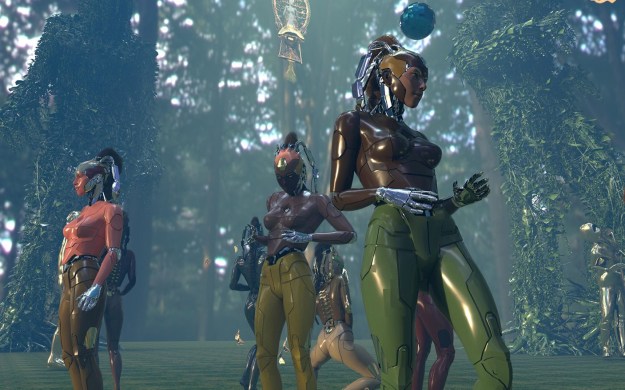
The Multiplication of Organs (MoO) [1] is not the Deleuzian Body without Organs (BwO), it is not the Žižekian Organ without Body, it is not the extension of McLuhan’s man, it is not Donna Haraway’s cyborg, it is not Braidotti’s posthuman, it is not the Xenofeminist utopia of technological reappropriation, it is not Stiegler’s organology, it is not Dominic Pettman’s erotic ecology or Preciado’s Dysphoria Mundi. The MoO is not just the manifesto, for better or for worse, of an ongoing phenomenon. MoO is a process of surgical operations on desire. The MoO is the redefinition of a post-technological organicity. The MoO is placed in a duality in positive (+) and negative (–) power. The MoO+ multiplies and externalizes hungry organs digitally connected to the body. The MoO+ is ambiguous and is based on direct stimuli and ideologies. The brain is the only organ attached to the body; it transmits the sensations of all the organs multiplied in digital space. MoO+ is enrolled in the sensitive/educational program on the influence of digital technologies. MoO+ is statistical desire. MoO is multi-reception: I multiply and send my organs in search of information and sensations. I access and exceed, I get confused and become vulnerable. Notifying and scrolling mechanisms generate dopamine rewards and statistical desires; images, language, prostheses, data, and sensations are the currency of exchange. The MoO comes into contact with information circuits, communication, digital images, texts, devices, and ideologies. Performing Organ Multiplication without critical thinking is a dangerous activity. The MoO is not divided into typologies; rather, it must be identified as a common movement that profoundly influences politics, gender, class, and ecosystem. MoO is the human and obsessive search for meaning and response to one’s desires influenced and reprogrammed by the new technologies of work, information, entertainment, and self-representation. Bodies and identities always seek something culturally induced; the desire of an era is the fruit of the social, political, and economic organization of that time. Wishes age; they can be centuries-old trees or roses with a deciduous life.
The MoO is a neutral phenomenon expressed chemically as + and –. The + represents the risk of being ensnared in oppressive and controlling apparatuses, while the – is what I propose. The + leads to death, the – to potential life. My fundamental critical assumption lies between the + and –: the rejection of the view of technology theorized as extension; if the latter implies enhancement, multiplication instead signifies a fragmentation of perceptions and an impoverishment of the original physical organ. Criticism of the MoO is fundamentally a critique of the positivism of transhumanism and the capitalist discourse of development and progress disguised by a false ethical foundation. Above all, it critiques how this discourse intercepts bodies by integrating them into a MoO+: using technology as a space for capturing and reprogramming desire. The MoO+ must be dissolved in the shadow of the negative.
Dissolve the MoO
Žižek, like Bataille, maintains that true enjoyment, in its erotic form, arises from the hindered and failing condition of the human being. This would be the authentic experience of eroticism. It is precisely by maintaining this condition that eroticism can take place by building itself through psychological expedients given by the imagination, or even better by the phantasmatic supports that we must build to support our desire. Here we return to Edwarda, to the de-idealization which is opposed by a divinization that is forced, a natural counterbalance to that sudden and horrifying desublimation that leads the subject to see the partner’s organ as a “repugnant octopus”. The concept is not that the encounter with the (desublimating) Real of the body as such really disgusts us, but that this encounter is reflected in the question “why do you like me? Why do you like this?” This attraction, already present, has simply escaped our responses and these responses are filled by our imagination. What happens if imagination is lacking precisely at the event in which the subjects mix? Could it be that through and because of predatory technological development, desire is being captured through the sterilization and reprogramming of our phantasmatic capacity? What exactly are we losing? Is it really a harm? Is there a way to reverse this trend? We must go back, start again from what was the historicization of desire, in which overall we see how this is never “completely ours”, but always located and influenced by the historical period, and therefore by culture, politics, the imagination, from the symbolic order and current ideologies, in a word, from the “big Other”. No desire is truly random: they are ours, but always overdetermined by the big Other. In Sex and the Absolute, Žižek therefore asks himself whether digitalization really brings something new to all this:
Is the digital big Other just a new case of the symbolic big Other, a case which enables us to become aware of how we are decentered and regulated (spoken and not speaking, as Lacan put it)? Lacan’s answer is a resolute no: what is threatened in digitalization of our daily lives is not our free subjectivity but the big Other itself, the agency of the symbolic order, in its “normal” functioning. Another of Lacan’s axioms, above “desire is the desire of the Other,” is “there is no big Other,” and we should take this statement in its strongest sense, as opposed to a mere “doesn’t exist.”
(Žižek, 2020, pp. 166-167)
The statement “there is no big Other” precisely indicates the absence of a controlling entity; instead, there exists a chaotic, inconsistent, and inevitable superstructure that intrudes and “overdetermines” subjective desires. This overdetermination occurs precisely because desires collide with a chaotic structure, allowing the subject to desire precisely due to the obstacle it must inevitably confront. Between us and the big Other — this virtual entity that separates us from the socio-symbolic structure of the external world — there always exists a gap formed by the clash between our desires and the influencing and hindering elements of the big Other. According to Žižek, the novelty that digitalization would introduce is therefore the materialized existence of a grand Other, and this manifestation in the contingency of daily life “digitalization doesn’t decenter the subject, it rather abolishes its decentering” (ivi, p. 169). Returning to my central assumption — today’s technology as a space for capturing desire — this capture precisely entails absorption, weakening, and neutralization. And what constitutes the essence of desire, if not the very imagination that activates it? To activate desire, the fantasy itself must remain inaccessible, or at least in a form that one aspires to achieve; only then does the impetus occur.
But desire is not ahistorical, acultural, and apolitical. Today, through technology, there is a reprogramming of desire where this overdetermination is experienced as “ours”, and the desires, both inherent and induced from external sources, appear to originate from within. The digital environment and technology at large, with its visible/invisible and direct/indirect management of work, social relationships, and life itself, become the perfect mechanisms to control this reprogramming and conveyance through the exploitation of the mimetic capacity of desire: not only are our desires overdetermined, but they also strive to imitate other desires (see Bown, 2022). When all these desires stem from the same unhealthy root of imposed order, discipline, suffocating work, and career aspirations, and in a simultaneous movement implicitly impose the reprogramming of leisure time, then the latter ends up supporting the political-economic system that holds the world in its grip and from which we struggle to free ourselves. The technological reprogramming aimed at capturing unproductive desire space leads us to construct a desire that is no longer unpredictable or occasionally improvised, and in a more radical sense, no longer responsive to the transient and inconsistent needs of human beings. It is a statistical construction, a political definition of thought that convinces us not only that the desires imposed upon us are our own and originate from within, but also persuades us that we can control and convey them as if they were mechanical instruments. Statistical desire is a form of desire that thrives on becoming a number, gamification, predictability, and the anticipation of actions we intend to take, rejecting error and adhering to calculation. This statistical desire is tested through the proposal of technological development and progress as an extension of the human, therefore representing an infinite enhancement in a world of finite resources and within a constrained body/mind, not attributable to the total mathematization of being.
The transhumanist push and the current evolving political-economic model therefore threaten the ability to transform the malaise, which acts as an obstacle, into a revolution — a state of tension, awareness of the ephemeral. It is no coincidence that much of the expansionist rhetoric about technology focuses on health, medicine, security, and, at its extreme, immortality. Those who are part of an advantaged class or are naive often embrace the ideological capture of transhumanist capitalism because the promise of a better human condition offered by technologies used in this manner, in a world of finite resources, is pure hypocrisy and indifference to real suffering. Consider hyper-technological cities like Dubai or projects like The Line, the “city of the future” planned in Saudi Arabia, as well as all smart city projects. Here, we are witnessing a future in which class disparity will be exacerbated in proportion to the development of the most advanced technologies, concentrated in limited and inherently elitist locales, while conditions outside these enclaves will deteriorate. The global trajectory is trending towards the right, evident today, as despite technological progress offering various advantages, the prevailing political-economic model globally exploits resources, perpetuates new forms of colonialism and disparity, and erodes progressive individual and collective freedom. In addition to the potential instrumental advantages, there is the inevitable counterbalance of ever-increasing control over bodies, identities, roles, and movements. The same model of social management employed during the pandemic can now be reactivated and strengthened through increasingly invasive technologies. And it is understood that this pandemic may not be the last. Similarly naive are the post-humanist rhetorics that entertain the idea of a proletarian appropriation of technological means, while we are aware that these means currently revolve — and will continue to revolve — in the hands of a few. For this reason, perhaps the initial step to reverse this trend is personal deceleration concerning technology. To achieve this, we cannot simply reason by prohibiting instrumental use; rather, we must understand and distance ourselves from technology as an ideological space for capturing desire and controlling the weather.
MoO (+) / MoO (–)
In this duality between digital perfection (fantasy/desire/impossible action) and organic imperfection (fantasy/desire/possible action), the current condition of Organ Multiplication (MoO) must be split into two parts: one positive (+) and one negative (–). Positive MoO (henceforth MoO+) is the most common condition, universally shared, whereby technology is conceptualized and configured as an extension and enhancement. From a theoretical perspective, this vision aligns closely with positivist transhumanism, championed by the major financiers of technological development in the contemporary world. It also aligns with the entire political-economic model that funds research and development in all bio-techno-scientific fields, as well as digital information, marketing, and entertainment models.
Obviously, the narrative of technology as an extension and enhancement tends to focus on instrumental use (through destructive and extractivist logics): the practical improvement of daily life, the elimination of uncomfortable jobs for human beings, the development of new treatments for currently incurable diseases, and so on. Parallel to these developments, the narrative of technology as extension and empowerment contributes to the refinement of social and political technologies, erasing and reprogramming the imagination (replacing it with a big digital Other), and limiting the ability to envision alternatives and relationships, thereby constraining desire and impossible action.
It is not merely the instrumental use of technology that risks undermining human desire, but rather the digitized evolution of its unproductive use and the ideological impasse of adhering to statistical desire.
At this point, McLuhan’s famous concept of technology as an extension of the body begins to be a toxic narrative despite being almost always taken for granted in common sense. From a more radical perspective, we must replace the MoO+ vision of technology as an extension and enhancement in individual and intersubjective space with that of an MoO– (negative) which instead looks at technology as multiplication and therefore as an impoverishment of the original organ during its multiplication. As we have seen, from sociality to eroticism, ultimately metaphors of unproductive time par excellence, each extended meaning — perfected through digital mediation — corresponds to a loss of the very constitutive obstacle of desire and/or the generation of a statistical desire. The condition of the MoO+ is then to focus on the programming and materialization of what should never materialize or be programmed. In contrast to this digital phantasmal murder, we see more and more episodes in the world that bring us back to the organic sense of things, to the danger of death, to contradiction, to the need for imagination. The point is not simply that a hypothetical and utopian perfection can no longer make us human beings, while imperfection would keep us as such, but the acceptance of the fact that it is precisely the illusory condition of (apparent) perfection that creates the true impossibility of to desire, while the imperfection and obstacle constitutive of being remain an impossibility that is always in tension and can be filled, and in this imaginative filling we feel alive.
In Ballard’s short story Running Wild, a wealthy residential neighborhood hosts families living seemingly perfect lives. Within these families, thirteen children aged from eight to sixteen follow meticulously planned routines, filled with commitments such as school, sports, and music. Every hour of their day is occupied, and to ensure their safety, each room is monitored by adults via video surveillance. However, this environment, devoid of impurities and saturated with structured activities aimed at eliminating any potential unproductive behavior, ultimately leads to a collective psychosis among the children. In a drastic turn of events, they conspire to murder all the adults. This extreme act serves as their last chance to reclaim their humanity, transitioning from the realm of perfection to the imperfect, from MoO(+) to MoO(–). Here, the act of homicide metaphorically symbolizes a distinctly human impulse to descend from perfection, from unattainable desires, into the realm of imperfection where fantasies and desires are unleashed. The divergence between the story and reality lies in the fact that the children were controlled and coerced by their parents, whereas we willingly subject ourselves to similar pressures. The potential for emptiness, fantasy, and desire in children was programmed and subdued through adult manipulation of time. In contrast, we willingly surrender our emptiness, fantasy, and desire by investing time in unproductive technological pursuits, sometimes seeking to exploit this temporality through forms of statistical desire. There is no easy solution to this toxicity, except perhaps by endeavoring to break free from technology’s grasp as a space for capturing desire.
The loss of excess energy
While the world we have constructed spins in a direction contrary to the natural order — transcending us — I feel compelled to turn my back on it and run in the opposite direction. However, time in our world, in the human world, does not transcend us; thus, we easily lose our bearings, perpetually caught in that loathsome one-way motion. The relentless and cyclical movement we are coerced to partake in is that of production: everything aligns with this purpose, even that which should not, and gets drawn into it, including unproductivity.
Let us return to the world, not the one we have fashioned as a society, but the one that transcends us and yet encompasses us as human beings. In his discourse on the meaning and laws of the general economy, Bataille embarks on a series of reflections on nature, particularly on the circulation of energy on the terrestrial globe. I shall attempt to summarize his discourse briefly: the living organism, whether conceived as planet Earth or an individual organism, theoretically receives more energy than it requires for its sustenance; the surplus represents an excess. When the organism reaches a point where it can no longer grow and absorb this surplus energy entirely, it must find a way to expend it without benefit. For an organism, energy resources surpassing those necessary are essential for growth and reproduction; in essence, life demands this surplus energy to be spent unproductively, or else it becomes mere survival. However, true surplus arises only when growth is constrained, a phenomenon inherent in living matter; yet, by attempting to reprogram these surpluses, we have perpetually upset our equilibrium:
Since the dawn of civilization, humanity has possessed the capacity to harness a portion of available energy not for biological growth, but for the technical augmentation of its own energy reserves. […] The introduction of the workaday world supplanted intimacy and the profound unleashing of desire with the rational chain, where the truth of the present moment is overshadowed by the subsequent results of operations.
(Bataille, 2015, p. 86 and 105, my translation)
Once capitalism ascended, the pursuit of pleasurable expenditure gave way to accumulation, entailing the reinvestment of surplus in the acquisition of additional means of production. Across the centuries, every unproductive act of the individual has increasingly been repurposed for production and productivity. It is the ordeal of living to work, where the energy expended on existence becomes an investment of useful time aimed at enhancing societal productivity. As humans become commodified, all surplus energy is directed toward breaking free from this state and reconnecting with presence, self, and the world.
Two avenues afford meaning to this quest for liberation: the first entails incorporating a series of daily and occasional actions within a ritualistic and symbolic framework, while the second involves uncompensated action solely to gratify our desires. These avenues of escape have historically unfolded — and continue to do so — on the physical plane, through traversing streets, engaging in experiences, acquiring knowledge, making mistakes, and embarking on paths that, in hindsight, may be deemed right or wrong, yet serve as condensed reservoirs of knowledge and self-awareness. Today, however, something diminishes these experiential forms, and in our lethargy, we gravitate toward more comfortable escape routes than the asphalt and trails, thereby diminishing the very complexity of the human experience. As a distorted mimicry of social reality, the digital realm programs fantasies, reproduces attractions of pleasures and desires, and we perceive them as our own. The point is that these forms of pleasure are hollow; they do not contemplate error, the unexpected, and experience. Here desire becomes impossible, fantasy is denied, and obstacles are overcome. Consequently, through the denial of these aspects, the capture of unproductive and productive time constructs a form of statistical desire whose necessary imperative is that of rational prediction, of a calculating brain that ultimately triumphs and pierces the laws of the heart. It is not the robot resembling the human being that disturbs, but the simplicity with which the latter becomes an automaton that reasons through statistics, probabilities, and mechanized pleasures. This is our tragic becoming cyborg.
Caged sun
The technological apparatus of capturing and reconstructing desire through unproductive and productive time prematurely ages us, and the situation risks worsening over time. We face such social pressure that, ultimately, every escape route only foresees self-determination possible through contradiction, compromises, continuous negotiation, sacrifice, and the pursuit of balance.
Desire is not only drained from us; rather, it is under siege, under cognitive stress that convinces us that what we desire adheres to what we fundamentally are. But are we really? And when? The reprogramming of desire through technological capture devices aims to reconfigure the very concept of happiness understood as “the lightness of proceeding through life without knowing its abyss” (Berardi, 2023, pp. 258-259, my translation). Today’s happiness is culturally constructed as the ability to proceed with the machinic heaviness of continuous and anticipated programming of one’s life. We are spoken by a sort of statistical desire. In Eroticism, Bataille speaks of human beings in terms of continuity and discontinuity:
Reproduction implies the existence of discontinuous beings. Beings which reproduce themselves are distinct from one another, and those reproduced are likewise distinct from each other, just as they are distinct from their parents. Each being is distinct from all others. Their birth, their death, the events of their life may have an interest for others, but they alone are directly concerned with them. They are born alone. They die alone. Between one being and another, there is a gulf, a discontinuity. This gulf exists, for instance, between you, listening to me, and me, speaking to you. We are attempting to communicate, but no communication between us can abolish our fundamental difference. If you die, it is not my death. You and I are discontinuous beings.
(Bataille, 1962, p. 12)
What happens if, instead, we begin to regard ourselves as fundamentally continuous beings, and view discontinuity as a cultural artifact of civilization? The political-economic system, powered by technologies, is geared towards constructing a discontinuous subject. Therefore, if we start to conceive of ourselves as inherently continuous beings, it implies that discontinuity is a partial imposition, a voluntary choice, ultimately an induced desire. We are continuous beings ensnared by statistical desire, rendered culturally discontinuous. It is precisely from the impossibility of an alternative to the system in which we exist that statistical desire is fashioned today as the sole plausible desire capable of gratifying a subject compelled to inhabit this world. Contemplating continuity entails suffering. The notion of long-term social or romantic relationships is daunting. Forgiveness seems foreign, offering oneself or others a second chance appears futile, and failure is deemed forbidden and unacceptable. The functional, the programmable, and the individual inevitably take precedence, consuming what could have potentially flourished. However, the application of statistical desire always risks betraying itself, sooner or later. All that’s left is to redefine a post-technological organicity amidst the ruins of human relationships: dismantling the technological ideology of progress and mass hypnosis can emerge from the selfless act of resisting statistical desire, commencing with the critical dissection of how aesthetics, narratives, platforms, and technological interfaces convey and constitute subjects within an ideological ecosystem increasingly difficult to evade.
We must rip up abstract laws and maps, rediscover the coordinates of our own desire — the one that hits the asphalt and falls, the one that experiences its own sovereignty — and discard every corrective discipline like a piece of waste paper. Without embracing the eroticism of a personal obsession in all its allure and repulsion, without touching upon the principles of self-destruction, without edging closer to the death of the self, any chance of composing oneself anew is negated. Amidst the futile splendor of being nobody, if desire is a caged sun, there exists no alternative but to set it free.
References
Ballard, J. G. (1988). Running Wild. London: Hutchinson.
Bataille, G. (1962). Erotism, New York: Walker and Company.
Bataille, G. (2015). La Parte Maledetta Preceduto da La Nozione di Dépense (Trans. F. Serna). Torino: Bollati Boringhieri.
Berardi, F. “Bifo” (2023). Disertate. Palermo: Timeo.
Bown, A. (2022). Dream Lovers: The Gamification of Relationships. London: Pluto Press.
Braidotti R. (2013). The Posthuman. Cambridge: Polity.
Deleuze, G. and Guattari, F. (2003). Anti-Oedipus: Capitalism and Schizophrenia (Trans. R. Hurley, M. Seem, and H. R. Lane). London: Continuum.
Deleuze, G. and Guattari, F. (2013). A Thousand Plateaus: Capitalism and Schizophrenia (Trans. B. Massumi). London: Bloomsbury.
Haraway D., (1991). A Cyborg Manifesto: Science, Technology, and Socialist-Feminism in the Late Twentieth Century. In Simians, Cyborgs and Women: The Reinvention of Nature (pp. 149-181). New York: Routledge.
Hester H. (2016). Xenofeminism. Cambridge: Polity.
McLuhan, M. (1964). Understanding Media: The Extensions of Man, New York: McGraw-Hill.
Pettman, D. (2020). Peak Libido: Sex, Ecology, and the Collapse of Desire. Cambridge: Polity.
Preciado, P. (2022). Dysphoria Mundi. Paris: Éditions Grasset.
Stiegler, B. (2020). Elements for a General Organology (Trans. D. Ross). Derrida Today, 13(1), 72-94.
Žižek, S. (2004). Organs Without Bodies: Deleuze and Consequences. London: Routledge.
Žižek, S. (2019). Sex and the Failed Absolute. London: Bloomsbury.
Endnote
[1] In the original formulation in Italian: Moltiplicazione degli Organi, or MdO.
This article is an extract from the book Manifesto della Moltiplicazione degli Organi: Corpo, Identità, Tecnologia, Desiderio (Compagnia Editoriale Aliberti, 2024) by Christian Nirvana Damato.
Christian Nirvana Damato is a writer, curator, and independent researcher focusing on philosophy, technology, and visual culture. Concurrently, he pursues research on writing and publishing as artistic and experimental practices. He teaches Integrated New Media Techniques at IED in Turin. He publishes, writes, signs, and collaborates, in various capacities, with Mimesis, Fata Morgana, Artribune, Not (NERO), Kabul, TBD, Coeval, RUFA, and PSe (Flashart). He is the founder and curator of Inactual, an editorial, artistic, and curatorial collective. He has published Manifesto della Moltiplicazione degli Organi: Corpo, Identità, Tecnologia e Desiderio (2024). Currently, he is curating Medial Disorders: Interpretative and Non-Statistical Compendium of Technological Disorders (2024), a collective volume with contributions from Geert Lovink, Alfie Bown, Isabel Millar, Arianna Caserta, Eyal Weizman (Forensic Architecture), et al., edited by Inactual.
Credit for cover: © Jacolby Satterwhite
 Blue Labyrinths
Pingback: Digitalna seksualnost – Slavoj Žižek | PULSE Magazin
Pingback: Slavoj Žižek: Digitalna seksualnost | radio gornji grad