
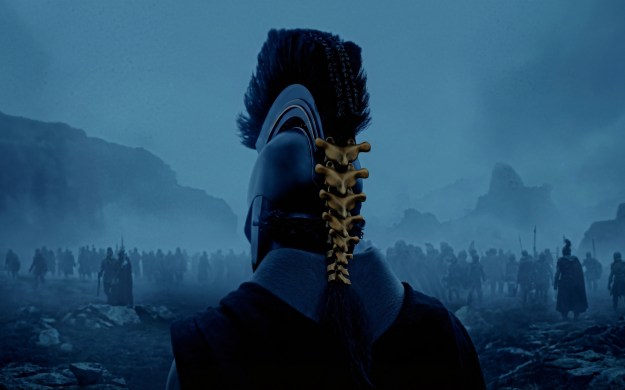
1. A camera, a sigh, a disappearing poetry
“Why can one not straightaway keep hold of whatever he sees and then narrate it by simply describing it?”: this is the thought that, perhaps with a sigh, crossed Heidegger’s mind as he gazed upon Ithaca during his cruise in Greece, on which the essay Sojourns is based. This could well be described as cinema’s dream: to preserve the images as they are – the images of Ithaca, Odysseus’ homeland – and to restore them to their original radiance… Nothing could be further from Nolan’s The Odyssey (2026), which is currently causing quite a stir.
The film is, first and foremost, aesthetically poor. The sparse set design – more than just minimalist – confirms the loss of colour that afflicts so many contemporary films, while the editing follows the stylistic conventions of action movies. In short, when people on social media joke that the beggar who arrives at Penelope’s house is, after all, Jason Bourne, they are not so far from the truth.
The Odyssey appears to be an attempt to establish a myth within Nolan’s own cinematic universe, as it shares far more characteristics with the huge narratives of wars, personal conflicts and intrigues to which the British-American director has accustomed us, rather than with Homer’s work itself. So much so that it frequently has to distort entire sections of the poem or to add elements in order to support the plot. This is the case, for example, with the dual MacGuffins represented by Sinon’s stick and Penelope’s doll figure, which stand in for the two distinct narrative threads – that of a friend’s betrayal in war and that of love for the wife – which are in fact secondary at best in the Odyssey. By contrast, the theme of the journey should prevail, as does the role of the divine forces embodied in nature, which in the film instead serve as a backdrop to the far more important battle scenes.
Can we, then, have a cinematic adaptation of the Odyssey today without it being a fantasy or action movie? It would seem that this is a very difficult undertaking. The literal subversion of Homer’s Odyssey is also achieved through the incorporation of contemporary genres into the narrative: Nolan populates the epic with aliens (the Laestrygonians), zombies (the dead in Hades rising from the earth), and a clash of civilizations centred on foreign invaders (not specifically identified, they could be the Sea Peoples or the Trojans). Then there is the horror element (both jump scares, as in the scenes with Polyphemus and Scylla), and body horror (with Circe, who molds the sailors’ bodies to turn them into pigs). Not to mention the dash of feminism, which serves as an underlying theme to the critiques of the narrow-mindedness of men by Circe and Penelope – though this is not enough to change the fact that Nolan’s female characters remain two-dimensional and entirely secondary to the male ones, as usual.
As we begin reading this review, and thus set out on this little odyssey of words, we can already tell that there is too much that is American, and too little that is poetical, in this movie.
2. An Odysseus who stands on its head
Borrowing a famous remark that Marx made about Hegel’s dialectics, we could say that Nolan’s Odysseus is an Odysseus that instead of standing on its feet, stands on its head: he is, in many ways, a reversal of Homer’s hero.
Matt Damon’s performance at the same time takes away and adds something else to the hero of the epic poem. Something is taken away from Odysseus: it is hard to describe the rather stoic Damon as πολύτροπος, “facing many directions”, versatile, cunning – the very first adjective used in the poem’s beginning to describe its hero. Also, many ruses and tricks which in the Odyssey give its titular character a chance to display his guile are simply not portrayed in the movie. At the same time, Nolan’s and Damon’s Odysseus adds something else to the nature of Homer’s hero. Several ideas, elements and motivations which are completely absent from (or blatantly contrary to) the poem’s context are instead presented to the viewer. The most shining example is Odysseus’ regret for what we could call his technical role in allowing the genocide of the Trojans. In the poem, Odysseus calls himself – and revels in being called – “sacker of cities”.
Why does Nolan feel the need to change the protagonist so much? The answer is clear: in order to minimise the elements which could make it difficult for the viewer to identify with Odysseus and his struggles. The most radical example of this tendency is shown in one of the first scenes in which the main character is seen. During a flashback, we see a boar hunt, the same hunt that will result in Odysseus’ leg scar: the same scar thanks to which the servant Eurycleia will be able to recognise the disguised hero’s identity. During this hunt, and other scenes in the movie, too, Odysseus makes his bowstring “twang” rather musically, in order to alert the quarry of his arrival, providing it with a chance of escape: a show of fair-play that would make an English gentleman blush. Here, the crafty, cunning epic hero is literally turned upon his head: it’s hard to recognise the same Odysseus that deceives Clytemnestra into giving up her daughter Iphigenia for sacrifice; that tricks the reluctant Achilles, disguised as a woman to avoid Agamemnon’s draft for war, into revealing his identity; or that wins the dead Achilles’ suit of armour because of his rhetorical skills as an orator.
Predictably, it’s not just Odysseus’ character to be changed according to the aforementioned logic – that of making the Odyssey palatable to a contemporary audience. As an example, we can mention Antinous’ and Sinon’s plotline (half borrowed from Virgil’s Aeneid, half invented), apparently inserted in order to make Antinous look even more despicable. Or, again: Polyphemus does not speak (if not to pray to his father Poseidon). All the dialectical tension between the Cyclops and Odysseus is lost in the movie; the latter does not convince the monster to drink the wine, or to eat him last. As a result, what is arguably Odysseus’ most famous deceit, that of calling himself “Nobody” (Οὔτις) cannot even take place. The revelation of his true name to Polyphemus – a key moment in the poem and the reason for Poseidon’s wrath – is completely absent from the movie.
Ultimately, what is altered in Nolan’s film is the relationship between the characters and their own world. In the poem, the phrase “keen bronze” is a recurring one, a mnemotechnical device that helps both the poet-singer and the audience familiarise with the narrative and the materiality of its context. In the movie, instead, the characters are aware of living in the Bronze Age. And it does not stop here: the characters are aware that their age is nearing its end, and that the invasions of the Peoples of the Sea (a nod to an old historiographic theory about the Bronze Age Collapse) will be a fundamental factor in its demise. So, Telemachus’ journey is partly explained with the need to mobilise an army such as that which only a legitimate king can muster. What is depicted in the poem as a divinely inspired coming-of-age journey becomes a matter of pseudohistory, postmodern pragmatism and pop psychology.
3. Psychology: Today’s mythology
Nolan’s “psychologisation” of the characters’ motivations and experiences has been rightly underlined by many viewers and reviewers as a key to this specific rendition of the Odyssey. Many have drawn parallels between this specific representation of Odysseus and Hollywood’s current obsession for concepts like trauma and PTSD. Even more specifically, Nolan’s Odysseus embodies the typical cinematic portrayal of the traumatised, repentant Western veteran: “Yes, our hero maybe committed war crimes or participated in genocide, but he, too, suffered and is suffering from it”. This trope is rather problematically reinforced by the namelessness and facelessness of the Trojans in the movie – whereas in the epics, there are countless named characters (and even gods!) on both sides of the war.
In the poem, Odysseus is driven to tears by the songs of the Trojan War: for example, during Demodocus’ performance at the court of the king of the Phaeacians, Alcinous. The hero cries as he remembers his and his comrades’ woes and tribulations, not out of regret for his actions in the war (this specific change in the representation of Odysseus might embody Nolan’s attempt at a political message for the movie – which we will deal with later). In the movie, instead, Odysseus’ grief is directed internally, not externally towards his companions or comrades in arms. His sorrow is that of shame, at his role in the war, which prevents him from being able to return home with a clear conscience – indeed, this shame seems to prevent him from being able to return home altogether. That is what the Sirens’ song seems to suggest to Odysseus: his awareness, his memories of the war are in conflict with his desire for νόστος, homecoming. This change is particularly evident in Calypso’s portrayal. In the book, Calypso’s love is not enough to prevent Odysseus from wanting to return home: he is described sitting on Ogygia’s beach, watching the horizon and longing for home and family (a longing that does not prevent him from making love with the nymph). In the movie, Calypso is portrayed as a psychedelic-assisted psychotherapist, who uses the mythological properties of the lotus flower to suppress Odysseus’ memories of his past and his home – for a time, at least.
Homer’s epic poems are firmly rooted in Ancient Greece’s body of myths: narratives that deal with fundamental aspects of a society or worldview, and often explain their origin in religious and/or supernatural terms. It can be argued that in 2026, “pop” psychology has largely replaced mythology and religion in embodying the main narrative that we use to talk about the origin or the motivation of a specific thought or behaviour. Every behaviour or relationship can become toxic; all of our exes are malignant narcissists; each worry we experience becomes anxiety; every sorrow or pain we go through is traumatic. The problem is that, as French psychiatrist and psychoanalyst Jacques Lacan put it, “psychology is itself an error of perspective on the human being”; a belief that humans can clearly see themselves, know themselves without error and therefore fully resolve themselves.
Nolan’s Odyssey starts with an implicit premise: the underlying structures and logic of Homer’s poem are too alien to be brought to the screens. Therefore, the narrative needs to be brought to the present, and portray modern sensibilities – even as they are masked by a hodgepodge of quasi-mythical, fantasy elements. Insecurities, not ὕβρις (hubris); vulgar materialism, not divine inspiration; and, at the end, a heartwarming happy ending of sorts.
Instead, reading Homer’s Odyssey in 2026 – possibly a significant, positive side effect of this movie’s distribution – exposes the reader to a refreshing quota of otherness. A religion which permeates daily life through rituals that border on the incomprehensible; values that sometimes defy our logic; and so on, until we reach the most elementary level, words and phrases whose meaning has been lost with the passage of time (and the death or transformation of the context in which they were born). This is what Nolan’s operation chooses to sacrifice: the possibility of playing, of flirting with otherness. The very idea that there is a part of our past – a part of us – which cannot be explained away.
Nolan’s obsessions with themes such as memory, time and identity – far from being just one director’s preferences – resonate with audiences insofar as they mirror some of our society’s most fundamental questions. How do we deal with our past? How can we perceive reality, morality, meaning in a postmodern world? Part of Nolan’s success could be attributed to his ability to create movies which try to articulate an answer to these questions. Yet, these films cannot escape their instrumental, pacifying nature: commodities that temporarily sedate our angst by trying to construct a moral or vision that can give the viewer the illusion of the possibility of meaning. Seen from this point of view, Nolan’s movies are the true lotus flowers.
4. A return of a King
A certain kind of sleepiness also permeates the movie’s attempt at conveying a modern political message. Some reviews positively remarked on this, applauding Nolan’s way of metaphorically dealing with contemporary issues by setting them in ancient times: “Our very own, our present civilization is endangered by our current tendency to ignore the rule of law, by our engagement in war”. A façade of progressivism, maybe: but we should remember the many other elements in the movie that go in the opposite direction, like its treatment of the faceless Trojans. Most importantly, let’s look at the movie’s ending: some kind of order is restored – can only be restored – by a Father, by a King; even as he leaves his throne to his son and sets sail in exile, it is only because of his return that, in one way or another, civilization can be saved in the present and in the future.
It also needs to be said that “The Peoples of the Sea, the real monsters are us!” is a rather anticlimactic revelation, bordering on trite; moreover, as a message it is weakened by the source material’s moral ambiguity. Are the strangers to be treated as gods in disguise (the suitors in Ithaca, Greeks among Greeks) or as enemies to be killed or robbed (the Trojans, the Ciconians)? Is trickery bad, as in the Trojan Horse episode, or good, as in Odysseus’ disguise when back home? The point here is that this very ambiguity is one of the precious elements of difference between our time and Homer’s time; in the Odyssey, this powerful lack of a clear (at least, according to our standards), black-or-white, edifying moral message rewards the reader with surprise and an insight into the different ways of thinking and behaving of our very past. In the movie, instead, these ambiguous elements clash with Nolan’s clear intention of leaving nothing to the imagination, of explaining everything according to our present ways of thinking.
It should be stated clearly: these are not just details, nor is this analysis aimed at defending an imaginary “Western tradition”. Traditions are always an invention. What is at stake here is the very possibility of (or interest in) articulating the Ancient Greek “otherness” inherent in the Odyssey. In order to explore this possibility, what matters the most is the structure of the characters’ relationship with themselves and their world; not the “accidents”, the details of the characters’ representation like Helen’s ethnicity.
5. Why Nolan isn’t a good sailor, or: the shipwreck of Greek thought
Greece is the extimité of Western culture, to use a term coined by Lacan: given that it is regarded as the cradle of so-called “Western” civilisation and thought, it seems strange – or even unacceptable – to recognise Eastern, foreign elements within it. But this is precisely the point: Greece – and archaic Greece, to stay within the realm of the Homeric epics – has far more in common with the East than with Europe. Above all, the epics, and their oral tradition, are much closer, for example, to the tradition of the Epic of Gilgamesh and the Eastern bards than to our contemporary ways of telling stories, which owe so much to the invention of the novel.
It is no coincidence that Heidegger, during his trip to Greece, noted that our modern perception tends to merge ancient Greece with Roman Italy into a single distorted imaginary, and this becomes very evident in movies. The Italian locations chosen by Nolan therefore do not merely serve the need to be spectacular and consistent with this imaginary world, but above all bear witness to this precise act of translation – from epic to history, and from history to an invention of the past. In The Odyssey, moreover, the influence of Norse epic poetry is also evident, as evidenced by other locations (such as Iceland and Scotland) or by the type of vessels (Odysseus’ ship is a Viking drakkar).
So, in this movie, there is very little sense of Greece as an “otherness”, at the same time maternally familiar and profoundly alien to each of us, even as a geographical area: the land, on the contrary, is reduced to a mere backdrop for the far more interesting human drama. This is one difference, for example, from Franco Piavoli’s Nostos (1989): a film inspired by the Odyssey in which nature is the true protagonist, with its sounds making up almost the entirety of the soundtrack and its vast landscapes engulfing man, a tiny presence moving within the static shots. In Piavoli’s film, it is clear that the gods, to whom Odysseus addresses incomprehensible prayers, are forces of nature, and not hallucinations in human form, as Athena in Nolan’s movie.
The film’s biggest flaw is, in fact, that it has completely failed to portray the relationship between men and the gods, obscuring it beneath an ethnic conflict with the Sea Peoples, which is foreign to Homer’s epic but much closer to our own times. Even though it is a subplot compared to the main storyline of the hero’s revenge and personal redemption, the film’s literally xenophobic premise makes us forget that the Odyssey opens with a debate amongst the gods, and that Telemachus himself sets out in search of his father not of his own volition, but because he is spurred on by the goddess Athena. However, revealing this truth would have meant depriving the true protagonist – the young Telemachus himself – of his agency. He is, quite literally, the one who fights from a distance, but he is so close to us: it is as though we were fighting many of our social struggles from a distance (by engaging more on social media than in real life and failing to find effective ways of challenging the authorities), sometimes dangerously waiting for someone to come along and sort things out. And let’s remember that the hero of this coming-of-age story is a conservative, who longs either to seize power himself or to restore the old order.
The threat posed by the elusive Sea Peoples (whom we never see) reduces the conflict between the human and the divine to a sterile, and rather vague narrative of the end of civilisation, to the extent that we reach the absurd scene in which, as Odysseus returns to Ithaca transformed into a beggar, he speaks to his wife Penelope and tells her: “Our Age of Bronze is collapsing” and she, more surprised than frightened, replies: “Wait, you’re the Sea People?”. This is the film’s postmodern and ironic climax. It is as if the characters, possessed by the little naughty voice of historiography, were breaking the fourth wall by revealing that, from the very beginning, they had been speaking to us – the average Euro-American viewers who have studied a bit of Greek history at school.
Another postmodern touch is the frequent reference to “Zeus’s law”, which has rightly gone viral on social media – and we really do need to pay attention to this, since memes are today’s Patristics: they provide the yardstick for interpreting cultural products. Zeus is clearly a postmodern father, in the sense that Žižek speaks of. His authority exists, but we can disavow it, make fun of it, repeat that there is this “Zeus’s law” but that it is not so austere, so authoritarian. The problem is that it isn’t even a law; it’s a myth. And this is where the semantic shift from mythos to logos occurs: everything has been rendered rational, which is not merely a problem of the contemporary world; it is already an issue inherent in Greek culture itself.
Mythos is to nature as logos – rational discourse – is to the city. Logos adheres to the principle of non-contradiction, whilst mythos is alien to it. Evidence that Nolan dispenses with mythos can be found in the scenes where Odysseus complains to Athena that the gods express themselves in an incomprehensible manner, whilst the goddess retorts that pain, tears and blood are understandable to everyone. But here, once again, it is historiography and our interpretation of Greek epic poetry that speaks: certainly, these human elements still make the Odyssey a relevant work today, but they cannot form the basis of a reflection on mythos, simply because it is not a form of communication, and to concern oneself with its comprehensibility is to fail to grasp its formative value for ancient Greek culture.
On the subject of education – paideia in Greek – we cannot help but refer to Jaeger’s essay of the same name, from which we can draw two fundamental points for a critique of the film: the value of areté and the concept of the person. As regards the former, it must be said that areté (virtue, the warrior’s skill) was the highest (non-moral) principle of Greek nobility, and lies at the heart of the Odyssey, which portrays a nobility that belongs to a later period than that depicted in the Iliad, but transposed to an earlier era: thus there is already an act of translation within Greek history itself. Nobility is a trait shared by all the protagonists of the Odyssey (even Penelope’s suitors are described as noble and are far from the vulgar characters in the film) and is complemented by the presence of ordinary people (like Odysseus’ servant Eumaeus); hence Jaeger goes so far as to say that the Odyssey is an “epic changing into a novel”.
What really matters is the concept of the person in archaic Greece, which is secondary to the hero’s deeds and, in any case, closely linked to the context. Whilst it is true that in contemporary epic (as seen in action films or the Marvel universe) the courage and capacity for self-determination of an individual prevail, this is not the case in Homeric epic poetry. Jean-Pierre Vernant, in his Myth and Thought Among the Greeks, states that the epic tales never focus on the perspective of a subject, but rather on the deeds performed by the heroes, who are so precisely because of what they have done:
How could the hero be responsible for a success that he never has to win or deserve? […] The exploit is not the outcome of his personal excellence but the sign of some divine grace, the manifestation of supernatural assistance. The heroic legends do not represent man as a responsible agent, in control of his actions and of his personal destiny. […] None of this has anything even remotely to do with personal identity.
The concepts of personal identity and inner life emerged later than the Homeric epics, and are traditionally associated with other literary forms such as lyric poetry. Although the Odyssey does indeed present an innovative character compared to the Iliad, with a deeper exploration of the psychology of individuals (it is no coincidence that it takes its name not from a city, but from the protagonist), this does not justify Nolan’s approach. Here, Odysseus’ personal affairs and private vendetta are the centrepiece of the story, even sidelining the influence of the gods to such an extent that, at one point in the film, Penelope can utter something as inconceivable as “in this world where a man can do anything by his own will”. In support of Vernant’s words, Jaeger too, whilst commenting on the innovative nature of the Odyssey as a “proto-novel”, observes that: “Nowadays we must find it difficult to imagine how entirely public the conscience of a Greek was”. Patriotism does not exist for the aristocratic class, and Jaeger adds, regarding Homer’s value as a teacher and sculptor of well-rounded characters:
The secret of Homer’s sculptural power is his gift of placing every character within his own surroundings as clearly and accurately as the mathematician co-ordinates a point within a geometric system.
We should envisage a visual interpretation of the Odyssey through the eyes of a sailor rather than a hunter. Nolan’s Odyssey lacks cartography and navigation, and above all, human cartography: in the sense that we see the characters as if we had already reached them, without seeing the context that defines them as such – and by context we mean their relationship with the gods, with nature, and with the socio-political structure within which these members of the aristocracy operate.
It would have been better to explain less and show us more of this all-encompassing picture of archaic Greece that Homer depicts because it might be useful for us, too, to start thinking that our social struggles are never individual, but collective, and intrinsically linked to the nature and context with which we are grappling.
6. A too American Odysseus could benefit from a bit of D&G
The Odyssey is part of a broader trend in contemporary cinema towards explaining everything, which may be driven by the fact that our attention span has been eroded by social media and that we need to be constantly reminded of what we have just been told. Odysseus’ predicament – he cannot remember because Calypso has drugged him with the lotus flower (yet another inaccuracy compared to the poem) – mirrors our own situation as viewers: we need a plot to guide us, otherwise we are unable to piece the whole story together. In this respect, the film represents a complete betrayal of the oral tradition: indeed, whilst in Homer’s poem it is clear that Odysseus’ story is narrated in such a way as to be remembered (there are recurring formulas and expressions), the film’s insistence on the protagonist’s post-traumatic flashbacks and his form of regressive hypnosis radically erases memory, leading us to a conception of time that is not at all creative, but rather trivialising. The film reduces to prose what was expressed in poetry, flattening the temporal complexity of the epic.
An Odysseus who remembers nothing, then, is an Odysseus with whom we can identify. Even the episode with the Sirens (perhaps one of the film’s worst scenes) points in this direction: in the poem, in fact, the Sirens’ song is dangerous because it is harmonious and because they know the whole story, whilst in the film the vague content of their song, which drives the hero to the brink of madness, is described as ‘everything you desire, which in the end is everything you have lost’. To mention another film that can be read as an adaptation of the Odyssey – namely Tarkovsky’s Stalker (1979) – the final destination, that is the room where everything you desire comes true, which in Nolan’s version would be the Sirens, is problematised in the right way: not by denying desire, but by revealing its risk. Tarkovsky’s protagonists lack the courage to voice their desires because of the potential future consequences of what might happen if they were fulfilled. Instead, by framing everything in the past tense, Nolan makes the mistake of denying the desire of the unconscious. Odysseus, who does not remember, knows all too well, after all.
It would be easy, at this point, to conclude the review by saying that Nolan’s film is pure Hollywood. Yes, it is, but it must be made clear that it fails to translate the Odyssey because it cannot do so on geographical and philosophical grounds. The film emerged from the very heart of capitalism and was born of the American empire; clearly, it has nothing to do with the geo-philosophical origins of the Odyssey, which arose from an archipelago of cultures.
Even before its release, both the right and the left have criticised or praised the ethnic diversity of the characters, which they claim does not correspond to the image of “Greekness” that we have constructed thus far. But we believe that this is clearly the least interesting aspect of the film: Nolan’s real mistake lies on another level. The film is an “Americanised” production for deeper reasons, because it should have prioritised geophilosophy over history. In making this criticism, I am referring to the essay What is Philosophy? by Deleuze and Guattari, in which one chapter is entitled “Geophilosophy”. From this perspective, the historical approach to philosophy in general – and to its roots in ancient Greece in particular – is reductive compared to a possible analysis that takes into account the processes of deterritorialisation (breaking free from the rigid structures of identity in favour of change) upon which the genesis of thought about Being is based.
It does not make much sense to say that The Odyssey is historically inaccurate – indeed, one could almost say that it is a film that reveals the way we study and interpret history today. Nolan’s error is philosophical and is closely determined by the economic, social and political conditions in which this film was conceived and made. As Deleuze and Guattari argue, the Greek city-state and the capitalist empire entail two distinct and irreconcilable types of deterritorialisation: whilst the former, for example, is based primarily on horizontal dynamics of friendship and rivalry, the latter verticalises reality and crushes peer-to-peer interaction under power. The deterritorialisation depicted in Nolan’s film is American, and Ithaca is a capitalist emporium.
So if, from a geographical and political perspective, a translation of the Odyssey is very difficult today – because we are within the empire – it is also, and even more radically, quite impossible from a philosophical perspective, which partly exonerates the director. For instead of interpreting the Odyssey as a great historical and personal drama (as Nolan also did in Dunkirk or Oppenheimer), we could reinterpret it as a metaphor for philosophy itself.
It is for this reason that the too American Odysseus should, perhaps, engage more deeply with Deleuze and Guattari in his spare time. His journey is the (infinite, peril-strewn) path that the philosopher takes to reconnect with philosophy: after all, Deleuze and Guattari remind us that the term “philosopher” originated with Heraclitus, but the term “philosophy” originated with Plato. So, in the end, it’s all about going back to Greece:
“Philosophers are strangers, but philosophy is Greek.”
Bibliography
Deleuze, Gilles & Guattari, Félix, What Is Philosophy? Columbia University Press, 1994.
Heidegger, Martin, Sojourns: The Journey to Greece. State University of New York Press, 2005.
Jaeger, Werner Wilhelm, Paideia: The Ideals of Greek Culture. Oxford University Press, 1945.
Lacan, Jacques, The Seminar, Book I. Freud’s Papers on Technique, 1953–1954. Cambridge University Press, 1988.
Lacan, Jacques, The Seminar, Book VII. The Ethics of Psychoanalysis, 1959–1960. W. W. Norton & Company, 1997.
Vernant, Jean-Pierre, Myth And Thought Among The Greeks. Zone Books, 2006.
Sara Nocent is a PhD candidate in Philosophy at the University of Trieste and Udine. She earned a degree in Literature from the University of Udine. Her research interests focus on aesthetics, French post-structuralism, and Lacanian psychoanalysis, which she studied at the University of Ljubljana. She is a member of the International Ernesto De Martino Association and the Italian Society of Aesthetics. Her research has focused on the relationships between subject, duplication, and the end of the world.
Giacomo Bonetti is a psychotherapist and psychoanalyst from Trieste, Italy. He is currently researching the interaction between the concept of “mental health,” capitalism, and online presence; he also contributed to works on psychotherapy in the context of migration and asylum. His other interests include Marxism, literature, cinema, and music (especially extreme metal and Eastern Mediterranean modal music).

