
The following article is an edited transcript of a talk organized by the University of Amsterdam, titled Planetary Ecologies and Cosmo-Politics.
*
In his book Ancestral Future, Ailton Krenak – an indigenous philosopher and activist of the Krenak people in South America – tells an anecdote which took place in Milan, following the United Nations Conference on Environment and Development the previous year. One day, he entered a building owned by a rich Italian lady only to discover that a five-metre-tall tree had been planted in the interior garden of the house. Yet, the owner did not even know the name of the tree: she built a monument to a nameless and unknown plant. According to Ailton Krenak, this is the epitome of the savagery of the Western people, whose culture uproots the last forests without even knowing their proper names.
In ancient times, the Sun was worshipped as a god – the Ancient Egyptians’ Ra, the Ancient Greeks’ Helios, the Ancient Romans’ Sol Invictus. But in the modern age, nature itself is colonized. According to Russian philosopher Oxana Timofeeva, one might claim that the colonization of nature and the Sun does not have anything in common with the European colonization of the Americas and Africa – the term “colonialism” would be an inappropriate one here. Yet, both the human and nonhuman parts of the colonized Earth bear witness to the structural relevance of the term; in fact, both are only disposable goods and resources to be further exploited. In her book, entitled Solar Politics, Oxana Timofeeva makes the argument against an extractive cosmo-logic, in which not only the resources of the Earth itself are extracted (which would amount to an extractive geo-logic), but in which the Sun and the planets in the Solar system are now taken up by the capitalist economy. The Sun itself is only another nuclear fusion reactor.
And so, today, green capitalism is also a moniker for a new form of colonialism on a cosmological scale, in which natural resources are exploited for economic gain. The once free-giving economy of the Sun is reinstated into the capitalist economy of demand and offer.
Yet, solar politics does not suggest that we should return to worshipping the Sun, nor that we continue to extract from it. Solar power should neither be placed above or below the economy as such, but rather reconceptualized in the framework of an economy of free exchange.
How is it to be done?
To answer this question, it is useful to bring up a dichotomy by André Gorz, recently popularized and developed further by Japanese philosopher Kohei Saito. There are, in fact, two kinds of technologies: locking and open technologies. The former are ones that do not allow autonomy to its operators: they cannot be reprogrammed and they have very strict procedures. A prime example of locking technologies is nuclear power plants, which necessarily require highly-skilled workers and expensive machineries to function; they are owned by the State, and almost never by a small community. Even if these technologies produce a seemingly more sustainable relationship with nature in the short term, in the long term they inevitably return to the extractive economy of capitalism.
On the other hand, open technologies relate to co-operative industries and generally do not restrict resources and services in a monopolist economy. A prime example of open technologies, according to Kohei Saito, is solar panels and other renewable-energy technologies. These technologies, in fact, can be managed as a form of commons: open, freely accessible and communally owned. Renewable energies, like solar power and wind power, are abundant and truly unlimited. As Kohei Saito notes in his book, Slow Down, these attributes are fatal to capitalism.
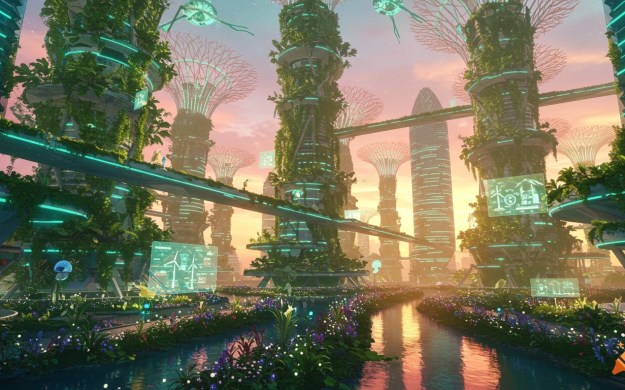
In short, for a solarpunk future, we must move away from locking technologies toward open technologies.
Yet, an additional distinction between open and locking technologies regards how they affect their users in radically different ways. On the one hand, the worker of the nuclear factory – the paradigmatic example of a locking technological system – is only a worker, sometimes a State worker, who performs highly-skilled labour in a capitalist economy. (Every technology is also an apparatus of subjectification, to use a Foucauldian terminology.) On the other hand, the operator of a communally-owned solar panel has seemingly broken away from the regime of value.
Open technologies, in this regard, reproduce a post-capitalist subjectivity, while they “decolonize” nature.
In fact, as capitalism imposes its own techno-logic through locking technologies, open technologies break away from it and imposes not only a new techno-logic, but a new cosmo-logic: the Sun is no longer just a resource to “exploit.”
Finally, we come back full circle to Ailton Krenak’s cautionary tale about the unknown tree and the savagery of Western civilization. As the South American indigenous philosopher opposes his own kind of animism to the materialism of capital, solarpunk should reproduce its own alternative to the capitalist ideology. Solarpunk, too, must decolonize nature from capital.
In conclusion, we should not forget that every piece of technology is an ontology as well as a cosmology, a relationship with the world, and that only a radical change in the mode of production will bring a new mode of existence with the world and its future.
Reference list
Krenak, Ailton. Ancestral Future, trans. Alex Brostoff, Jamille Pinheiro Dias, Cambridge: Polity, 2024.
Gorz, André. Écologica, Paris: Galilée, 2008.
Saito, Kohei. Slow Down: The Degrowth Manifesto, trans. Brian Bergstrom, London: Weidenfield & Nicolson, 2024.
Timofeeva, Oxana. Solar Politics, Cambridge: Polity, 2022.
Alessandro Sbordoni is the author of Beyond the Image: On Visual Culture in the Twenty-First Century (Set Margins’, 2025), Semiotics of the End: Essays on Capitalism and the Apocalypse (Institute of Network Cultures, 2023; Becoming Press, 2024), and The Shadow of Being: Symbolic / Diabolic (Miskatonic Virtual University Press, 2023). He works for the Open Access publisher Frontiers.
 Blue Labyrinths