
A child aimlessly moves their toy train in circles, oblivious to the realities of transportation. In play, the models move for their own sake, not to move goods and people. Like Theodor Adorno put it in his essay “Toy Shop” (1951), the playing child shuns the calculating logic of industrial society. They look beyond the general abstraction into which things and people alike are subsumed. Instead of the world becoming a gray mass of exchange values, the playing child still sees color by appreciating an object for itself.
That children experience joy playing is a sign that they are not yet alienated. As a consequence, Adorno sees child’s play as a subversive activity. But is it the playing itself that subverts the logic of current societal arrangements, or is it a part of some wider notion of unalienated activity? And how does play even manifest within industrial society apart from the playing child?
Each in their own way, two 2023 films based on major toys help shed light on these issues: Barbie and Dungeons & Dragons: Honor Among Thieves.
In Barbie, Margot Robbie embarks on a botched hero’s journey. As “stereotypical” Barbie, she parties every day in Barbie World with various other versions of Barbie and Ken. One day, weird things happen to her, from thinking about death to shunning high heels when she puts her feet flat on the ground. With a little push from an eccentric pseudo-punk reject, she enters the real world. There, Mattel executives come after her, and she and Ken (Ryan Gosling) learn more about societal structures of gender, to be applied back home.
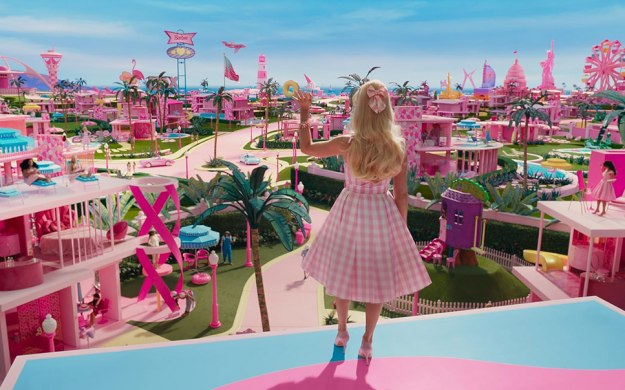
The sets scream artifice in Barbie World, pink as they are. The environment feels as manufactured as director Greta Gerwigs performances from her mumblecore past feel genuine. Her spontaneity in films like Nights and Weekends or Yeast (2008) has been replaced by deliberate directing here. The film directly addresses the plastic sheen of its sets with coy winks, when for instance Ryan Gosling, desperate to impress as “beach” Ken, bumps head-on into the hard waves.
His overeager acting contributes to an overall sense of artifice. Especially Robbie’s uncanny facial expressions and impeccable appearance heightens it. The masses of Barbies and Kens explicitly act out different roles – no doubt conforming to Mattel’s product line. The film really drives home the point that its story deals with toys. Characters float down from heights, as if a child moves them around.
Gerwig’s scripting (with Noah Baumbach) sharply contrasts the pink Barbie World with a gray real world. In both almost every man turns out to be a doofus. It forms a set-up for rants about patriarchal values, riffing off the connotations of the Barbie doll with those values.
As Wolfgang M. Schmitt pointed out in his analysis, in this process the film foregoes any socio-economic dimension to the issues it moralizes about. Instead, it presents a “fixed” Barbie World at the end of Robbie’s journey. There, each person knows their place, from the president down to the builder. It feels like a utopia for dominance hierarchy enthusiasts.
With its self-awareness, the film myopically presents the Barbie doll as a conduit for myopic moral messaging. In this way, Barbie cynically sees the toy as a pedagogical tool only. Opposed to the self-contained activity of the child with model trains, play is seen here as a purely functional activity to train someone in exhibiting certain behavior. In that sense, it closely mirrors the instrumental logic that permeates industrial society.
Apart from Will Ferrell’s amusing antics as the bumbling Mattel CEO, Barbie dislikes fun. Its view of play as functional makes it into something dead serious, a far cry from historian Johan Huizinga’s definition. He argued that the basis for any culture lies in play – defined as non-seriousness. In his view, humans at heart are a playing animal: the “homo ludens”.
The Dungeons & Dragons film embraces a vision of play closer to his. Directors Jonathan Goldstein and Francis Daley follow a ragtag group of misfits that stumble from one adventure to the next in a generic high fantasy world. The adventurer’s deeds often recall the mechanics of the tabletop role-playing game it is based on in various ways, recreating the average campaign as experienced by players and their dungeon master.
As a simple example, characters introduce themselves with their class, like many at the table would do. In another hilarious instance, characters call attention to the peculiarities of the “speak with dead” spell. Undead answer their ill-posed questions a bit too faithfully, with a brain-dead logic reminiscent of Monty Python’s absurdities.
Most importantly though, highly stylized stunts show off classic monsters like owlbears, with the camera swirling around as characters shift to and fro in acrobatic ways. Michelle Rodriguez as a barbarian especially knows her way around the approaching henchmen, using whatever is at hand to battle them with. This extravagant blocking resembles the convoluted ways a player would describe their character in combat to a dungeon master.
The fantasy here comes across as subservient to enjoyment. Realism be damned. The visage of the city of Neverwinter appears without a farm in sight – features such as food provision aren’t addressed in Goldstein and Daley’s worldbuilding. When the group enters a dungeon, they get an explanation of how to traverse a bridge within it, only for one of them to immediately ignore all advice, step on the first tile, and destroy it. Instead of evoking a sense of history, the place rather feels like one elaborate set-piece, as if an interesting battle map to put miniatures on.
Through its self-aware humor, the film connects an idea of play as enjoyment to the product it is based on. It markets a game of Dungeons & Dragons as escapist fun, through its attempt to capture the feel of sitting at the table with friends, and rolling some dice. Its view of play champions it as a time of leisure – as opposed to the time one spends laboring.
To this end, the fantasy world in Dungeons & Dragons functions as a space to enable leisure. Goldstein and Daley’s sense of space reminds one of artist Constant Nieuwenhuys. With his conceptual city of New Babylon, he envisioned how human-constructed spaces should look like if everyone had swaths of free time, thanks to fully automated production of basic needs. One can see that urban planning as an extension of Huizinga’s notion of the homo ludens.
Instead of people tied to certain social arrangements, they would be able to move around and associate with others at will. In whatever space they may find themselves, they can construct or reconstruct that space without restrictions, encompassing all senses, including sound or smell. Being distributed in ever varying compositions across ever fluctuating spaces, people would realize their freedom through expressing their creativity.
Constant starts from a vision of play as creative expression, a far cry from the industrial vision of Barbie. Barbie World feels like the complete opposite of New Babylon. The hard plastic of the sets cannot in any way accommodate a state of flux. Its spaces scream in a monotone voice of pink, a reflection of how the toys within reproduce variations of the same societal arrangement with their fixed mannerisms. Regardless of which gender dominates, the characters stick to their roles within a rigid hierarchy.
The fantasy world of Dungeons & Dragons feels more akin to Constants vision. Characters freely move around as if distance doesn’t matter, to embark on adventure after adventure, where monsters and traps challenge them to think creatively. Yet stylistically, the film, with its tongue in cheek joking and acrobatic camera movements, shows a problem with New Babylon.
For a place that stimulates creative expression, it feels too much like an amusement park – a place of hyper-individualist consumption.
Constants conceptual city hinges on a division in activity between labor and leisure. With the former mostly outsourced to advanced machinery, the latter is what occupies an individual’s time. As such, in planning that time it follows an instrumental logic inherent in technology as well, where the cost of producing has been minimized and the esteemed benefit of, in this case, free time, has been maximized. It bifurcates human activity in two rigid categories.
It reminds one of another one of Adorno’s essays, where he argues how within industrial society time for leisure merely serves as a time to recoup from the time spent laboring. The functional logic of labor comes to dominate leisure time as well. For instance, by scheduling those latter activities.
By adhering closely to the labor-leisure dichotomy, Constant implicitly follows that instrumental logic. Moreover, the creativity of New Babylon’s denizens can only be channeled through the use of the technologies of the city. Expression is mediated through a similar instrumental logic as a result, where the erected constructions are conceptualized from a form of a linear thinking of means and ends.
Those technologies have at the same time freed people from any obligations. In moving around without any ties however, Constants city merely reproduces the hyper-individualism running rampant in industrial society. Without any roots, the New Babylonian is a blank slate filled with expression filtered through technologies. Peculiarly, they feel like a contemporary consumer, who can pursue anything they want with a few clicks on their phone.
Yet both Dungeons & Dragons and New Babylon do adhere to Huizinga’s notion of play as non-seriousness, as both ultimately champion joyful expression. Contrary to what Adorno’s essay suggests, play does not necessarily lead to subversion. Instead, play can be as alienated as any other activity within industrial society, engendered within its logic.
For an activity to potentially be subversive, it should arise organically from an individual. So what, if any, elements of the child’s play are responsible for its subversiveness? The actual game of Dungeons & Dragons itself hints at an answer.
Played properly, the dungeon master describes challenging situations within a fantasy world for the players to respond to. They do this through their characters, stating their actions, which the dungeon master then resolves – if need be, with the help of the dice. From the outcome arises a new challenging situation, and the dynamic starts all over again.
Such a process done right stimulates one’s imaginative and problem-solving skills. Since players and their characters (or the dungeon master and the fantasy world) cannot be disentangled, these two capacities intertwine with social interaction. As a result, a story emerges from those interactions – and feeds back into them.
For instance, a party might after years still fondly recall how an angry giant blocked their way to a cursed temple of riches. Their characters being the misers they were, refused to pay him toll for passing through. Instead, they tricked him with playing on his love for mutton, cleverly deduced from conversation. Leading him to a trap, they could quickly escape, thanks to that one lucky roll they made at the end, as they held their breath in suspension.
Stories like these show how the game can fully engage the players. It arises organically from their own capacities. In that sense, Dungeons & Dragons transforms the gaming table into a space of autonomy. It enables the expression of the full range of emotions a human being can hold.
It reveals the fundamental alienation present within industrial society. There, a disposition of calculation has taken precedence over the various other emotional dispositions that makes up an individual, instead of acknowledging it as one of the many.
Barbie, with its instrumental idea of play as pedagogy, clearly demonstrates that fundamental alienation. Producer Hasbro with its Dungeons & Dragons film does not escape it either, as it sees play as a form of leisure opposed to labor, as passive entertainment. It does so, even as it is compatible with Huizinga’s notion of the homo ludens. It shows how even Constant’s New Babylon stays fully within the logic of industrial society as well, instead of subverting it.
Hence, play can become encapsulated within the overall disposition of calculation characteristic of industrial society. In the end, what’s so daring in Adorno’s playing child is the full engagement of its range of emotions within a self-created space of autonomy. Perhaps it is better to seek out unalienated activities in all its various forms, than it is to myopically put one’s hopes on the homo ludens alone.
Bibliography
Adorno, T. W. (1951). Minima Moralia: Reflections from Damaged Life. Suhrkamp Verlag.
Adorno, T. W. (2001). The Culture Industry (J. M. Bernstein, Ed.). Routledge Classics.
Filmanalyse (2023, July 30). Der blödeste Kulturkampf-Film: Barbie – Kritik & Analyse. YouTube. https://www.youtube.com/watch?v=qzk7w0XhF4I.
Huizinga, J. (1938/1950). Homo Ludens: Proeve eener bepaling van het spel-element der Cultuur. H. D. Tjeenk Willink & Zoon.
Nieuwenhuys, C. (1974). New Babylon. NOT BORED! https://www.notbored.org/new-babylon.html.
Sjoerd van Wijk is a Dutch film and music critic, writer and filmmaker. He currently lives in Nijmegen.
 Blue Labyrinths