
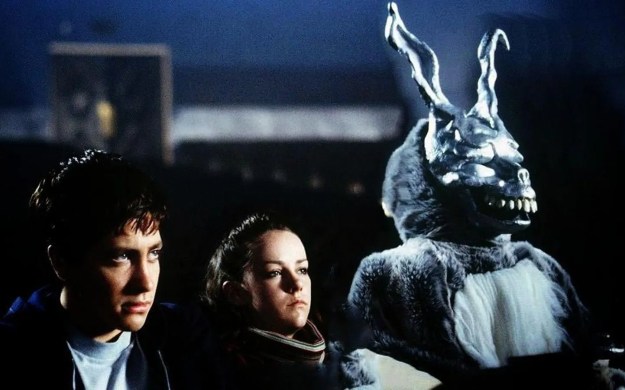
I couldn’t know why at that age, but watching Donnie Darko split open a melancholy in me that was hard to interpret as a child, and even still now. A sense of nihilism invaded my body and took all its heat away. I was left searching for the warmth I had before watching it. I had questions; I was curious about the ambient sense of anxiety tied to waking life, its closeness with time and the quantum possibilities it produces. I felt, for the first time, the artifice of time. It’s the loosening grip of the real. What is all this time stuff and why is it all over my body and house? What is the relationship between the sky and the future?
When Richard Kelly’s horror film first appeared in October 2001, it was a commercial catastrophe. A film about a jet engine falling from the sky, released weeks after 9/11, exploring the time-event matrix that determines futurity, could perhaps have foreseen its own downfall. Now, the ominous rabbit who speaks of time travel named Frank, and the troubled despotic teenager he visits are firmly embraced within the broader horror canon. The film begins with Frank giving Donnie 28 days, 6 hours, 42 minutes, 12 seconds until the world ends. It’s only a fictional pressure of time’s power to make the world burst; but today, the film remains one of the most apt mappings of our collective unease as dystopia saturates the present, registering the dyschronia of a world that insists on the space-time of Capital.
Broken Minds and the Psychopathology of Capitalist Time
“It goes without saying that all mental illnesses are neurologically instantiated, but this says nothing about their causation… This requires a social and political explanation; and the task of repoliticizing mental illness is an urgent one if the left wants to challenge capitalist realism.”
— Mark Fisher, Capitalist Realism: Is There No Alternative?
We know that time is just another thing in this crowded sensorium of a life to be perceived. Time and perception go hand in hand, which means mental health, implicated with the aptitude for healthy perception, is in a bond with time. Mark Fisher called the condition of late capitalist culture the slow cancellation of the future, and he located the cancellation precisely in the period Kelly’s film is set, 1988, the hinge of the Reagan era, the moment the postwar future was being seized and sold back as nostalgia. The film’s suburban normality is already haunted by the contradictions of the American dream with Reaganite optimism, evangelical moralism and the creeping sense that the future is all dressed up as a return to better times. Donnie, meanwhile, is medicated and therapised for perceiving the jankiness of the dystopian world around him. With the red circle of schizophrenia drawn around him, he is dismissed as having no contact with reality. The cure on offer for Donnie’s broken pathology is sedation back into consensus reality. Fisher spent a career arguing that this is what mental health services (in the UK) are for under capitalist realism. Healing would be too ambitious, but recalibration to a world whose arrangements cannot be imagined otherwise is good enough. The forward-marching status-quo linear model of time gives purpose to the struggle of living within a system that continually reproduces its own misery.
In Donnie Darko, the apocalypse can be scheduled to the second, but we cannot imagine a world in which Donnie, with the broken mind, survives into a different one. Easier to imagine ‘the end of the world’, and so on. But, as Fisher argues, to locate mental illness in the brain is not to explain the conditions that produce it. The film opens with a family dinner-table debate over the presidential election, while Jim Cunningham, the cookie-cutter milquetoast town’s revered self-help guru and moral authority, is later exposed as a paedophile. Donnie senses the rot beneath the town’s moral certainties before anyone else: a feeling not unlike living through today’s hypernormalised dystopia. We arrive tired and angry to all our mornings, carried into the next tragic day by whatever small glimmers of justice barely survive it. Like Donnie, buoyed only by the stubborn emergence of love and connection which materialises in the character Gretchen, who becomes his girlfriend, sometime before the world’s end.
Quantum Fields in Donnie’s World and Ours
“Thinking of time as a physicist is very different to how I think about time as a human. As a quantum field theorist, time goes forwards and backwards. It is reversible; there’s no arrow of time. Obviously, as a human, there is. How you go from having no arrow of time in fundamental physics to having an arrow of time in our human scale is a massive question, and we don’t know the answer”
— Dorota Grabowska, Time: Rasheedah Phillips & Dorota Grabowska
Dorota Grabowska, the Senior Theoretical Physicist at CERN, reveals this in conversation with Rasheedah Phillips, an artist, researcher, and lawyer, of Black Quantum Futurism (BQF). That open question is the premise of BQF’s CERN 2021 residency project CPT Symmetry and Violations.
Describing Western Time as a ‘master clock’ and a construct, Philips’ work with BQF unpacks time’s history as a violent tool of colonial social control that restricts the temporal autonomy of marginalised communities. At the centre of their CERN research, they use retrocausality to explore how the past, present, and future are not fixed, irreversible events but interconnected dimensions that constantly modify each other, and the possibility that a particle’s future can alter or influence the conditions of its past. A quarter century after Richard Kelly’s release, Donnie Darko‘s blogs online and TikTok videos are thick with explainers insisting that the liquid spears or bubble-tunnels Donnie sees emerging from people’s chests, translucent tubes of water pulling each person along their predetermined path, remain one of the most accurate visualisations of the fourth dimension ever committed to film. These liquid spears make it look as if the current, previous, and next action are all tethered to one breath.
A physicist at the time of its release even explained that the wormhole mechanics depicted in the film were “pretty much on the money,” according to a quantum mechanics idea called Many Worlds Interpretation (MWI), which outlines, as in Donnie Darko, the existence of multiple, possible, simultaneous event outcomes branching into parallel, siloed realities. Kelly’s unlikely reference point for this pseudo-alchemical physics is the sports broadcast telestrator, whose highlighting arrows trace a player’s next move over replay footage. It’s the future sneaking into the frame as an overlay on the present.
Alongside this, Philips’ CERN residency tapped into concepts of quantum entanglement and CPT symmetry (charge, parity, and time reversal), where microscopic particles can behave identically whether moving forward or backward in time. This kind of thinking offers a particle physics foothold for this article’s wider political and philosophical speculations: that time is a field of possible relations, where events might flow back into a collective, living macro-time—the dynamic gut we call the past, continually digesting what has happened and spitting it out onto our present, whether it’s reckoned with or not.
Before timeline and After timeline
Though there is no sturdy basis for the linear time model in quantum field theory, the modus operandi of framing time as a one-directional arrow seems fit to explain a political world predicated upon posts.
In the twenty-five years since, 9/11 outgrew the bounds of its own shock, becoming a chrysalis in the historical imagination and the temporal rupture from which a new, violent epoch emerged and unfurled its wings–the event successfully produced an ‘after’ in the launch of the ‘global War on Terror.’ “The Arabic-style font on the promo movie posters need to be changed (to Palatino) because the perpetrators of 9/11 were all from the Middle East” reads a comment from Donnie Darko Fansite under Donnie Darko 9/11 coincidences—one of many digital relics showing how the film’s fan blogs ransacked the imagination of American paranoia in every crevice possible, and showing the legitimacy of 9/11.
However, some events fork the timeline in such a way that not everyone inherits the post-world. History’s ruptures, in other words, are unevenly distributed. Their aftershocks are immense for those who live them, but scarcely disturb the wider event matrix, and time cracks into two channels.
Few speak with more clarity and precision on this than curator, writer, author of The Age of Earthquakes, OG timeline fiend and friend Shumon Basar. His newest formulation maps the sharpness in dissonance felt with the ongoing genocide in Gaza, and how apocalyptic futures are actively produced in the present, through the conditions that make catastrophe inevitable. In his words, the world split “into before timelines and after timelines… the only people I’m interested in being with are in the after timeline. The majority of the world is in the before timeline.”
Shumon understood that the accelerated technological flux being squashed into the present would alter the very terms of our being in the world. Our cognition and our planet, both sensoriums where the abstractions of violence and unrest are made material, would bear the fallout of a billionaire technophilia intent on zipfiling all aspects of organic life into legible data. With Douglas Coupland and Hans Ulrich Obrist, The Age of Earthquakes named the “Extreme Present” back in 2015, a moment “when the future seems to be happening much faster than we ever thought it would,” where our lives, fragile as they are, would need to bear the weight of a future arriving too early to be understood, let alone lived.
These split timelines are reified by our psychic distance from those who have normalised within the pre-timeline. Palantir in 2025 cemented its expanding, near-monopolistic grip on Western surveillance and defense architecture by securing a massive 10-year, $10 billion U.S. Army enterprise contract. There is a cosmological distinction for example, between the one who associates Palantir with the foremost killing technologies advancing Israel’s genocide, versus the one living in a world that is organised around Palantir being at the aspirational frontier of enterprise AI integration, operational data ontology, and sovereign AI deployment.
It doesn’t help that this world and its politics have a fetish for erasure too, but the future arrives in fragments of everything our present failed to reckon with. To borrow once more from Shumon, “Certain neurologists claim that the brain’s experience of the present lasts between two and two-and-a-half seconds. Everything before this is before, and everything after is the faraway future.” The space-time of Capital depends on that immediate, vibrant present being hijacked. By either the oncoming of a promising, lucrative future to make the ‘right now’ bearable, or the psychopolitical production of fear towards a lesser wanted, ‘boogieman’ future (one of the more ‘slow-release’ boogieman futures is laden with the nightmare that immigrants will overrun modern Western capitals, smashing the Euro-American chamber of safety under threat by Shariah law, or something to this effect).
The Unbearable Velocity of the Present
“Emotions, as Heideggerian philosophy teaches us, do not take place inside time; rather, they are the vectors of time. But unlike boredom or anxiety, hyperstimulation does not have any relationship with clock time. Instead, it reproduces its own timeframe through technology. Indeed, since the advent of electricity in the 19th century, the Sun is no longer the measure of human temporality; the light of the digital screen always rises over the Empire…”
– Alessandro Sbordoni, How to Reclaim the Present
Neuroscience’s Event Segmentation Theory (EST) suggests that the brain updates its model of the present whenever prediction breaks down; the ‘unplanned’ disrupts routine, i.e., whenever a jet engine falls into Donnie’s bedroom. The theory suggests that negative emotional experiences dilate subjective time—the ambulance that takes forever to arrive, while positive emotional ones compress it—the happy couple that has been together “50 short years.”
In Heidegger’s Being and Time, our human existence is only understood through possibilities we can imagine before we have lived them, a condition of being-towards-death where our lives are lived authentically through projecting them onto the ever-anticipated horizon of death, which is certain to come. We interpret ourselves through possibilities we have not yet realised. It’s through this perspective that the future literally shapes how we inhabit the present. Heidegger’s formula was the future arrives through the present rather than after it, which is to say the catastrophe is not approaching us from ahead but being assembled here, now, in the having-been we refuse to reckon with. Ever distracted by what Byung-Chul Han outright names in The Burnout Society, a way of self-optimising into your own demise, the image of your own apex-in-the-future zombifies you. Byung-Chul Han warns that the disciplinary machinery of the past has given way to the tyranny of possibility. It’s the command that you can, the possibility of juicing yourself of all the labour you can possibly do, until the self becomes both its own overseer and exploiter; that is the concerning social and cognitive pathology.
Exhaustion, and also overstimulation, once imposed from above, is now generated from within, as the subject drives itself towards neurological collapse, stripped of the solitude and deep contemplation through which another world might become thinkable. Screens keep us in a state of permanent arrival, forever hurtling towards the next thing without the last door closing shut. Under conditions of technological dopamine flooding, the present becomes difficult to inhabit and almost trained to be abandoned; everything is rushing, even right now there is an unbearable velocity to the current moment.
So emotions are a vehicle for time in the Heideggerian sense. But as Sbordoni’s quote implies, technology increasingly engineers the rhythms of our attention and affect, and so it recalibrates our sense of the present, and perhaps even the conditions under which history fractures into before and after. It’s through the frenetic flashing of the screen that time becomes ungraspable.
Just Another Sign
In Semiotics of the End: Essays on Capitalism and the Apocalypse, Alessandro Sbordoni describes how the end of the world/time/me/you has been packaged and absorbed as ‘just another sign’. Drawing on Franco “Bifo” Berardi’s concept of semiocapitalism, Sbordoni maps out the ways that capitalism begets itself like a cancer on the endless reproduction of catastrophic signs, from apocalyptic cinema (films with big frightening rabbits) to disaster as content. The end of the world is perpetually underway, absorbed into the very system it is imagined to destroy, as merch. A looping, stagnant repetition, a “yawn”, that creeps into a strange temporal flatness unlike the loud thunder from the sky we are taught to fear or prepare for. Our very preparation of it only produces more allegiance to Capital. The apocalypses predicted for fifty years never arrive because the end has already been eaten as content, produced, and re-produced in what Sbordoni calls the paradigm of reproduction. The end as spectacle is just the end defused.
Sbordoni references Byung-Chul Han words in Capitalism and the Death Drive: ‘Capital is accumulation in order to escape death. Capital may also be seen as frozen time; infinite amounts of capital create the illusion of an infinite amount of time.’ The promising linear future, the boogeyman future, both are capital’s frozen time, the present infinitely extended so that nothing genuinely other can arrive.
But Semiotics of the End takes these ideas to a field where we’re not done imagining. Positioned in contrast with Fisher’s capitalist realism, it announces itself as “a manifesto for the imagination of another relationship with the end”: if it is easier to imagine the end of the world than the end of capitalism, Sbordoni insists, “it is only because we have not imagined anything yet. The end is just the beginning”. As an opaque and radical praxis, true imagination refuses to mirror the dominant capitalist dictum. Alternative ways of seeing don’t call themselves ‘solutions’ on arrival; they first appear as transgressive anomalies that rupture the repetitive cycle of commodified eschatology. Imagination itself is a political faculty where better futures can fall from the sky.
Sbordoni takes us to an understanding where the end and beginning always coexist, with his reading of Nick Land’s ideas as the hinge on which everything turns. Land thinks that accelerating capitalism to its limit will eventually cause it to collapse, and humanity with it. Land views humanity as an obsolete biological stage destined to be outrun by AI. Sbordoni argues that this misses what capitalism is really accelerating–those damn signs. The circulation of signs, images, and information is what gets dizzy with speed, not the thing itself. If capitalism has absorbed even the image of its own destruction, the future remains to be imagined outside the terms it provides, or anything that can be chewed for profit–through anti-hauntological means as per Matt Bluemink’s ideas, to resist estrangement from our capacity to contemplate new ways into the future. We eschew fetishising the apocalypse (and its image, as per Semiotics of the End), or the compulsory doom of accelerationism. This is especially urgent for the Global North where complicity in the conditions of the violent present makes the refusal of fatalism a political imperative: the apparent inevitability of the end is itself a political luxury.
Donnie Darko’s closing hope, right before the sky bursts open with a new world at its centre, is a “hope that when the world comes to an end, I can breathe a sigh of relief, because there will be so much to look forward to.” Alessandro Sbordoni’s book closes with a manifesto’s promise that “the end is just the beginning.” The melancholy the film opened in me as a child was real, and I don’t think it was wrong; I just misread its direction. Nothing stole my warmth away; that was just the chill of a door opening onto all the other rooms. What I had taken for the death of possibility was the vertigo of discovering how much of it there was out there. There are futures yet to fall, brewing in the clouds. So I keep a prayer for you and me, and my eyes on the sky.
Bibliography
Basar, Shumon, Coupland, Douglas, and Ulrich Obrist, Hans. The Age of Earthquakes: A Guide to the Extreme Present, New York: Penguin, 2015.
Fisher, Mark. Capitalist Realism: Is There No Alternative?, Winchester: Zer0, 2009.
Han, Byung-Chul. The Burnout Society, trans. Erik Butler, Stanford: Stanford University Press, 2015.
———. Capitalism and the Death Drive, trans. Daniel Steuer, Polity, 2021.
Heidegger, Martin. Being and Time, trans. John Macquarrie and Edward Robinson, New York: Harper & Row, 1962.
Kelly, Richard (dir.). Donnie Darko, Newmarket, 2001.
Phillips, Rasheedah, and Grabowska, Dorota. Time: Rasheedah Phillips & Dorota Grabowska, Arts at CERN Podcast, Season 1, Episode 3, 15 June 2022.
Sbordoni, Alessandro. Semiotics of the End: Essays on Capitalism and the Apocalypse, Berlin/Nicosia: Becoming Press, 2024.
Sbordoni, Alessandro, and Cardozo, Camila. How to Reclaim the Present with Alessandro Sbordoni, Spike Art, 21 October 2024.
Yasmin Alrabiei is a London-based writer and researcher whose work spans cultural insights research, artist profiles, essays, and investigative features. Grounded in a background in Neuroscience and Cognitive Science, she explores the entanglements of perception, belief, technology, and semiotics.

