

It is not difficult to grasp why cinematic language requires signs that take into account the relation between representation and its object: even when filmic narration departs from “realistic” storytelling, cinema presents itself as a simulacrum of something else, whether it is real life or any other possible world. In order to narrate life (or parts of it) within a few hours, cinema makes use of signs to fill the frames with meanings that go far beyond the superficial level of their visual configuration. It often happens, especially within postmodern culture, that cinema assumes the task of reflecting upon the very mechanisms that govern it, and, considering every artistic expression as an extension of human experience that ultimately transcends it, it is not uncommon for it to formulate a discourse on the very act of living as representation.
This is the case with Mister Lonely (2007) by the American director Harmony Korine. In the film, the protagonist is a young man working in Paris as a Michael Jackson impersonator; yet, the disguise extends beyond the work context, since the man never stops impersonating the celebrity. While at work, he meets a woman dressed up as the world-famous actress Marilyn Monroe. Like him, Marilyn has retained none of her original identity except for the absorbed character. The woman invites Michael to follow her to Scotland: there, a group of outsiders – social outcasts who have never felt in the right place – escape the lives unjustly assigned to them by fate by pretending to be different people: celebrities or prominent historical figures such as Charlie Chaplin, Lincoln, James Dean, Little Red Riding Hood. Each of them has set aside their social role and freed themselves through fiction and role-play.
Running parallel to the main story is another narrative: a group of nuns assists an indigenous community in Panama under the guidance of Father Umbrillo, an eccentric and alcoholic priest who believes he has attained divine grace when he discovers that, if they jump from a helicopter piloted by him, the nuns can levitate thanks to the power of faith.
Related to the notion of icon – where the latter refers to a stimulus that can be taken as immediately meaningful substitutes for something else – is Umberto Eco’s so-called “theory of the lie,” a semiotic concept closely tied to the notion of suspension of disbelief in cinema. It is here that the Theory of Icons in Mister Lonely takes shape: if semiosis is a potentially unlimited chain, the only way to temporarily halt its continuous flow is to find a provisional end that is satisfactory.
A costume: the result of a constantly evolving process, taken synchronically in order to achieve pragmatic stability. The connection with the film’s protagonists is immediate: their strength lies in a form of mimesis that allows them to resemble celebrities; these are represented synchronically, that is, at a specific moment in their lives (at the peak of their fame, configured as the media have packaged them). Moreover, it is clear that the protagonists do not wish to live the same lives as the stars they admire, nor to retrace their actions as persons; rather, they aim to assimilate their state of iconicity, to wear only the “costume” in which these figures have been fixed within the collective imagination.
It follows that, as with any type of sign, their recognition is only possible within a specific cultural code, which in this case is widely – but not universally – shared: imagine showing such a person to inhabitants of a place without internet or television – they would certainly not recognize them. In the case of look-alikes, the cross-confirmations go beyond mere attributes: they adopt not only the names of the characters they portray, but also imitate their voice and intonation.
From this point onward, the director engages the viewer through narrative devices that refer to the lie/suspension of disbelief dualism recurring throughout the film: it is suggested, for instance, that the person behind “Michael” may have Hispanic origins, due to his accent and occasional use of Spanish words. This same out-of-place semantic marker reappears in the scene where Chaplin practices a British accent. In this way, the text highlights how residues of a previous cultural identity survive even after (supposedly) complete transformation into icons.
Through a semiotic analysis of the filmic text, it is therefore possible to identify the fundamental Topic of the film: the protagonist, dissatisfied with his life and unable to find its meaning, seeks refuge in becoming an Icon. Michael feels uncomfortable with the natural flow of life and finds comfort in the convenience of being someone else: an icon that, as such, does not age and continues to carry the same meaning over time. This is confirmed by another detail in the film: Michael habitually records long monologues in order to listen to them again whenever he wishes. He justifies this by saying, “I always thought life moved too fast; this is my attempt to slow it down.” The attempt to crystallize and halt the “vital” flow thus corresponds to the attempt to block a moment of semiosis – potentially infinite – with a “costume,” or, in other terms, to select a sememe among many possible interpretive paths.
In formulating the author-reader relationship in Lector in Fabula, Umberto Eco identifies cases in which the reader must draw upon their own encyclopedia to activate what he calls “intertextual script-based inferences” (Eco 1979), that is, the act of stepping outside the text to compare it with prior knowledge and disambiguate its meaning. This connection, which establishes a link between author and reader, is often achieved through the use of transtextual typologies theorized by Gérard Genette.
One of the most easily recognizable methods concerns casting choices, which fall under both quotation and metatextuality: the author and producer select an actor whose prior relationship with the audience (previous roles, biographical information) influences how they are perceived in the new text. A well-known example is Michael Keaton, famous for portraying Batman, also cast in Birdman, a film about an actor haunted by the superhero role that made him famous. Similarly, Rock Hudson’s roles in the 1950s and 1960s echoed the presumed homosexuality of the actor.
The same transtextual procedure occurs in Mister Lonely: it is no coincidence that two characters are played by world-renowned directors, far more famous than the film’s own director. Michael’s employer, Renardt, is played by French director Leos Carax, while Father Umbrillo is played by German director Werner Herzog. Examining their respective filmographies reveals a deeper rationale: both auteurs engage with the film’s central theoretical concern. Carax’s cinema often explores the concept of simulacrum and simulation (e.g., Holy Motors, which features an impersonator, or Annette, which begins with the director handing costumes to actors), while Herzog’s work investigates the fragile boundary between fiction and reality (e.g., Family Romance LLC, about an agency that rents out family members).
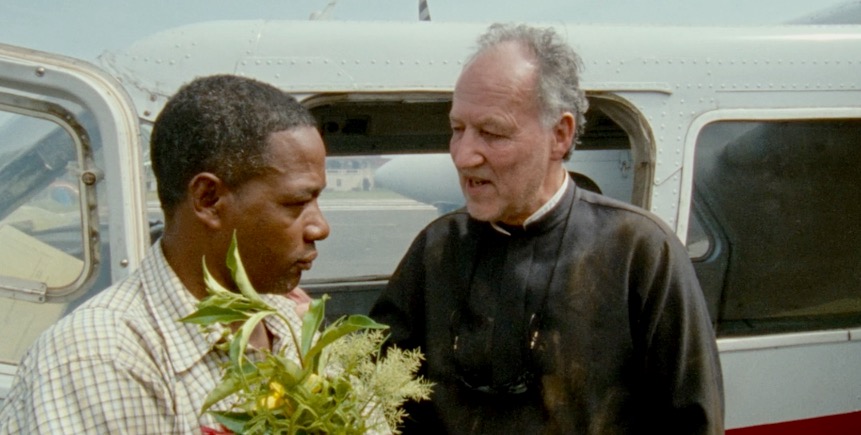
Addressing an ideal viewer with the competence of a cinephile, the text thus provides two substantial clues about its Topic: the concept that also connects the two seemingly distant parallel plots: the Icon, or more precisely, the relationship between reality and simulacrum.
The film opens with a voice-over, an enunciative débrayage. It is Michael’s voice, delivering the following speech:
“I don’t know if you know what it means to want to be someone else. To wish to appear different from what you are […]. To find a purpose in this world. It’s easier to see things in others, to see what you admire and then try to become that.”
The images accompanying this monologue do not depict the speaking character, nor his space or time; instead, they show the nuns from the parallel narrative, dressed in light blue and white habits: chromatic tones recalling Marian iconography. They are shown baptizing a child in a river: another reference to the Virgin/Nativity. The anchoring of speech to images allows for an immediate disambiguation of the correlation between the two plots: the director suggests that religion is one of many ways (or supports) through which humans create the illusion of meaning in life. The nuns, like the protagonists, strip off their garments to wear symbolic ones.
With a sharp cut, the enunciator is revealed: a man dressed as Michael Jackson positions himself at the center of a crowded Parisian square, which will prove to be the heterotopic space of the narrative. He has a bag, a stereo, and a bucket for collecting coins. He begins to perform like the artist, mimicking his dance moves and inviting passersby to donate. Through the construction of the sequence, the director suggests a comparison between sacred and profane icons.
Thanks to the voice-image anchoring and the (semi-)information provided in the first presentation of Michael, it becomes possible to suspend reality. In a biopic about Michael Jackson, suspension of disbelief would help immerse viewers in the narrative – there is a shift between denotation and connotation. From the beginning, the protagonist of Mister Lonely is immediately presented as a street performer; the “fiction” Eco refers to is openly declared. Therefore, the mechanisms of denotation and connotation are unstable, mediated by information that contradicts them.
The referential fallacy is illustrated in another scene where children, unaware of the discrepancy, approach Michael to ask for an autograph, mistaking him for the real one. Although the experience in Scotland initially appears positive, the balance within the community soon collapses irreparably: it is impossible to superimpose human emotions onto the status of an icon.
Disappointed, Michael returns to Paris and decides to stop impersonating. Meanwhile, the nuns are shown lying lifeless on a beach, having failed in their attempt to fly through faith: neither isolated group has succeeded in finding a true escape.
Then, after removing his characteristic costume, Michael returns to the bustling streets of Paris, filled with fans (a reference to other cultural illusions humans rely on), but this time he appears in different – both literal and metaphorical – attire:
“I can see hope in everyone’s faces. I know they’re looking for something. Everyone is searching for answers. But they don’t realize they’ve already found them. They’ve found them in each other.”
Michael is now willing to merge with the crowd in the Parisian square, which functions as the heterotopic space of the narrative. In the structure of Russian folktales, a hero leaves an isolated space to reach an overcrowded one where he reunites with society. Here, however, the text is constructed to make the viewer believe that this space of conjunction is Scotland, where Michael hopes to join a community that will accept him. The final revelation is that what appears to be a space of conjunction is actually a utopian and paratopic space where the hero acquires the knowledge necessary to return to the original space – initially perceived as one of isolation, but ultimately transformed into one of conjunction.
In this sense, the final scene mirrors the opening: the streets of Paris are the heterotopic space from which the protagonist departs and to which he returns after acquiring a new philosophy of life. The conjunction with the Object of Value – the desire for inclusion – is deferred until after the end credits.
The text of Mister Lonely thus triggers a reflection on cinema itself: any medium that opposes the flow of life is fiction insofar as it is representation, and it is impossible to renounce a “costume” in order to return to the world. Only through the interpretation of the subtle relations within the text – abstracting it from its objectual representations and then recomposing it – can one understand where truth resides.
Bibliography
Umberto Eco, The Role of the Reader: Explorations in the Semiotics of Texts, Bloomington: Indiana University Press, 1979.
Gérard Genette, Palimpsests: Literature in the Second Degree, Lincoln: University of Nebraska Press, 1997.
Paolo Peverini, “Il videoclip: un’analisi dei dispositivi enunciativi”, in Isabella Pezzini (ed.), Trailer, spot, clip, siti, banner (pp. 67–109), Rome: Meltemi, 2002.
Charles Sanders Peirce, Collected Papers, Harvard: Harvard University Press, 1958.
Filmography
Leos Carax, Annette, France, 2021.
Werner Herzog, Family Romance LLC, USA, 2019.
Leos Carax, Holy Motors, France/Germany, 2012.
Harmony Korine, Mister Lonely, USA, 2007.
Arianna Caserta (2001) is a writer and film theory researcher focusing on the links between cinema and internet culture. Her research areas include experimental films, teen movies, online subcultures, and new media art.
 Blue Labyrinths