
Intimations of Dystopia
The Age of Surveillance Capitalism by Shoshana Zuboff was published in German in 2018. English language editions were released in the following year.
Spanning social science and contemporary history, it captured the zeitgeist. Yet Brexit and Trump were only mentioned in passing. Hannah Arendt’s classic conception of totalitarianism—which everywhere formed the horizon for discussions of democracy in peril1—was the opposite of Zuboff’s behaviourist dystopia, one characterised by “psychic numbing” and a generalised loss of agency rather than political oppression.
Zuboff charted the rise of “surveillance capitalism”. Its animating principle is instrumentarian power—the capacity to predict, shape and monetise conduct through the analysis of behavioural surplus, the informational byproduct of online activity.
Instrumentarian power would seem a new concept in the field of political theory. Intimations thereof may be discerned in the corpus of science fiction. It became a reality, Zuboff shows, with the momentous jumps in computing power of the new millennium.
The Lifeworld
Zuboff gave substance to the feeling that a “coup” had transpired. Yet the site of this coup was not a state but the notion of human agency.
Conveyed by the tenor of the prose, this required no theoretical elaboration. However, it was clearly Zuboff’s intention to bequeath a framework for research.
Hence, it would become necessary to specify the “commodification of the human”2 central to her thought. After all, it was not a literal practice of enslavement she had in mind. Nor, more subtly, the private ownership of genetic data (though the latter might well intersect with surveillance capitalism).
When I was at work on the second edition of Habermas and European integration, Zuboff’s commodified human reminded me of the lifeworld. A concept central to my book, the lifeworld originated in the thought of Edmund Husserl and was developed further by Alfred Schütz. It has come to be associated with German philosopher Jürgen Habermas. He conceives of it as the background of shared, taken for granted assumptions that underpin everyday interaction. Habermas wrote of the lifeworld’s colonisation by the imperatives of administrative and economic systems.
In 2022 Habermas engaged directly with Zuboff’s work. In the same year, in a major supplement to her thesis, Zuboff referenced Peter Berger and Thomas Luckmann’s idea of commonsense knowledge—the lifeworld in all but name. In 2023 Zuboff’s colleague Mathias Risse also brought the concept of the lifeworld into liaison with that of instrumentarian power.3 However, his account made no reference to the thesis of colonisation. Instead, the “digital lifeworld” formed a neutral background to his narrative. From another point on the spectrum to Risse, meanwhile, Byung-Chul Han had referenced both Habermas and Zuboff.4 The effects of surveillance capitalism might already, he seemed to suggest, have exceeded the parameters of lifeworld colonisation as understood in the late twentieth century.
The Meta-crisis of Every Republic?
The dystopian character of contemporary societies is often remarked. A blend of two fictions is thereby implied: George Orwell’s Nineteen Eighty-four and Aldous Huxley’s Brave New World.5
During the Biden administration Zuboff sought to conceptualise the foregoing challenge to liberal democracy.6 Yet this episode in the history of populism was still explained in terms of instrumentarian power, a research program described as the “unified field perspective”. Surveillance capitalism had become the meta-crisis afflicting all republics. It was the fundamental source of de-democratisation—Huxley’s dystopia begetting Orwell’s.
Zuboff grounded her argument in empirical evidence. Misinformation tends to be extremist in orientation. It is particularly lucrative because it commands a disproportionate level of engagement. Hence, surveillance capitalism facilitates the spread of extremist content, albeit through the “radical indifference”, rather than bias, of its algorithms. (The case that data found online is inherently “mean”, in some qualitative sense, can also be made.)7
Social media companies may come to prefer populist regimes. For the latter, Zuboff suggests, are less inclined to legislate against surveillance capitalism than proponents of liberal democracy.
Fear and Bliss
Despite this marshalling of evidence, Zuboff does not account for the populist tide. After all, she makes clear, surveillance capitalism grew under the aegis of the Obama administration. A political concept is required as a counterweight to that of instrumentarian power. This too can be found in her work.
Drawing on the thought of Giorgio Agamben, she writes of 9/11 resulting in a state of exception with regard to the legal protection of individual privacy.8 Hence, a totalitarian moment in the sphere of governance created conditions for the rise of surveillance capitalism—a path of causation opposite that of the unified field perspective.
Yet the distinctness of the two dynamics—politico-administrative and techno-economic—is obscured by Zuboff’s reliance on psychological explanation. Recalling Max Horkheimer and Theodor W. Adorno’s Dialectic of Enlightenment, she identified an aversion to uncertainty as the motivation of intelligence operatives and their cohorts.9 While this may explain the behaviour of specific individuals and professional networks, a recourse to psychology does not account for the duality of the dynamics set in motion.
Caught in a logic of circular causality, aloof to the fate of the lifeworld, each dynamic falls short of ascendency. Pondering this state of affairs, I also think of Luc Tuymans—populism entails a concert of “fear” and “bliss”.10
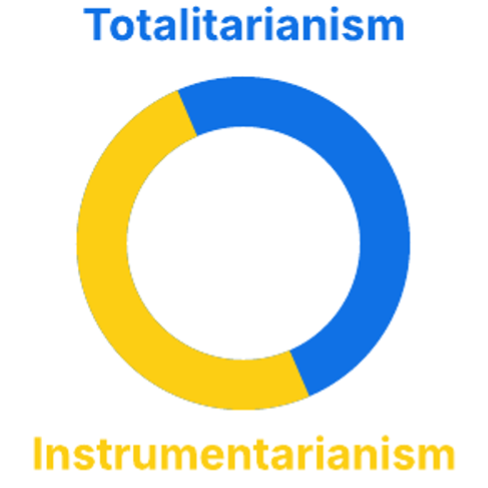
Figure 1: Fear and Bliss
Postscript: Salò at Fifty
Salò was first screened, in Paris, on the 23rd of November 1975. Pier Paolo Pasolini’s final film is tangled in the memory with his death three weeks prior. Arendt considered the appeal of the Marquis de Sade to intellectuals of the interwar years—a promise of criminal authenticity—anticipating Pasolini’s transposition of The 120 Days of Sodom to the Italian Social Republic.11
Yet Salò was intended as a critique of consumerism, which had transformed Italy within the space of a decade, not fascism. Parallels may be drawn between the cultural “genocide”12 Pasolini described and Zuboff’s reference to the “atrocities”13 of surveillance capitalism. If intensified sensation is, in some “Sadean” sense, common to each respective mutation14 of the market economy, its locus is the human nervous system. For Arendt, moreover, the body—libertine or otherwise—is a final threshold: the militant goes over, disavowing human form.
Decades after his appearance in Pasolini’s The Gospel According to St Matthew, Giorgio Agamben came to prominence worldwide. A series of blog posts criticised emergency measures against the spread of coronavirus. The pandemic he argued had brought to the fore the tendency of modern medicine to “split the unity of our vital experience, which is always inseparably bodily and spiritual, into a purely biological entity on one hand and an affective and cultural life on the other.”15 The estranged spiritual component was the domain of “The Church”. Benjamin Bratton designated Agamben’s oeuvre a form of “literature”: it was irrelevant, if not inimical, to the epidemiological realities of the moment.16
Pasolini would seem the quintessential littérateur. It was perhaps for this reason Agamben took exception to Salò. Intended by the director as a break with all that preceded it,17 the film complicates Agamben’s dichotomy of medical “abstraction”18 and religiosity: Pasolini found intimations of The 120 Days in Dante’s Inferno,19 leavening Sade’s materialism with a theology of sensation. Agamben’s suggestion that with Salò the “representation” of power had replaced its contestation signifies a refusal of Pasolini’s thought. The claim he “could no longer distinguish his own anarchism from that of the four villainous hierarchs” implies a turn to political reaction.20
References
Agamben, G. (2017) “Giorgio Agamben ci racconta Pasolini: l’anarchia del potere, la scomparsa delle lucciole” [Machine translation from the Italian], Città Pasolini, 25 November 2017, available at: https://www.cittapasolini.com/post/giorgio-agamben-pasolini-intervista?mibextid=Zxz2cZ (accessed 18 October 2025).
Agamben, G. (2020) “A Question”, Translated by Adam Kotsko, An und für sich, 15 April 2020, available at: https://itself.blog/2020/04/15/giorgio-agamben-a-question/
(accessed 18 October 2025).
Arendt, H. (1951) The Origins of Totalitarianism (Allen & Unwin Ltd, Second Enlarged Edition, 1958).
Bachmann, G. (1976) “Pasolini’s Last Film”, Film Comment, March-April 1976: 38-47.
Bratton, B. (2021) “Agamben WTF, or How Philosophy Failed the Pandemic”, Verso Blog, 28 July 2021, available at:https://www.versobooks.com/en-gb/blogs/news/5125-agamben-wtf-or-how-philosophy-failed-the-pandemic?srsltid=AfmBOopVE3XnXITEf7uoAxI5PkSjTl5sHDinopjzEqLVO5sLKndQcRYt (accessed 18 October 2025).
Chiesi, R. (2011) “Salò: The Present as Hell”, The Criterion Collection, 4 October 2011, available at: https://www.criterion.com/current/posts/513-salo-the-present-as-hell (accessed 18 October 2025).
Grewal, S. (2019) Habermas and European integration (Manchester University Press, 2019).
Habermas, J. (2022) Ein neuer Strukturwandel der Öffentlichkeit und die deliberative Politik (Suhrkamp, 2022).
Han, B. (2021) Infokratie: Digitalisierung und die Krise der Demokratie (Berlin: Matthes & Seitz Verlag, 2021).
Horkheimer, M. and Adorno, T.W. (2002) Dialectic of Enlightenment: Philosophical Fragments, Translated by Edmund Jephcott (California: Stanford University Press).
Lanchester, J. (2019) “Orwell v Huxley: whose dystopia are we living in today?”, Financial Times, 18 January 2019, available at: https://www.ft.com/content/aa8ac620-1818-11e9-b93e-f4351a53f1c3 (accessed 19 October 2025).
Pasolini, P.P. dir. (1964) The Gospel According to St. Matthew [Film].
Pasolini, P.P. (1975*) “Il vuoto del potere” ovvero “l’articolo delle lucciole” [Machine translation from the Italian], Corriere della Sera, 1 February 1975, available at: https://www.corriere.it/speciali/pasolini/potere.html (accessed 19 October 2025).
Pasolini, P.P. dir. (1975) Salò [Film].
Powers, J. (1998) “Salò”, The Criterion Collection, 21 July 1998, available at: https://www.criterion.com/current/posts/35-salo(accessed 19 October 2025).
Risse, M. (2023) Political Theory of the Digital Age (Cambridge University Press).
Rohdie, S. (2011) “Salò: A Cinema of Poetry”, The Criterion Collection, 4 October 2011, available at: https://www.criterion.com/current/posts/512-salo-a-cinema-of-poetry?srsltid=AfmBOooEpw7Fr012n4wCcOOJ-kKmNLMUS59sipHmrFOyOb7nV65RkbqH (accessed on 19 October 2025).
Steyerl, H. (2023) “Mean Images”, New Left Review, 140/141 (double issue), available at: https://newleftreview.org/issues/ii140/articles/hito-steyerl-mean-images (accessed on 19 October 2025).
Tuymans, L. (2016) “Luc Tuymans: artist and curator”, Financial Times, 28 October 2016, available at: https://www.youtube.com/watch?v=vQPmtvmA8-8 (accessed on: 19 October 2025) [YouTube video].
Williams, Z. (2017) “Totalitarianism in the age of Trump: lessons from Hannah Arendt”, The Guardian, available at: https://www.theguardian.com/us-news/2017/feb/01/totalitarianism-in-age-donald-trump-lessons-from-hannah-arendt-protests(accessed on 19 October 2025).
Zuboff, S. (2019a) The Age of Surveillance Capitalism: The Fight for a Human Future at the New Frontier of Power (London: Profile Books).
Zuboff, S. (2019b) “Surveillance Capitalism: An Interview with Shoshana Zuboff”, Surveillance and Society, 17(1/2), available at: https://ojs.library.queensu.ca/index.php/surveillance-and-society/article/view/13238/8503 (accessed on 19 October 2025).
Zuboff, S. (2022) “Surveillance Capitalism or Democracy? The Death Match of Institutional Orders and the Politics of Knowledge in Our Information Civilization”, Organisational Theory, Vol. 3: 1-79.
1 Williams, Z. (2017) “Totalitarianism in the age of Trump: lessons from Hannah Arendt”, The Guardian, available at: https://www.theguardian.com/us-news/2017/feb/01/totalitarianism-in-age-donald-trump-lessons-from-hannah-arendt-protests
2 Zuboff, S. (2022) “Surveillance Capitalism or Democracy? The Death Match of Institutional Orders and the Politics of Knowledge in Our Information Civilization”, Organisational Theory, Vol. 3: 1-79.
3 Risse, M. (2023) Political Theory of the Digital Age (Cambridge University Press).
4 Han, B. (2021) Infokratie: Digitalisierung und die Krise der Demokratie (Matthes & Seitz Verlag, 2021).
5 Lanchester, J. (2019) “Orwell v Huxley: whose dystopia are we living in today?”, Financial Times, 18 January 2019, available at: https://www.ft.com/content/aa8ac620-1818-11e9-b93e-f4351a53f1c3
6 Zuboff, 2022.
7 Steyerl, H. (2023) “Mean Images”, New Left Review, 140/141 (double issue), available at: https://newleftreview.org/issues/ii140/articles/hito-steyerl-mean-images
8 Zuboff, 2019a: p. 74.
9 Zuboff, S. (2019b) “Surveillance Capitalism: An Interview with Shoshana Zuboff”, Surveillance and Society, 17(1/2): p. 262, available at: https://ojs.library.queensu.ca/index.php/surveillance-and-society/article/view/13238/8503
10 Tuymans, L. (2016) “Luc Tuymans: artist and curator”, Financial Times, 28 October 2016, available at: https://www.youtube.com/watch?v=vQPmtvmA8-8 [YouTube video]
11 Arendt, H. (1951) The Origins of Totalitarianism (Allen & Unwin Ltd, Second Enlarged Edition, 1958): p. 330.
12 Pasolini, 1975*; see also Chiesi, R. (2011) “Salò: The Present as Hell”, The Criterion Collection, 4 October 2011, available at: https://www.criterion.com/current/posts/513-salo-the-present-as-hell
13 Zuboff, 2022: p. 7.
14 Pasolini, 1975*
15 Agamben, G. (2020) “A Question”, Translated by Adam Kotsko, An und für sich, 15 April 2020, available at: https://itself.blog/2020/04/15/giorgio-agamben-a-question/
16 Bratton, B. (2021) “Agamben WTF, or How Philosophy Failed the Pandemic”, Verso Blog, 28 July 2021, available at: https://www.versobooks.com/en-gb/blogs/news/5125-agamben-wtf-or-how-philosophy-failed-the-pandemic?srsltid=AfmBOopVE3XnXITEf7uoAxI5PkSjTl5sHDinopjzEqLVO5sLKndQcRYt
17 Powers, J. (1998) “Salò”, The Criterion Collection, 21 July 1998, available at: https://www.criterion.com/current/posts/35-salo
18 Agamben, 2020.
19 Bachmann, G. (1976) “Pasolini’s Last Film”, Film Comment, March-April 1976: p. 45. See also Rohdie, S. (2011) “Salò: A Cinema of Poetry”, The Criterion Collection, 4 October 2011, available at: https://www.criterion.com/current/posts/512-salo-a-cinema-of-poetry?srsltid=AfmBOooEpw7Fr012n4wCcOOJ-kKmNLMUS59sipHmrFOyOb7nV65RkbqH
20 Agamben, G. (2017) “Giorgio Agamben ci racconta Pasolini: l’anarchia del potere, la scomparsa delle lucciole”, Città Pasolini, 25 November 2017, available at: https://www.cittapasolini.com/post/giorgio-agamben-pasolini-intervista?mibextid=Zxz2cZ
Shivdeep Grewal is the author of Habermas and European integration (Manchester University Press, 2019). His work spans critical theory, literature and politics.
 Blue Labyrinths