
A boundless landscape, roads stretching far beyond the horizon. Wind in the hair, the sky overhead, and society somewhere far behind. Iconic cinematic depictions of cars moving freely through the landscape and its associated imagery seem to come almost naturally, especially when connected to the vast expanses of the United States. These images are built on the fulfillment of horizontal motion, one of the car’s defining features.
As philosophers of technology point out, a car is actually quite limited in the movements it allows: forward/backward and circular turns left/right. No sharp angles, close to no abrupt changes in direction, no vertical motion. Even the driver’s gaze is generally fixed straight ahead, toward the distance, the future. A fantasy of freedom.
A Person Travels Through the Landscape
The road movie is, after all, primarily an American genre that as such developed only after World War II, and it draws on and develops the imagery of the Western. In typical depictions, distant shots (emphasizing the landscape, solitude, and movement) alternate with close-ups of the upper body (connecting the landscape with subjectivity). The car serves as a tool for reaching a goal, and even though it is often an object of fetishization, it is evident that it is a machine designed to serve humans, fundamentally unresisting, driving almost on its own. This is also why such films rarely include shots of steering wheels or pedals.
The person in the car dominates the open landscape, which, while enabling the realization of their freedom (even as the narrative often challenges this success), is largely kept as passive background for human activity. The fact that no car would pass through this landscape without roads – and thus without society’s organized intervention into nature – is left unaddressed in narrative and visual construction. After all, if we wish to construct the seductive myth of individual freedom, it would be unwise to remind viewers that this freedom could not exist without society.
Within this strategy, all socio-material components (such as roads or automotive technology) fade into the background, while seemingly free individuals stand out as figures. This capacity to form and work with meanings is where art’s strength lies: to take a fragment of the world and transform it into something so powerful that it becomes the foundation of how the broader society perceives the world. Without works of art, cars would never have become tools of freedom the way we take for granted.
The Speeding Driver
Over time, the iconography of American cars incorporated new types of movement. With postmodern action films, such as the later installments of the Fast & Furious series, new qualities of motion emerge. The theme of freedom remains central, but its nature changes. The stark distinction between the city and the open countryside disappears. Everything becomes a stage for outrageous action scenes, where speed is paramount, and the impact of the driving on the surroundings becomes irrelevant. In the city, dozens of cars and portions of public infrastructure are inevitably destroyed; in the countryside, it’s the cacti and slightly smaller amounts of infrastructure that take the hit.
The action heroes’ cars are often reduced to fragmented shots that emphasize speed, and few are able to stop them. This new type of movement is not the result of the car itself but rather of the human. Bodies connected with the cars jump, fly, fall, spin. Another new figural movement introduced by the Fast & Furious series is drifting. This sideways motion originated in the mountains of Japan and entered the series with the Tokyo-based film aptly named Tokyo Drift. Its depiction shows it as a maneuver allowing rapid directional changes. However, it requires relatively wide streets and remains largely a variation of the standard sweeping turn, unable to execute sharp angled changes in direction.
In the Tokyo context, cars and people are more integrated than in the first two films of the series, yet everything remains structured under the imperatives of power and dominance, with little sensitivity toward the cars or subtlety. The iconography of white male America finding freedom in semi-wilderness beyond the cities is replaced by a more realistic, multiethnic urban space from which there is no ultimate escape.
Japan is a country of cities, and with new technologies and accelerated mobility, the space between cities has become more like an extension of urban areas, at least in its popular iconography. Here, freedom takes on a literal form: the ability to forge connections and create unconventional families bound by shared experiences and affinities rather than shared biological origins – a theme central to the rest of the series. Cars remain a means of achieving freedom and respite from social pressures. However, their function no longer lies in physically transporting someone to freedom, but in enabling actions that allow the emerging collective to be relatively undisturbed by dominant society.
A Turn in Hong Kong
What happens when cinema’s cars are relocated to a metropolis with few straight and slowly curving roads, and close to no open space beyond the city limits? This question was evidently pondered by the creators of the 2012 Hong Kong film Motorway, produced after the motifs described above had already become staples of the Fast & Furious series.
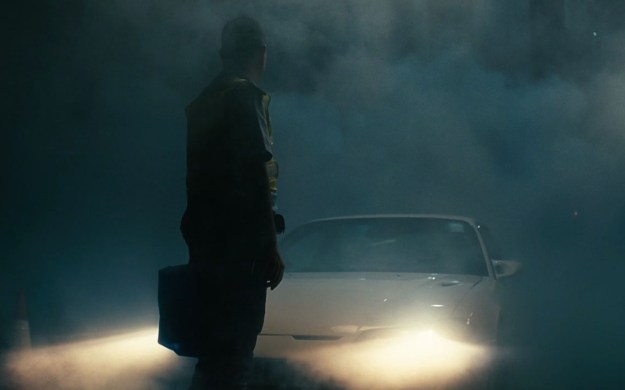
Hong Kong, a city built on several hilly islands and peninsulas, is one of the most densely populated areas in the world. It is characterized by narrow alleys which ask for new tools. At the heart of Motorway’s plot is a fugitive villain capable of making 90-degree turns in narrow alleys. This seemingly unthinkable maneuver is the direct opposite of how the Fast & Furious tradition evolves automotive figuration: Motorway focuses on slowing down, patience, and finesse. Escape routes are newly constructed using maps and the search for right angles. And as the film has far fewer cuts than its American genre counterparts, it comparatively offers significantly more shots of hands, the steering wheel, and pedals. The first chase in the film does not rely on speed. The young policeman, the story’s hero, crashes his car into an opposing wall. Unable to turn around, his driving style remains primarily an expression of force and aggressive confidence. This is expressed through a variation of scenes: first, he, driving, circles the young doctor who has caught his interest. She persistently rejects him, viewing his aggressive, dominance-focused behavior as childish. Later, a group of villains similarly encircles their victim and finally shoots them. It becomes evident from both scenes that the union of car and human creates a combination that behaves as an entity in itself, an assemblage so to speak. People and cars are likened to animals, hunting packs. Cars take on organic qualities. Human and car live intensely together, forming a new machine: the human-car.
Fusing with the Machine
Certain philosophical approaches view the concept of the machine as an entity where heterogeneous elements interact without losing their uniqueness. These elements include both material components and immaterial ones, such as intentions. Such a machine functions by bringing forth the potentialities of its parts which would otherwise remain imperceptible. The most effective machines are those whose parts are capable of adapting to feedback from their environment. Improvement, therefore, depends on the ability to evolve along with the surroundings.
Hong Kong requires a different kind of movement, one that demands the emergence of a new subjectivity. For the film’s hero to succeed, he must learn patience and better attune his senses to the car. Mastery of the automobile no longer relies on brute force but on subtle discernment of sounds and vibrations. Only after mastering this can the hero achieve the impossible: a 90 degree turn in a narrow alley. The introduction of this new movement into the cinematic language of the cinema of cars manifests on multiple levels, allowing other elements to adapt accordingly.
The scene where the driver finally succeeds takes place as a very slow chase in a pitch-black, crowded parking lot. The movement is constructed not only from shots of the cars and the police but also from images of touch and distance. The driver’s body is intimately connected to the car – literally, through hands gripping the steering wheel and feet on the pedal, clutch and brake. This connection includes bodily memory and embodied learning. The driver perceives the space as though they themselves were the car. It’s about sensing subtle differences in distance and employing just the right agility, allowing the car to slowly make that right angle turn.
Disconnect is Temporary
From the images created by the filmmakers, a cyborg emerges in the sense introduced by the American philosopher and biologist Donna Haraway. The cyborg is composed of all kinds of elements, both organic and inorganic, material and immaterial. Here we have the human-car assemblage, as well as the human, who, even when temporarily disconnected from the car, still has a body conditioned by this connection. The originally external technology of the car has permeated the human. This transformation is expressed in the dialogue: “It doesn’t matter how well you drive: when you lose your passion, you’re worse than a broken car.”
Thus, in Motorway, in contrast to Fast & Furious, a different conception of freedom can be discerned. The movie is rooted in Chinese traditions, which have been further developed for the modern reader in the works of French sinologist François Jullien and Hong Kong philosopher of technology Yuk Hui. A sage is someone who does not go against the world, but instead flows with it. This is expressed in Taoist traditions as “wu wei” (non-action). Confucian freedom, on the other hand, involves fully adapting to one’s environment, both as society and what we in the West call Nature. From this conformity, however, the sage is able to leave at any time for another environment, which is ultimately conceived as something more akin to natureculture. True freedom lies in not being bound by either the system or the idea of living outside the system, which is ultimately always a projection of lived conventions anyways.
This entire process leads to the human’s ethical reorganization
The fugitive driver and his partner, the antagonists, embody this type of morality. They are loyal professionals who adhere to a code, albeit not a state-sanctioned one. They manage to escape because they follow codes of behavior. The film’s central protagonist, on the other hand, is portrayed as a youthful rebel with strong personal moral principles but without regard for conventions and rules, which causes trouble for both him and those around him. He is always in conflict with the world, which he wishes to dominate forcefully. He only succeeds when he learns to merge with the world, transforming himself into a new kind of person. In the final scene, he uses his abilities to help others. The dominating ego recedes through the car. Freedom rests in not resisting the world’s conventions, allowing one to operate freely, rather than merely reactively.
Whether or not we agree with this direction of transformation, the film is remarkable in that it treats the car as an actor capable of inducing a moral transformation in the hero. Motorway thus exemplifies a post-humanist world, where technology is neither a mere tool for human goals nor a threat, but a created and simultaneously creative force that, as its users, we can change with, both accidentally and imperceptibly, as well as with awareness, and therefore freely.
Milan Kroulík is a Warsaw based para-academic that researches image and perception at the confluence of technology, arts and cosmologies.
 Blue Labyrinths