
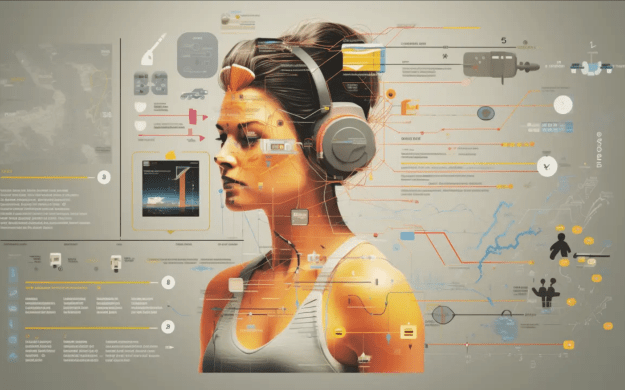
‘Listen to your body: all you have to do is wear it’
This is the promise of the FitBit Inspire 3, launched in 2022. This is a product, the ad tells us, that ‘makes fitness so fun, you’ll move more, love it and see how it all adds up’. Oh, and don’t forget: ‘track it or it didn’t happen’.
The global fitness tracker industry was worth around $54 billion in 2023 and shows no signs of slowing down. Around the world, more people are strapping on wearable devices – FitBits, Garmins, Apple Watches, Oura Rings – in pursuit of health, wellbeing and a fully optimised existence. These trackers monitor daily physical activity and bodily processes like sleep and stress, capturing, analysing and presenting back the data. This information motivates the wearer towards benchmarks and helps them steer away from negative habits.
These popularity of these devices marks the normalisation of ideas developed by the ‘Quantified Self’ movement, which was kickstarted in 2007 by tech journalists from Wired magazine. QS proponents argue that tracking our behaviour and translating our lived experience into data offers a path to greater understanding and continual improvement. Their mantra exalts ‘self-knowledge through numbers’. The appeal of this kind of self-surveillance seems clear enough. Through continuous measurement and engaging data visualisation, users are given the boost they need to become faster, fitter, stronger and more productive versions of themselves.
For those with acute medical conditions, there are transformative benefits to the increased availability of smart devices that can monitor vital signs like heart rate, blood sugar levels and blood pressure. Inevitably, there is less money to be made in selling assistive technology to those who most need it, so mainstream self-tracking is marketed as a fashionable ‘lifestyle’ accessory. Fitness tracking is pitched primarily to fit and healthy consumers who have the time and means to dedicate to their own constant contemplation.
These devices combine biometrics with machine learning to produce speculative (and trademarked) overall scores for an individual’s wellness. In their own words, Garmin’s ‘Body Battery’ continuously analyses combinations of heart rate, heart rate variability (HRV) and movement data, and ‘like a gas gauge on a car, indicates your amount of available reserve energy’. As researcher James N. Gilmore puts it, these aggregate metrics attempt to capture ‘seemingly ineffable qualities of our bodies’ and render them knowable. Like weather forecasts, these products compete to ‘produce forecasts for the human body’. Unlike weather forecasting, these predictions have a profound ability to shape reality.
The many faces of workplace surveillance
If you are the sum total of your data, the devices which gather this information become extremely valuable and employers are starting to figure this out. For mega-corporations reliant on physical labour and complicated logistics, tracking at an individual level means greater ability to monitor, evaluate and cajole the workforce. In 2018, Amazon patented designs for a wristband ‘bracelet’ which can track exactly where warehouse employees are placing their hands and use vibrations to nudge them in a different direction. Under the rationale of improving efficiency and helping workers to fulfil more orders, this tracker overrides the worker’s immediate agency over their own body. Amazon are also alleged to have used monitoring software to automatically fire delivery drivers if they don’t meet speed and efficiency requirements.
In 2022, researcher Dr Matthew Cole told a UK House of Commons Select Committee that this type of ‘increased surveillance and decreased autonomy over the order of tasks or how workers perform their work leads to increased stress and anxiety’ amongst employees. While Amazon insist they’ve ditched the ‘bracelet’ tracker, the company received a €35 million fine from France’s privacy watchdog in January 2024 for widespread use of an ‘excessively intrusive system’ to monitor warehouse employees’ performance. The watchdog found the handheld barcode scanner allowed workers to be monitored to the ‘nearest second’, with a level of accuracy that broke data privacy laws and potentially requires employees to ‘justify every break or interruption’. In the warehouses of corporate giants, data-driven trackers empower a workplace regime which sees only machines in need of optimisation.
Businesses are also adopting tracking devices under the guise of empowering and caring for their employees. Btihaj Ajana, a Professor of Digital Humanities at Kings College London, has written that companies including ‘Target, BP, Bloomberg, Barclays, and Google have been running wellness programs for their employees with the aim to encourage healthier and more active lifestyles’. Corporate wellness is a billion dollar industry and schemes exist hand-in-glove with tech manufacturers. Fitbit initially released the Inspire range exclusively for employee programs. The company has also introduced a call service that contacts individual workers directly when their data shows they are falling short of their fitness goals. Devices are often given out for free, and employees willingly participate in schemes, enticed by cash rewards and reduced insurance premiums.
Even under a benevolent premise, the gamification of workplace performance can create losers as much as winners. The UK Select Committee also heard of a trial employer scheme which gave police officers FitBits and Bupa Boost smartphone apps to ‘promote physical activity and reduce sedentary time’. While they found that physical activity did generally increase, so did feelings of ‘failure and guilt when goals were not met’, alongside ‘anxiety and cognitive rumination resulting from tracking physical activities and sleep’.
Employer-sponsored activity tracking is fundamentally at odds with the idea of ‘work-life balance’. Ajana suggests these schemes can constitute a ‘colonisation of employees’ private lives’, by infiltrating almost ‘every sphere of everyday life (from tracking sleep, weight and work performance to measuring sexual activity, fertility and other intimate aspects)’. As employers link the sharing of self-tracking data to financial incentives such as bonuses and discounts on insurance, there are unclear boundaries between ‘what is voluntary and what is not’. Christopher Rowland writes in the Washington Post that significant numbers of American employers offering health insurance now collect data on their employees from wearable devices, data which could easily be abused to favour ‘the healthiest employees while punishing or stigmatizing those who are less healthy, or who show signs of unhealthy behaviour such as heavy drinking or drug use’. Activity trackers offer employers unprecedented access to their workers’ private lives, giving up quantitative information which can be decoded into sensitive insights that individuals did not consent to reveal. This opens the door to new forms of paternalistic coercion.
The right to privacy (what have you got to hide?)
This incentivised sharing of our data has serious consequences for the future of privacy. Put simply, the more people that offer up this information willingly, the more normalised it becomes. In turn this becomes expected, then enforced. There might seem a great distinction between monitoring bracelets given to manual workers and a stylish watch worn as a lifestyle accessory, but every act of self-tracking contributes towards society’s malleable understanding and attitude towards surveillance and quantification.
Self-tracking is not an ambient presence in physical or digital space like CCTV or internet cookies, but something we actively endorse through participation. Full disclosure: I’m pretty religious about tracking my runs using the Strava app. It’s interesting to see my progression over time, useful to monitor how far I’ve gone and fun to see what others are up to. Seems innocuous enough, but there’s also the unavoidable pang of disappointment when the numbers don’t come back as fast as hoped. Meme pages now exist dedicated to the excuses that people compulsively spin to justify perceived underperformances. These vary from physical and technical malfunctions – ‘shoelace undone’, ‘didn’t record properly’ – to faintly ludicrous environmental claims (‘heavy sidewinds’). The social aspect of these apps instils a feeling of accountability; in reality no-one on your feed cares if you were four minutes slower than usual.
Insurers might note this information with interest though, and many companies are already encouraging customers to offer up their self-tracking profiles. Simon Usborne described in The Guardian how his life insurance policy was linked to a yearly points total, accumulated daily by steps walked, calories burned and the ‘rises in my heart rate measured by a smartwatch’. The annual tally ‘determines insurance status and premiums’. This is more tailored than the reductive standard calculations based on age and occupation, but at the cost of microscopic surveillance and the punitive policing of everyday habits. This glut of data can invariably fail to tell the full story. Usborne notes dryly that ‘while my lifestyle hasn’t changed since my Garmin died, my insurer thinks I have become idle and therefore at greater risk of life-shortening conditions’.
From sharing 5k workouts with friends to 24/7 biometrics with insurance companies and employers, the creeping normalisation of self-tracking presents an ethical dilemma, owing how it will affect those who do not engage with or consent to this activity. In the words of author and Big Tech critic Evgeny Mozorov: ‘if I choose to track and publicise my health, and you choose not to, then sooner or later your decision to do nothing but might be seen as a tacit acknowledgement that you have something to hide’. Mozorov argues that those with ‘excellent health, impressive driving habits and Stakhanovite productivity’ will be excited to share their data’, less so the poor, the sick, and those ‘who don’t have the time or stamina – which those who work three daily jobs to stay afloat might lack – to engage in self-tracking’.
Given the anxieties that tracking can fuel even amongst the healthy middle-classes, Mozorov rightly asks what the poor and sick are likely to discover if they do engage in self-monitoring: ‘that they eat food high in calories and saturated fat and they never ‘check in’ at their local gym because the fees are too high or they never have the time’. The standardisation of self-tracking offers benefits to the physically well and financially stable, while for others it could accelerate new forms of social exclusion, economic penalties and mental burden for the crime of being less fortunate.
Self-tracking lets you be your own boss
Putting aside how self-tracking is leveraged by others, this obsession with quantification has less considered consequences for how we experience our own lives. By monitoring every breath, every action and every minute of our day, we can reduce the messy complications of daily life into datasets which we can assess with a sense of detachment. As Quantified Self movement founder Gary Wolf argued: ‘numbers make problems less resonant emotionally and more tractable intellectually’.
This mentality aligns well with the neoliberal model of society built on personal responsibility. Self-tracking and quantification provide a convenient way for the state to delegate problem-solving to citizens, rather than addressing systemic issues. It’s easier to blame health issues on lazy individuals who neglect their numbers, than regulate highly processed foods, tackle the root causes of poverty and boost access to sports and green spaces.
Western societies in the twenty-first century, argues philosopher Han Byung-Chul, are inhabited by ‘achievement-subjects’ who are ‘entrepreneurs of themselves’. Unbounded freedom and the relentless drive for personal success and growth – think the ‘grindset’ – have replaced discipline or solidarity as the structuring forces of our lives. Where society used to impose prohibitions and restrictions, we are now relentlessly told ‘you can’. Productivity is no longer confined to the factory or office, but a requisite for all aspects of our lives.
The achievement-subject ‘gives itself over to compulsive freedom’ and the demand that we are always improving or delivering something. But this excess of freedom burdens and weighs on us. It becomes ‘auto-exploitation’ as we don’t simply compete with others but ourselves, all the time. ‘Look in the mirror, that’s your competition’, as the slogan in the gym reminds us.
Han argues that anxiety and burnout characterise the condition of the neoliberal achievement-subject, and it’s plain to see how constant self-tracking could turbocharge this. These devices remind us to keep our gaze inwards, not towards collective struggle or structural change but our fluctuating stats, and the personalised targets always just out of reach.
It’s easy to forget the most popular self-tracking devices are made by the same Silicon Valley companies who carefully engineered smartphone apps to be addictive. The manufacturers really do want you to get that dopamine hit from ‘closing your rings’. All the better to capture your attention, produce data you want to share with friends (and strangers), and enclose you tighter with a lucrative ecosystem of products, services and upgrades.
Why we can’t resist the digital mirror
The popularity of recreational self-tracking partly owes to an allure of seeing ourselves reflected in data. There’s something affirming about having our identity broken down into ones and zeroes, then remade into a recognisable picture. This is perfectly illustrated by a scene in Don DeLillo’s 1985 novel White Noise, when the protagonist has a moment of transcendent awe at an ATM machine. As the balance on the screen roughly matches his own estimate, Jack Gladney reflects: ‘waves of relief and gratitude flowed over me. The system had blessed my life. I felt its support and approval. What a pleasing interaction. I sensed that something of deep personal value, but not money, not that at all, had been authenticated and confirmed’. Our technology sees us and we are grateful for it. Computer says yes.
This appeal goes not just for the biometrics captured by activity trackers, but for other tracked data which expresses our desires, interests and choices. An obvious example is the buzz around Spotify Wrapped, when we learn with feverish excitement that we played a lot of the songs and artists we already knew we liked. Many companies are recognising the marketing appeal of these data-driven portraits. Last year I was treated to a ‘Tesco Wrapped’ announcement about many packets of salt & vinegar crisps I’d bought, and ‘Year in Monzo’ revealed that I’m a big fan of my work canteen.
These trends play out the ideas of prophetic media philosopher Marshall McLuhan, who wrote in 1964 that individuals ‘become fascinated by any extension of themselves in any material other than themselves’. This is a narcissistic obsession, in the original sense of the Greek god who was so fascinated with his own reflection that he died, unable to look away.
The danger of these digital mirrors is that we become lost in their hypnotic glow, incapable of knowing ourselves without them. Fitness trackers and the compulsive, real-time checking of our health – not just the raw metrics but branded, composite metrics like ‘Body Battery’ –threaten to erode our instinctive knowledge of how we feel. Instead we outsource our embodied intuition to devices which tell us how we feel.
This process is plain to see on self-tracking forums. Users talk of ritually checking their number first thing after they wake up, then watching with dismay as it incrementally drops throughout the day; they try to squeeze in some restful activities to get the number back up, or ruminate on whether they should exercise on such a low score. Others share the anxiety of unexpected numbers, now convinced they are unwell despite feeling fine. One user recounts the panic of waking up after a great sleep to an inexplicably low score, and pre-emptively cancelling dinner plans. Real stress arises from being told that you are stressed. The wearers of these devices are taught to doubt their instincts as the number on a screen becomes the goal, the motivator and the ultimate truth.
A particular source of distress for avid self-trackers is the realisation that their device hasn’t been recording, meaning their sleep, run, or heart rate has effectively been off-grid. The ‘track or it didn’t happen’ ethos is not just a great marketing tool for wearable tech, it sums up a core tenet of our postmodern age: that something seems ‘real’ to us now only if it is ‘reproducible’. Experience must be mediated by technology, connected to a wider network of communication, and validated by external forces. This is what Jean Baudrillard in the 1980s theorised as ‘hyperreality’. In other words, there is no existence outside of the simulation.
In our data-driven society, we have what philosopher Slavoj Zizek calls a ‘strange reversal of the Bentham-Orwellian panopticon in which we are (potentially) observed all the time’: now anxiety arises ‘from the prospect of NOT being exposed to the Other’s gaze’. Instead of fearing surveillance, we actively want to be observed and monitored as a kind of ‘ontological guarantee of our being’. Armed with our Garmins and Fitbits, we are like the subjects of Richard Brautigan’s utopian 1969 poem, living in our ‘cybernetic meadow’ and content to be ‘all watched over by machines of loving grace’.
In data we trust
When we are confronted by a chaotic world, uncertain futures, and an excess of information, the promise of quantification is the feeling of order and control, at least of ourselves. Sociologist researcher Deborah Lupton has pointed out the similarities between self-tracking and the therapeutic process: both are external interventions concerned with ‘achieving self-scrutiny and self-knowledge’ and ‘revealing the hidden’. From both, individuals seek ‘control over their destinies by managing the complexities of their bodies and lives’. But where therapy remains open-ended and subjective, constant self-tracking trains the user to view themselves and the world around them as calculable and determinate.
This drive to transform everything into data and numbers primarily serves the marketisation of human experience and the underlying profit-motive of Silicon Valley tech-capitalism: our data is a valuable commodity and the more there is to exploit, the better. Quantified selves are an algorithm’s best friend. This neoliberal worldview can extract no value – and so assigns no worth – to experiences not recorded, feelings not posted, intuition without tech and introspection without numbers.
Modern technology can reduce everything we do to a precise series of numbers and extrapolate from this to tell us things we didn’t know about our lifestyles and habits, some of them fun, some of them genuinely useful. But the digital mirror will always be flat and still. Human identity is an unsettled, kaleidoscopic thing, ceaselessly shifting between experience and knowledge, memory and desire, reality and fantasy. A quantified life promises greater certainty and control under the watchful eye of technology, but it cannot negate the contingencies and contradictions which are part of being alive. As we put our faith in our devices, the risk is not that they capture everything about us but what they miss, and what they train us not to see: all the parts of ourselves which do not compute.
List of works cited
Btihaj Ajana, ‘Personal metrics: Users’ experiences and perceptions of self-tracking practices and data’, Social Science Information 59, 2020.
Richard Brautigan, The Pill versus the Springhill Mine Disaster (1968).
Han-Byung Chul, Psychopolitics: Neoliberalism and the New Technologies of power, 2014.
Deborah Lupton, ‘You are Your Data: Self-Tracking Practices and Concepts of Data’ in Stefan Selke (ed), Lifelogging:Digital self-tracking and Lifelogging – between disruptive technology and cultural transformation (2016).
James N. Gilmore, ‘Predicting covid-19: wearable technology and the politics of solutionism’, Cultural Studies 31, 2021.
Culture, Media and Sport Select Committee (2022), ‘Connected tech: smart or sinister?’, (HC 10, 2022-23).
Marshall McLuhan, Understanding Media: The Extensions of Man (1964).
Evgeny Mozorov, To Save Everything, Click Here: Technology, Solutionism, and the Urge to Fix Problems that Don’t Exist (2014).
Christopher Rowland, ‘With fitness trackers in the workplace, bosses can monitor your every step — and possibly more’, The Washington Post, 2019.
Simon Usborne, ‘Intimate data: can a person who tracks their steps, sleep and food ever truly be free?’, The Guardian, 2021.
Gary Wolfe, ‘The Data-Driven Life’, The New York Times Magazine, 2010.
Slavoj Zizek, Eric L. Santner and Kenneth Reinhard, The Neighbor: Three Inquiries in Political Theology (2013).
George Harry James works in communications and writes about culture, philosophy and technology. He lives in London (and inside the simulation). You can reach him at georgeharryjames1@gmail.com
 Blue Labyrinths