
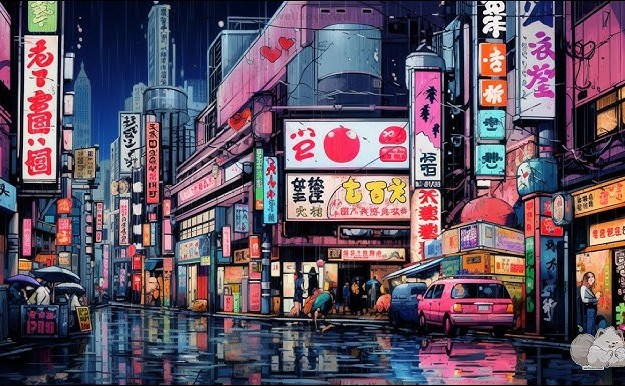
The anime Megazone 23, directed and written by Ishiguro Noboru and produced in 1985, can be cited as an example of an otaku work that reacted sensitively to the self-congratulatory atmosphere of those times. In the setting of the anime, contemporary Tokyo is in reality just a fiction created on a futuristic spaceship, a virtual reality constructed by a computer. As the narrative unfolds, the hero comes to realize the fictitiousness of this world and struggles to escape its confines. This setting alone is of profound interest, but more notable is a scene in the second half of the story, in which the protagonist asks the computer its reason for choosing the 1980s Tokyo as the stage for its fiction. In answer to this somewhat metafictional question, the computer replies, “because for the people, it was the most peaceful era.” These lines no doubt struck a common chord not only with otaku but also with many of the younger generation living in Tokyo at the time. Japan in the 1980s was entirely a fiction. Yet this fiction, while it lasted, was comfortable to dwell in.
Hiroki Azuma. Otaku: Japan’s Database Animals (2001)
I have spent much of the last few years looking at pictures of buildings, watching films, and most of all playing the music of, Japan in the 1980s. Judging by the number of hits on certain YouTube videos, I’m very far from alone in this. The algorithms have long since noticed, endlessly promoting to me looping, interchangeable mixes of ‘Another CITY POP Mix’ or of ‘Healing Music from Japan’. The City Pop playlists are most fitted to the medium, being enlivened by repeating GIF-like clips from 1980s anime. Neon street scenes, restaurants, launderettes: in the long lockdowns trapped in my apartment in 2020 and 2021, these looped clips were impossibly distant and romantic, familiar and unfamiliar, consoling but not recognisable enough to be too reminiscent of the ‘real life’ that was then on pause.
Being the sort of (middle-aged) person who prefers not to listen to music on laptop speakers and would rather listen to ‘albums’ with a particular beginning and end, I’ve been buying records that are either reissues of, or collections of, this music, either in their original sequence or in sequences that are rather more curated than the YouTube algorithm. Again, I was obviously not in any way unusual in this. One can note the Grammy nomination for the Light in the Attic compilation Kankyō Ongaku, with its cover image of an idyllic concrete building and its two discs of winsome, blank, airy ‘Environmental Music’, much of it produced for corporate clients over the course of the 1980s. In the hot, slow, empty spring and summer of 2020, listening to this on the balcony of the flat I rent in south-east London was a strange experience of intermingled bliss and dread, a perfect soundtrack to limbo.
It’s a truism to call this music relaxing, and it is; it’s also a commonly made point that this music has been seemingly everywhere over the last few years, served up in various different ways by online mixtape-makers and the ever-present algorithm, reaching its height in the way that you’re never more than a couple of videos away from ‘Plastic Love’ by Mariya Takeuchi, a melancholic pop-funk single produced by Tatsuro Yamashita and released in 1984; it’s highly enjoyable the first hundred times, though decreasingly so after that (since 2017, it has been viewed on YouTube 58 million times). What is also noticeable is that with a couple of exceptions – mainly, Yellow Magic Orchestra and its many side-projects – none of this music was known in the west at all at the time. It has been reissued in Europe and North America only in the last seven years or so. This rediscovery has happened at the exact point that retro tastes had reached their most jaded level – seemingly everything recorded in the US, UK, West Germany and Jamaica during the 1960s-1990s golden years that was worth listening to had now been heard, and the barrels were being scraped. And then, the online hive mind hit on a motherlode of wildly creative, apparently unknown, but surprisingly accessible music; most of what appears on these compilations and YouTube playlists was released on major labels. Suddenly, there is this embarrassment of riches, an entire separate past that is not yours, that you can explore for hours a day, a complete programme of geographical and temporal escapism without having to ever actually leave your room.
Music for Cities and Environments
What is also noticeable is that this music has almost nothing to do with the Japanese music that was previously celebrated in Wire-reading, record-shop-visiting circles in Europe and North America – the ‘Japanoise’ of Merzbow, say, or more relevantly, the gonzo drone-noise-rock scene that emerged at the start of the 1970s, celebrated in Julian Cope’s enthusiastic, informative but emphatically rock-only Japrocksampler. This stuff, though, isn’t noisy or hairy or loud. It’s precise, almost prissy electronic pop, overproduced pop-funk, and flotation tank ambient. If Cope’s ‘Japrock’ has often been connected with Japan’s long 1968, with some justification – the most original of those groups, the startlingly nihilistic Les Raillizes Denudes, had links with the Maoist terrorists of the Japanese Red Army – this is completely capitalist music, an integral part of the late 20th century’s most elaborate consumer culture. It is also – and I think this is at the heart of its appeal now, especially to the young – a music made by people who sound like they like living in the world that they live in, something now rather hard to imagine.
Reading up on Japanese pop music can be daunting, because of the sheer quantity of it, and because of the apparently puzzling nomenclature. Going through the parade of hairies in Japrocksampler, or reading Michael Bourdaghs’ more scholarly and panoramic Sayonara Amerika, Sayonara Nippon, you find a lot of unfamiliar genres. ‘Group Sounds’ means garage bands with fuzzboxes of the mid-sixties. ‘New Music’ means both the dense, exploratory early heavy metal of groups like Flower Travellin’ Band and the relaxed and wry folk-rock of groups like Happy End (the latter seam recently collected on Light in the Attic’s Even a Tree Can Shed Tears). ‘City Pop’ seems to mean anything from jazz-funk, slowed-down synth disco and Steely Dan-like highly produced soft rock, or a combination of these; while Kankyo Ongaku, ‘Environmental Music’, is usually somewhere between the spacious ambient of Eno’s Ambient seriesand the cheesier sounds of New Age. The algorithm music doing the rounds today usually fits into the latter two genres, although can’t be reduced to them. To add to the complexity, new, recently imagined subgenres of Vaporwave are completely in hock to the Japanese subgenres of the 1980s. Your ‘Another CITY POP mix’ may be followed in the algorithm by ‘Another FUTURE FUNK mix’, which has similar anime clips and the same vocalists and frequently the same tracks from the City Pop roster, but sped up to chipmunk intensity and strapped into the vehicle of 4/4 French house (itself a genre that is now 25 years old, and hence one of the genres of the past being referenced). Similarly, the dreamy, rainy ambient cityscapes of your ‘Japanese Healing Music’ playlist might segue into some compilations of similarly contemplative, spacious Dreampunk, the sample-free, cityscape-and-drift variant of Vaporwave begun by 2814’s Birth of a New Day, which often resembles a poisoned, dystopian variant of Kankyo Ongaku.
If you like to find out what it actually is you’re listening to, with information, track descriptions, original artwork and suchlike, you can find that on a rash of recent compilations and reissues, often with some sort of input from the musician Spencer Doran, who arguably sparked this rediscovery with his 2010 online mix Fairlights, Mallets and Bamboo. Japanese label Jazzy Couscous have two compilations of gorgeous Japanese ambient pop of the 1980s, Kumo no Mukō, but most compilations have come from European and American boutique labels. The more disco and AOR side of City Pop is collected on Cultures of Soul’s Tokyo Nights – Female J-Pop Boogie Funk; British retro label Ace’s Lovin’ Mighty Fire! sticks to funk and disco. We Want Sounds’ Tokyo Glow goes further than most into the cheesier side of the genre, while the same label’s Tokyo Dreaming is one of the nearest to a compendious collection that spans the avant-garde and the commercial, veering from Mariah’s extraordinarily beautiful, stately (and Armenian-language!) ballad ‘Shinzo no Tobira’ to the mutant disco menace of the duo Colored Music’s ‘Heartbeat’ and peppy anime soundtrack pop-rock like ‘Kazue Itoh’s ‘Chinatown Rose’.
Light in the Attic have put out the most successful of these bundles. Along with Kankyō Ongaku andthe more experimental, post-punkish Somewhere Between – Mutant Pop, Electronic Minimalism and Shadow Sounds of Japan, 1980-88, there is the fabulous City Pop series Pacific Breeze, the third part of which is released this spring. Each record in the series features airbrush covers of idyllic seaside cityscapes by the illustrator Hiroshi Nagai. The painter’s work rather sums up the entire endeavour – utopian images that take Hockney’s LA into an even more stylised and artificial world of palm trees, cubic houses and neon skyscrapers; they are just one step away from being the worst sort of 1980s interior décor, the sort of fake art deco you might expect to see fading in the corner of a mouldering café that hasn’t, or can’t afford to, make any renovations since the early 1990s – a sort of cybernetic modernist Jack Vettriano without the people. Of course, Nagai’s work now sells for large quantities of money. The Pacific Breeze series largely steers clearer than most of the more full-scale cheesy side of City Pop, however, which means they don’t have that same guilty thrill of enjoying something that is terribly close to being Luther Vandross at best, the Doobie Brothers at worst – but this also makes them a fair bit more consistent.
Nonetheless, the most exciting music on these is usually in a genre which doesn’t seem to have a name at all. It is heavily synthetic, and often involves heavy use of early samplers like the Fairlight and the Japanese-designed LMD-649 (not to mention the Roland-808, whose first recorded use was by YMO on their 1981 album BGM). It also has a percussive, Polynesian sense of working as both rhythm and melody at once, which is equally plausibly influenced by actual Javanese gamelan or by Steve Reich’s imitations thereof (or both). In that unnamed and perhaps unnameable category are musicians like Hiroshi Sato, Izumi Kobayashi, Akiko Yano, Yusuaki Shimizu, Miharu Koshi, Ichiko Hashimoto and Midori Takada, or YMO’s various side projects. None of these quite fit the monicker ‘City Pop’ – they’re too experimental, too odd, too unpredictable for the algorithmic drift (YMO’s Yukihiro Takahashi, who died earlier this year, was recently keen to inform American interviewers that YMO were never a City Pop group).
‘I Don’t Know If It’s Good or Bad’ – Techno-City Pop
Cityscapes are constantly used to illustrate this music, whether the neon skyscrapers the amateur anime clip compilations on the algorithmic playlists or the actually existing Iwasaki Art Museum, a 1983 building by Fumihiko Maki, on the cover of Kankyō Ongaku. It was common then, as now (with China and Korea fulfilling the role today), to see East Asia as a vision of an already realised future, which is rather cute given that these seamless gleaming cities of sleek infrastructure are no closer to arriving in Birmingham or Buffalo now than they were in 1983. This isn’t a ‘future’, it’s just somewhere else’s much more haptically ‘modern’ present.
Japanese architects were well aware of this at the time. Many were initially rather disappointed with the cityscapes that had been created by the 1980s, after forty years of reconstruction. In the 1960s, figures such as Maki, Kisho Kurokawa and Arata Isozaki from the 1960s generation, as well as older colleagues such as Kenzo Tange, had imagined creating huge megastructural collective cities, which would sometimes be suspended above the older city, and would sometimes float on Tokyo Bay; though connections with big business were inextricable, some of these designers, like Isozaki, were fellow travellers of Japan’s large Communist Party. But very little of this ever got built, and what did came to look increasingly shabby. Instead, there was the world’s largest real estate boom, with small prefabricated houses or skinny blocks of flats being forced into extraordinarily expensive plots of land, and the proceeds funding a spectacularly recondite form of refined consumerism.
Younger architects such as Toyo Ito were much more attuned to this. Ito noted in the 1988 essay ‘What is the Reality of Architecture in a Futuristic City?’ that ‘from the 1970s on, architects stopped drawing future cities; astonished by the huge discrepancies between the visions they were drawing and the rapid developments of reality, they turned away from the city’. Films like the then-new Blade Runner and Akira ‘surely approximate real scenes in places such as Shinjuku and Hong Kong’, meaning that science fiction had come to be ‘showing reality itself’.
‘Our lifestyle is that of nomads floating in a fictional city. We walk through streets scattered with symbols of consumerism, cycling from restaurant to boutique, to fitness club, to convenience store, to theatre. Strolling from fiction to fiction across dream stage spaces, we may revel in a futuristic urban life.’
That sense of existing within a self-constructed fiction or a collective hallucination was motivated by the sheer scale of the boom, which would, inevitably, collapse at the start of the 1990s, leading in Japan itself to a wave of nostalgia as early as 2001, when the cultural critic Hiroki Azuma would publish his study of the aesthetics of the fanboy or Otaku. It’s also, surely, connected with the strange position of people who had been connected with Japan’s once-powerful left, when thrown into this culture of extreme affluence, technological change, and discretely differentiated, compulsive shopping. Mid-way through Tokyo Melody, Elizabeth Lennard’s 1985 documentary on Ryuichi Sakamoto, the heavily made-up musician, who had been recording electro interpretations of Maoist anthems a few years earlier (and would, in the 2000s, join a short-lived anticapitalist party led by the Marxist philosopher Kojin Karatani), reflected with some puzzlement about this course of events.
‘It is 1984. I live in Tokyo. Tokyo or Japan has become the leading capitalist country. I don’t know if it’s good or bad. The season of politics is over. People don’t think of rebelling. On the other hand, they have a real hunger for culture’
– cue a scene of an entire street filled with people dancing in matching outfits, whether traditional-parodic or pop-parodic, while others watch from a flyover above. Much of the newly discovered (in the west) Japanese pop of the ‘80s shows at least traces of the influence of the artist’s 1978 debut, The Thousand Knives of Ryuichi Sakamoto. It consists of long, incredibly tight electro-funk tracks with catchy, tinny, roaming and deliberately stereotypically ‘Eastern’ melodies, which on the concluding ‘The End of Asia’ gradually resolve themselves into the tune of ‘The East is Red’, the Maoist ‘mass song’ that was closely associated with the Cultural Revolution. These show the wild ambition of this high-tech pop music, not just some banal ‘fusion of East and West’ but more an attempt at creating some sort of new, pan-Asian electronic language; keeping America out of the sound, as Neu! or Kraftwerk were straining to do in West Germany at the same time. Sakamoto, as the best-known member of Yellow Magic Orchestra outside of Japan, is probably the only 1980s Japanese musician of note to have had his records widely available in North America and Europe around the time they were recorded.
Almost everything in the music that has been rediscovered in the west over the last few years runs through YMO and their various side activities. YMO’s records have always been fairly easily available in the west, and reissues 20 years ago made it simple to find previously obscure work such as their finest album, 1981’s Technodelic, which takes the Pan-Asian proto-techno of Thousand Knives and takes it into an organised cacophony. But the group’s three members had all worked independently before the group was formed – Haruomi Hosono was already famous in Japan as a solo artist and member of the ‘New Music’ group Happy End – who were, as their Brechtian name trailed, already consummate ironists. Yukihiro Takahashi, whose relaxed, winsome lead vocals on big hits like ‘Kimi Ni Mune Kyun’ made him the closest thing YMO had to a frontman as well as its drummer, had made his name as the drummer in the glam rock group Sadistic Mika Band. The group’s thrillingly trashy records, which put them at the more chaotic, hipper end of 1970s pop, gained them some notice in the UK, though of a fairly grim sort – an appearance on the BBC’s Old Grey Whistle Test saw them appear in front of a redrawn sign, reading ‘Old Gley Whistle Test’.
The group’s early records are too glam, too seventies, for the compilations, but their later 70s period as Sadistics sees them appear on Pacific Breeze 2: ‘The Tokyo Taste’, (1977) which gives some sense of the opulent pleasure of their sound. It is slick funk taken slow, with the noise of a canned drink being opened punctuating the percussion; verses sung by the American vocalist Alex Easley, softly lubricious, are backed delightfully by a high, female pentatonic sing-song. The sound is sensual and artificial, funk without any sweat or exertion, evoking an Ohio Players who would never dare do anything so vulgar as put a naked woman on the cover of one of their records (instead, the album with ‘The Tokyo Taste’ on is rather more coy in its S&M references). This removal of some of the heat of funk, disco and early ‘80s boogie is surely part of the appeal in a lot of City Pop, and sometimes one wonders about the politics of this.
Tomoko Aran’s ‘I’m in Love’ (1983) also on Pacific Breeze 2, is one of many drum-machine and synth-bass soul ballads made in 1980s Japan that are as danceable as any Prelude track of the time. But they also dispense with the soul vocal, with the singers far more limited, less melismatic, but also less emotional, less embarrassing, and also without the same sense of release – sometimes you do just yearn to blast on ‘Somebody Else’s Guy’ instead, and hear cold music and hot vocals fight it out, rather than just more cold music and cold vocals. But this also draws attention to something interesting in quintessential City Pop tracks like ‘I’m in Love’ – they are perfect analogues of contemporary American electronic soul, without the sharp elbows and bandy legs of the attempts to emulate funk made by post-punkers like A Certain Ratio or the Bush Tetras. Rather, they’ve made a sound every bit as glossy and as beautifully played as the Americans (City Pop is a muso genre, marked by extreme proficiency). And it’s just one of several things they can do, before getting bored and doing something else. Produced by Hosono collaborators Friends of Earth, Fuyu-Kukan, the album from which ‘I’m in Love’ has been extracted, throws together AOR-pop like ‘Midnight Pretenders’ and ecstatic jump-up boogie like ‘Hitonatsuno Tapestry’ with ‘Body to Body’, resembling Bonnie Tyler crashing into Kraftwerk, or the freakish goblin hip hop of ‘HANNYA’. There was no commitment to a particular authentic sound or self-expression – everything is just sound, for the fun of it.
Takahashi’s own solo work moves away from straight-up funk into, first, a luxurious pan-global pop – the first album, Saravah! (1978), late Roxy Music gone bossa nova with a cover shot in front of the Eiffel Tower, is more Franco-Brazilian rather than Anglo-Japanese. Later albums such as Neuromantic (1981) or Wild and Moody (1984) cleave closely to YMO’s most straight-up pop moments. The second of these three includes one of the true classics included on the first Pacific Breeze, ‘Drip Dry Eyes’. What you notice first is the polyrhythmic complexity of the track, a stepping, oblique syndrum groove which is as much contemplative as danceable, then followed by an exquisitely melancholic melody, a high, chiming, repeated motif that has an almost transcendent sadness. Like a lot of this music, it is hard to believe a song so catchy and so beautiful – like someone yoked together ‘Take on Me’, Another Green World and Sinatra – isn’t globally famous (currently: around 300,000 views on YouTube, which is ok, but no ‘Plastic Love’).
Sakamoto, who had only released Thousand Knives when YMO’s first album came out in 1978, was probably the least famous member at the time. His solo records after Thousand Knives, all of them recently reissued, include the straightforward, joyful City Pop of Summer Nerves in 1979, the twitchy synth-pop of 1981’s Left-Handed Dream (recorded with M, of ‘Pop Musik’ fame), and experiments like 1980s’ B2 Unit (recorded with dub producer Dennis Bovell), whose audacious attempt to reproduce Afrobeat on synths, ‘Riot in Lagos’, has long been an underground classic. YMO had some rep in the USA through their cover of Martin Denny’s eastern-exploitation number ‘Firecracker’, and silly-serious covers of ‘Day Tripper’ and ‘Tighten Up’ – like Kraftwerk, they were big in clubs in Detroit and the Bronx, but unlike Kraftwerk they made it as far as an actual appearance on Soul Train; Sakamoto expanded this through his connections with the tellingly named south-east London synth-pop Japan. He appears on their 1980 album Gentlemen Take Polaroids, and the clattering rhythms and chiming ethnological fakery of their masterpiece Tin Drum is very clearly derived from Thousand Knives and YMO albums like BGM and Technodelic. Sakamoto’s two collaborations with their singer David Sylvian, the singles ‘Forbidden Colours’ and ‘Bamboo Music/Bamboo Homes’, would popularise a sound which many western critics have assumed was Sylvian and his group’s own product. Japan’s last record, the live Oil on Canvas, was made with Japanese multi-instrumentalist Masumi Tsuchiya, leader of the post-punk group Ippu-Do; his 1982 album Rice Music, featuring various members of the English band, is much more of a continuation of Tin Drum than any of their own solo records.
Hosono’s equally wonderful solo albums, on the other hand, have only been reissued in the west over the last few years. After splitting up Happy End, Hosono released four albums that became increasingly avant-garde and increasingly internationalist in their outlook and sources, culminating in 1978 with two very odd albums. The first was Paraiso, an exotica auto-critique credited to ‘Harry Hosono and the Yellow Magic Band’, which featured both Sakamoto and Yukihiro Takahashi. Songs like ‘Japanese Rumba’ and ‘Tokyo Rush’ were a surreal montage of Hawaiian, Caribbean and American sounds, with cross-cultural gags that are musical as much as lyrical (the satirical side of his work was extensively showcased with the side project Tin Pan Alley, whose best-of collection Yellow Magic Carnival features covers of ‘Chattanooga Choo-Choo’ and ‘Jackson’ interspersed with fake adverts and radio announcers). This was soon followed by the much more abstract Cochin Moon, a neurotic and harsh musical travelogue through southern India, mostly instrumental, which was almost as radical a departure from conventional song-writing as Sakamoto’s Thousand Knives. Of all the YMO members, Hosono was the most clearly satirical in his approach, with his records frequently working as a commentary on Japan as subject and object of imperialism, exoticised by generations of Europeans and then occupied by the Americans, while having had a colonial or neo-colonial relationship to the rest of East and South-East Asia. Much in these three albums work as concept albums about the fall and rise of the Greater East Asia Co-Prosperity Sphere, with the exoticised Japanese then exoticising south Asian and Pacific musics and cultures in turn. As Michael Bourdaughs points out, Hosono and YMO would come to ‘appropriate Western stereotypical fantasies of orientalness and perform them back as an empty, parodic identity’; but the joke worked in both directions at once.
Hosono’s solo work can’t be limited just to this hall of mirrors vision of exotica; it extends through the early 1980s into hauntingly beautiful, devotional Kankyo Ongaku records such as Paradise View and Mercuric Dance (both 1985), to skewed synth-pop like Philharmony (1982), and the daunting 1984 chiptune album Video Game Music, which constructed abrasive, atonal tracks out of the music and sound effects of Namco or Konami games like Pac-Man or Pole Position. YMO had been very early adopters of these noises, as in ‘Computer Game’, the montage of arcade sounds that would segue into the cover of ‘Firecracker’ on their first album. Hosono himself would justify his interest in these insanely irritating and catchy sounds as a sort of postmodern ‘folk music’, coming at the listener at all directions in the arcade (those who want to follow Japanese pop in this direction – audibly indebted to YMO’s own peppy, addictive techno-pop – would enjoy the recent Hyperdub collection Diggin in the Carts – A Collection of Pioneering Japanese Video Game Music, which develops from rudimentary chip-techno into increasingly elaborate 16-bit compositions by the early 1990s).
One can also follow YMO into works they’ve produced by others, or by their collaborators. For instance, the complex, chattering early computer music of their engineer Hideki Matsutake, on his solo project Logic System; Matsutake had worked with the Wendy Carlos-like synth orchestrator Isao Tomita, probably the only Japanese electronic musician of the era outside of YMO whose work was widely known outside the country. Similarly, one of the real revelations of the recent reissue programmes is the singer-songwriter Akiko Yano, who was a member of YMO’s touring band. Yano was married for a time to Sakamoto, and wrote most of the songs on his Summer Nerves; her albums Japanese Girl and Iroha ni Konpeitō are close to something like Yellow Magic Carnival in their use of ‘Eastern’ melodies over western AOR (backed by Little Feat on the first of these). But Tadaima is something else. From its manga cover inwards, it’s a personal and constantly imaginative record of long piano improvisations, crazed techno-pop and intricate combinations of both that evokes the Kate Bush of The Dreaming or the second side of Hounds of Love, predating both. As with Mariah’s Utakata no Hibi, it’s amazing to think that something so absolutely extraordinary was never deemed worthy of release outside of Japan. But given the experiences of Sadistic Mika Band or YMO on tour, perhaps her label would have been right to expect only bafflement or racist jokes.
YMO’s members also had various proteges, often ‘idol singers’ who hired the group to produce something more interesting and unusual than generic City Pop, but to instead fuse their pop songs with the avant-garde. One of Hosono’s proteges was the Japanese-American singer Sandra O’Neale, or Sandii – whose second ‘I’ was added by Hosono because he thought it ‘sounded Hawaiian’; her album Eating Pleasure (oddly not reissued) is a parodically sultry record of electro-reggae exotica, and features a delightful cover of ‘Drip Dry Eyes’. Similarly, all the members of YMO worked on two albums by the single-name singer Susan. (the Japanese-American Susan Nozaki). The second of these, The Girl Can’t Help It, a wild mixture of teen pop, folk melodies, proto-techno and girl group sounds, actually did get released in Britain in the early 80s, along with a clutch of Japanese LPs like a Sandii and the Sunsetz album and Tsuchiya’s Rice Music, which label bosses vainly hoped might appeal to the David Sylvian fans. Susan’s ‘Ah! Soka’ (1980), written by Takahashi and produced by Hosono, appears on Pacific Breeze 3, and fits the bill perfectly as self-consciously ‘Oriental’ pop – with its pentatonic melody and wood-block percussion, it is parodically Japanese at first, but then spins out into space-age pop, with her voice heavily distorted, backed at one point by a chorus of chattering chipmunks, with Hosono throwing weird echoed percussion from one end of the stereo space to the other. On the same compilation is the idol singer Chiemi Manabe’s Hosono-produced ‘Utonooko’ (1982), which is another minor YouTube hit (half a million views), although it is far too jarring to be any of the CityPop playlists – the pleasant drift of beautifully produced middle of the road music would be drastically interrupted by the percussive, synthesised dog barks that provide part of ‘Utonnooko’’s rhythm, its dub-like echoed space, and its peculiar key changes and the buzzing drone at the edge of the mix.
A figure who is much more than a ‘protégé’ here is Miharu Koshi, whose spiky, cabaret-style, fizzing and hissing synth-pop track ‘Scandal Night’ appears on Pacific Breeze 3. Koshi was an idol singer who hired Hosono to help her in a process of ‘de-idolisation’ on the albums Tutu (1983) and Parallelisme (1984), which included her own songs and covers of techno-pop groups like Telex. There is a wonderful YouTube clip of her and the YMO boys playing the title track to the latter on Japanese TV, an exquisite set of songs with all the romantic melancholy of ‘Drip Dry Eyes’, but yet more oblique, with their chiming, haunting melodies which resemble synthesised gongs. Both albums contain an impressive amount of songs in French, that global sign of modernist sophistication. They aren’t the only examples of this. Ichiko Hashimoto, one half of the duo Coloured Music, sings in French on ‘Naja Naja’, one of the standouts of Beauty, a 1985 album which yokes together crashing jazz-funk drums with whispered, minimalist, inescapably sexy songs which could be imagined on Prince’s Parade a year later, interspersed with unpredictable piano instrumentals which whip from Philip Glass to Ravel: swooningly romantic music.
Fictive Nations
A remarkable amount of this music was directly connected with the consumer economy of the 1980s bubble, probably the largest – until recently – of its kind. As Michael Bourdaughs notes, YMO’s ‘Technopolis’ was ‘used in a television commercial for cassette tapes, the musical playback medium that was achieving mass-market penetration with Sony’s just released portable Walkman player. This and other YMO numbers were also frequently used as in-store music by electronics retailers during this period.’ After splitting up his group Mariah, whose last album Utakata no Hibi (1983) is as extraordinarily ambitious as any of YMO’s best work, saxophonist and composer Yusuaki Shimizu worked extensively making music for TV advertisements – one of them, for Seiko watches, features on Kankyo Ongaku (his collection of advertising jingles, Music for Commercials, was avant-garde enough to be noticed by the Belgian post-punk label Crammed, who released it in Europe in 1987).
These sorts of corporate connections were very common – the sort of ‘useful’, corporate and unpretentious uses that Eno imagined with his Music for Airports but generally didn’t manage to actually achieve. Hosono’s Kankyo Ongaku tape Wearing a Flower (1984) was made to be played instore at the first MUJI shop. This music became, very literally, a form of Muzak in Japan, commissioned by retailers or arts centres or public buildings – or combinations of these, such as the Wacoal ‘Spiral’ Arts Centre in Tokyo, a fragmented Postmodernist building of 1985 by Fumihiko Maki, which commissioned Yoshiro Ojima’s Une Collection des Chainons I and II – Music for Spiral (reissued by WRWTFWW), whose synth dronescreateperhaps the most strikingly placid and utopian of the various Japanese ambient reissues. Some of these, such as Hiroshi Yamamura’s Music for Nine Postcards and Masahiro Sugaya’s Horizon have been reissued by a label named Empire of Signs, after Roland Barthes’ notorious 1970 book of praise for the culture of what he made very clear was a largely imaginary Japan, a ‘fictive nation’ based loosely on the actual country that he regularly visited.
This notion that there isn’t a ‘real’ Japan – that the place works on the level of the simulated 1980s Tokyo in Megazone 23, an imaginary non-place for people to project their desires and anxieties onto, is commonly used by writers in the ‘how Japanese pop culture took over the world’ subgenre. Matt Alt’s recent Pure Invention, for instance, draws its title from Oscar Wilde’s only half-ironic assertion that his fellow Victorian aesthetes had simply made Japan up to justify their own tastes and claims. This fits very nicely with the empty spaces and tiny details in much Kankyo Ongaku, but the notion of a culture of pure surfaces and textures, aesthetically rich but devoid of ‘meaning’, let alone critique or irony, is hard to countenance given the way that so much of this music consciously, critically plays with Orientalist preconceptions and stereotypes.
Two of the records that pick up most imaginatively on YMO’s auto-exoticising pan-Asian synth arcadia are Hiroshi Sato’s Orient (1979) and (inexplicably, not reissued), Izumi Kobayashi’s Nuts Nuts Nuts (1982). Tracks by both were among the real revelations on the first Pacific Breeze. Sato’s ‘Say Goodbye’ (1982) is an idyllic drift in which a chiming, gamelan-like percussion-as-melody, lounge piano and a vocoder vocal of the kind Herbie Hancock was pioneering with ‘I Thought It Was You’ create an irresistible sense of ultra-modernity and repose. Sato’s music evokes a placid pan-Asian utopia, with that gamelan-like use of mallet instruments, chimes and repeated notes, along with ‘Hawaiian’ guitars and vocoder vocals – although he was apparently asked to join YMO when it was formed, Sato’s music is so much more relaxed than Hosono, Sakamoto and Takashashi’s work, with the urban neurosis replaced with an image of the Japanese musical consumer taking whatever they like from ‘Greater Asia’ as the soundtrack for an idyllic beach holiday.
Not that the various borrowings are limited to just Asia plus black America with an occasional bit of Dusseldorf. That repeated chiming, chattering sound which runs through so much of the most exciting Japanese music of the 80s – with sources in gamelan, Moroder, and the southern African ‘thumb piano’, the kalimba – also runs through Izumi Kobayashi’s ‘Coffee Rumba’, another of the genuinely headspinning moments on the first Pacific Breeze; it fuses that sound with a partly synthesised, partly real-time approximation of the beat to the Venezuelan fifties novelty hit ‘Moliendo Café’. It is one of several equally bizarre and brilliant tracks on Kobayashi’s Nuts Nuts Nuts, self-produced by a City Pop singer who had previously recorded in L.A. It most resembles a Japanese analogue of the Compass Point sound used for the early 80s records of Grace Jones or Talking Heads – here, various Caribbean musics, from Cuba to Jamaica, are also thrown into the techno-Pacific mix. Again, there’s no angst, but a shimmering sound that circumvents Europe and the USA completely. It’s also goofy, and deliberately funny – ‘Coffee Rumba’ begins with Kobayashi murmuring, with her voice treated in robotic chipmunk style, ‘listen, listen, listen to me’ before the beat kicks in. She developed this side further in the various songs she recorded for the long-running TV anime Urusei Yatsura, with its tall tales of exotic bikini-wearing aliens in the Japanese suburbs.
World Music being made by the sort of people whose national music would conventionally be classified as ‘World Music’ was genuinely unusual – an example of geographical answering-back, expressed more through irony than direct criticism. There is a fair bit in this music of motifs taken from Japanese traditions – Pentatonic melodies from Enka folk music, the occasional Shamisen or Koto – but a lot of what sounds ‘Japanese’ to the foreign ear is actually taken from elsewhere. One of Cope’s favourite ‘Japrock’ groups, Geinoh Yamashirogumi, made ambitious attempts from the late 1970s on to synthesise heavy, droning rock with any vocal or instrumental tradition they could find – Bulgarian, East African, Javanese, whatever. Their 1988 soundtrack to Akira would be considered exotically Japanese by a generation of American and European teenagers, but those stretched vocal melodies are from Bulgaria, and the building, massing metallic percussion is from Java. The work of the multi-instrumentalist Midori Takada, both solo and with Mkwaju Ensemble, recently extensively reissued, has a similarly ‘Eastern’ sound – but the specific instruments and techniques are more often taken from Tanzania than from Tokyo. Often, the musicians are following Hosono by straightforwardly taking the piss in their various fusions, as in Ippu-Do’s lovely and ridiculous ‘Chinese Reggae’, or, on Pacific Breeze 3, the jazz-funk group Parachute’s ‘Kowloon Daily’ (1980), with its ‘70s Chinese restaurant muzak opening melody; it is on an album called From Asian Port.
It’s easy and tempting to make comparisons between this fantastic music and the work being made around the same period in West Germany. Both were overwhelmingly urban, high-tech, export economies with overdeveloped consumer cultures built upon charred ruins, overlaid uneasily onto a genocidal recent past. Can’s best records were made with the Japanese singer Damo Suzuki, and Dusseldorf, hometown of pivotal groups like Neu!, Kraftwerk and DAF, had by the 70s (and still has) the largest Japantown in Europe, created by industrial links that endured long after the Second World War. YMO, like Kraftwerk, would be the part-celebratory, part-auto-critical embodiment of an economic miracle, and both were much more popular in black America than either the stereotypes of the time or contemporary arguments for musical segregation as an allegedly progressive force might have you believe.
However, the two groups had a quite different relationship to mainstream Anglo-America, and to the recent past. YMO would occasionally deliberately provoke associations with Japanese fascism, as in the uniforms, posters and banners of the tour documented in the 1984 film Propaganda; this time without the cancelled socialist future of Weimar Germany to evoke in response. But relations between the Germans and their post-war American occupiers, and the Japanese and their post-war American occupiers, were obviously not comparable; nor indeed was the way the war was conducted, with the near-erasure of Japanese cities by the US airforce, and with Japanese-Americans interned en masse while German-Americans were left alone. The Japanese were many things – and in the first half of the 20th century, they were among the world’s most brutal imperialists, in a swathe from Seoul to Nanjing to Jakarta, from Taipei to Hanoi to Yangon – but they were not white.
It is this persistent theme of Japan as both coloniser and colonised that runs through YMO’s most savagely satirical work. On the album X∞ Multiplies, with its terracotta army of interchangeable figures on its cover, a series of sketches by the comedians of Snakeman Show brings all this out. As Bourdaughs describes these in Sayonara Amerika, Sayonara Nippon:
…a Japanese businessman’s apparent veneer of comfort at carrying out business in English falls apart…YMO itself gets into the comic game, with a heavily accented, parodic voice introducing the band in English as “the number 1 dance band in Tokyo!” over a techno-pop adaptation of Archie Bell and the Drells’ hit “Tighten Up” (1968). The song is given new lyrics, however, built around the repetition (again in English) of the phrase “Japanese gentlemen, stand up please!” Next…the afflicted Japanese businessman becomes the target of increasingly offensive comments by his apparently American business counterpart, his inability to speak English or to confront his interlocutor (who compares Japanese to pigs and monkeys) providing the uncomfortable basis of the humor. The sketch suggests that despite (or perhaps because of) the appearance in the United States of a seemingly Japanophilic trend represented best by Ezra Vogel’s best-seller Japan as Number One (1979), whose title is alluded to in the comedy routines, hierarchies continued to define the imaginary map by which Americans and Japanese understood their own geopolitical positions—hierarchies that YMO was at pains to undermine by revealing their basis in a hall of mirrors’.
This was a sly self-depiction by YMO as Japanese salaried gentlemen, going round the world taking polaroids, a persona that recurs in their work. ‘A sample of life/in old Korea/the girl wouldn’t let me/take a picture’ runs the refrain of their hectic, panoramic 1981 track ‘Seoul Music’. But X∞ Multiplies’ references to the sort of ‘humour’ displayed by the ‘Old Gley Whistle Test’ – racist jokes that the tellers assumed would fly over their heads – is biting.
But what of this misunderstanding today? One way of reading the revival of this music is as just the latest example of western pop music’s constant self-cannibalisation, this time through the rather incredible fact that a load of spectacular modern music made for major labels in a rich country in the global north had not been heard before in Europe or America. Speaking for myself, my enthusiasm for came first from the conditions of compulsory quarantine and depression, looking for some sort of escape, however arbitrary, from the politics and culture of the country I live in – finding it in an imaginary Japan is as good a place as any, especially the hyperactively creative and contradictory culture of its 1980s bubble. Given I have never been to the country it remains wholly imaginary for me, uncorrupted by any contact with the realities of an actual place.
But this also appears to be true for those who actually lived through the bubble, or visited the country at the time, as Azuma’s analysis of Megazone 23 strongly suggests – the Japanese eighties as a strange, unreal, evanescent moment of unimagined riches and impossible progress, at a time in which a lot of the rest of the global north was facing deindustrialisation and decline but for a few financial and service centres. The British writer and photographer Johny Pitts has recently been documenting his time living in Japan in the late 1980s – when his father was playing in a Namco-sponsored production of Starlight Express – and remembering the enormous contrast its seamless, ultra-modern, confident, wealthy environment provided with his native Sheffield, a steel city whose economy had just collapsed, its 1960s utopian housing estates emptying out and covered in soot, its high streets half-derelict. After the unevenly distributed boom of the 1990s and 2000s, most western cities are like that again, but then so, by all accounts, are many of those in Japan. The country has never regained anything like its post-war rate of growth, with drastic deindustrialisation, population decline and an ageing population.
There is another line that one can trace from this music – into a world where the pan-Asian modernist culture imagined by these musicians has substantially become a reality. In ‘Seoul Music’, the left-leaning YMO members mock both the authoritarian culture of the South Korean dictatorship (‘curfew from midnight til 4am’) and themselves as Japanese tourists in a country that was, in living memory, brutally dominated and colonised by its neighbour (‘people over 46 speak Japanese’). The irony is that it was not in fact Japan that would make its pop music truly global in the actually existing twenty-first century. Instead, it is dynamic, synthetic contemporary pop music by pretty, androgynous young men and women from Korea – and frequently sung in Korean – that is phenomenally popular among young people in the west. This music now sits alongside Japanese animation, Taiwanese cinema and Chinese science fiction as cultural products that many young people in Europe and North America find considerably more interesting, and feel more affinity with, than anything produced at home. One can find a distant precursor of that in the way that YMO and their contemporaries borrowed from absolutely everywhere except Euro-America, creating a vision of a world in which the USA and Western Europe are just provinces. The cultural and economic and human advances all happening somewhere else, whether it’s Tokyo, Tanzania, Tianjin, Jakarta or Jamaica. They anticipated, that is, the world we now live in.
Note from the author: this essay was commissioned by a well-known New York-based literary and political triannual journal in 2021; after doing nothing with it for around eighteen months, some minor edits and changes were suggested. These were made, and the piece was resubmitted in early 2023 in the form above. Since then, it has been sat on, without further communication from the editor (needless to say, the writer has not been paid). Finding that we both shared an enthusiasm for City Pop, I sent the piece to Adam Jones at Repeater Books, who suggested submitting it to Blue Labyrinths: and so, here it is. The piece is slightly dated. For one thing, Ryuichi Sakamoto is no longer with us; for another, the author has actually managed to go to Japan.
Owen Hatherley is a writer and editor, and the author of many books, most recently Walking the Streets/Walking the Projects, with Repeater. His website is owenhatherley.co.uk.
 Blue Labyrinths