
Faceshopping: Deconstructed Club and the Queer Futurity
In February 2021, after electronic musician SOPHIE’s death, Matt Bluemink wrote a blog post to discuss how SOPHIE and other artists seem to have renewed contemporary music and have moved beyond Mark Fisher’s hauntology. Bluemink termed this trend as anti-hauntology. Born in 1987, Scotland, SOPHIE was an influential pioneer contributing to the 2010s Hyperpop microgenre. She employed experimental sound design to create a new style of avant-garde pop music which expands the modern pop music scene. Her album Oil of Every Pearl’s Un-Insides earned a nomination for the Grammy Award for Best Dance/Electronic Album.
Although Bluemink’s article mainly focuses on how SOPHIE contributed to contemporary pop music, he commented that both the visual and auditory aesthetics of SOPHIE’s music video Faceshopping have been created to provide a sense of future shock in the listener. Bluemink didn’t give close reading for this music video, yet his point unfolds two layers I want to discuss: first, it implies that SOPHIE as an innovative artist not only uses music to evoke the sense of the future but also moves beyond music production to imagine the future visually. Due to the virtual world represented in Faceshopping, this music video could be reexamined within the discourse of science fiction. Second, this transmedia practice also implies opening up the possibility of rethinking the ontology of film, indicating that such innovation not only stays within the confines of the medium of music but reflects how one medium form (music) can influence and even rejuvenate another medium form (image).
Bluemink actually indirectly pointed out the first layer – that music videos like Faceshopping by deconstructed club musicians created a science fiction virtual future by employing experimental aesthetics. Faceshopping starts with a series of brief electronic synthesizer keyboard sounds, accompanied by corresponding rapid flickering on the screen. Following that, a cold, almost artificial intelligence-like female voice recites, “My face is the front of shop.”
At this point, the visuals unfold into a rapid montage, swiftly showcasing close-ups of SOPHIE’s face created through computer-generated animation, detailed shots of skin adorned with water droplets, and images reminiscent of cosmetic advertisements. Later, when the music becomes more fragmented and deconstructed, combined with abrasive electronic sounds and high-pitched siren, the animated fake face of SOPHIE starts to distort and twist. The smoothy, artificial texture and the stretchability of the skin withdraw the subject represented by this face into nothingness, and the face is restored to a pure surface, an empty plastic shell.
This is almost a consumerist version of Under the Skin (2016), yet in Faceshopping, what is under the skin is not an alien but close to “nothingness”, as SOPHIE sings, “Do you feel what I feel? / Do you see what I see? / Ooh, reduce me to nothingness”. The lyrics, images as well as the music represent a future where the face/skin is dissociated with one’s identity and is constructed and replaceable. Notably, SOPHIE herself is a trans-woman, and Faceshopping does achieve a queer future that when faces are shopped and becomes commodity, one’s gender–the true self for the queer people–can be free from the biological body. As Bluemink analyzed:
“The destruction and recreation of the digital images in the videos represent perfectly what producers like SOPHIE and Arca are trying to do within their music. They represent the infiltration of the new and innovative into the popular consciousness, and as trans-artists they certainly embody ‘a future that was no longer white, male or heterosexual’ in the way Fisher imagined.”
However, while Bluemink noticed that the destruction of digital images aligned with the characteristics of the music, he did not further examine this seemingly “natural” uniformity of the sound and images. I think it is this moment that challenges the ontology of film/video/music and extends Deleuze and Guattari’s deterritorialization and reterritorialization (1972). If the renewals of cultural forms are pushed to their limit, if we treat hauntology as the consequence of reterritorialization after deterritorialization, then the trend of media confluence in contemporary art scene, the erosion of the boundaries between music, films and games could be deemed as the next deterritorialization after the reterritorialization. In fact, this media confluence is not totally new, Fisher also mentioned how the electronic music genre Jungle is influenced by 1980s sci-fi films like Blade Runner, Terminator, and Predator 2 (31). But in SOPHIE’s case, it is different, as it forms a more complicated feedback loop.
The process of making a music video is different from film production, since usually the music is finished before the video comes out. Thus, we could find how the images become secondary compared to music as the meaning-making and the structure of them follow the music. In Faceshopping, the song is already very fragmented, and the destructive structure of it also influences the visual languages of the video. In other words, the experimental vibe of the music and the notion it tries to convey already foreground the direction of the images. In this sense, it embodies how music transcends itself to renew the other kind of art form.
Nonetheless, the visuals incarnate and enrich the senses and themes of this song as without the images we couldn’t fully visualize the melted, plastic face only by listening to the song. There is some information encoded in the sound—it is destructed and the vocal is less emotional and humane, which refer to the deconstructed identity—but we cannot directly hear the rubber-like texture of the face, the abstracted background implying the virtual cyberspace, and the nothingness beneath the skin which can only be represented by the materiality of digital images. Therefore, the visuals of Faceshopping are no longer subordinate to the music but reveals how the sound and images blend together to establish the whole piece of music video as an independent art work. And it is in this sense that it achieves the process of deterritorialization again. This time, is to switch the angle from examining it as a music video, as an appendage of music to viewing it as an audiovisual work and expand the map of sci-fi films.
Dream Journal 2016-2019: game, film or dream?
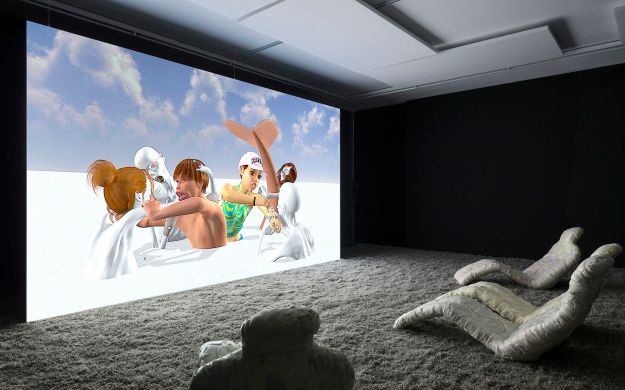
Canadian artist and filmmaker Jon Rafman’s Dream Journal 2016-2019 is another example that practices anti-hauntology and deterritorialize the sci-fi film genre by transplanting the aesthetics of video games. Animated with hobbyist 3D software, the texture of Dream Journal 2016-2019 resembles the virtual reality of Second Life. Besides the obvious game texture produced by digital materiality, its visual languages, narrative and structure all indicate its relevance with video games instead of conventional animation sci-fi films.
The film begins with a point-of-view shot of passing through an empty corridor with many doors on both sides. However, Rafman does not give any extra shot to reveal who the viewer is. Is it a third person god view? Or is it the simulation of the perspective from a disembodied, mind-uploading subject? It seems like from the very beginning Rafman already obfuscates the line between reality and the virtual space. If the hallway remains the resemblance with the real world, after the door at the end of the corridor opens, we are introduced into an estranged and bizarre world where the landscape is evocative of the experimental exploration game LSD: dream simulator: the eerie pinky sky filled with clouds and the huge chess board embedded in the middle of the barren rocky ground. In the following parts, we follow a young girl going through a series of monstrous, action-packed and violent adventures. A man with bull horns rides a motorcycle carrying her, entering the open mouth of a giant skull. Then, it transitions to a completely different world. Soon after, the girl’s eyeballs unfortunately fall out and she is compelled to do battle with a muscular minotaur to regain her eyes.
The subsequent parts almost consistently repeat this rhythm and pattern. It’s not hard to notice that this scenario differs from the narrative structure of classical films. Her experiences lack reasonable cause-and-effect relationships; instead, they are randomly triggered along with her spatial movements. The subsequent actions, such as the combat with the minotaur, lack strong motives and intentions (like revenge) and are rather explained by the reward-like outcome of regaining her eyeballs through this action. Therefore, while each action is explained and finished, there is no sufficient relations between them. They are more like parallel, identical actions and they do not push forward the story much. In this sense, it aligns more with the task-reward mechanism of a game rather than generating a cohesive story. Although in action movies, sometimes the main character just continuously fights and flees, those actions serve for a bigger story arc and a more centered motivation, yet in Dream Journal 2016-2019, the story is destructed into successive stimulations. In this sense, it renews the sensory experiences of film, because the overall sense of narrative cohesion is broken down into a more instantaneous, present, and intense sensory experience.
If we zoom out to examine the structure of the whole film, it is also highly game-like and innovates the sci-fi film genre and it associates with Rafman’s creation approaches. Overall, it does not have a clear story line but consists of several shorts. However, the existence of a young female protagonist weaves the different stories together. It does not follow the linear time, sometimes the story is suddenly disrupted by an accident or shifted into other characters. Yet the audience can still sense the accumulation of time, memories and data, as after a series of thrilling adventures in different weird worlds, the protagonist comes back to the place she went before and reconnects with the character she departed with.
However, the structure and part of the story all suggest the instability of the protagonist’s identity. Except for the first short story, in other stories, the protagonist is a young girl wearing a blue and yellow striped tank top and a pair of blue pants and she is in the same outfit in different stories. Even though in the last story she becomes more robust and muscular, the audience can still recognize her through the clothes. Yet in one of the stories, she wakes up with the Matrix-like installation connected to her brain. A mysterious woman shows her a picture of her being tied to a chair and tells her that she is the clone of the clone. Simultaneously, an amputated girl in a pink bikini comes into the room, sharing an identical appearance with her. This interlude could be read in two ways. One is that the protagonist is “the clone of the clone”. Another is that this clone situation is the virtual reality in the virtual world that we perceive. This unsolved identity mystery of the protagonist implies each girl appearing in different stories may also be clones. This virtuality is also indicated in several scenes: when the protagonist walks into a restaurant, the images of her walking into it are simultaneously shown on the phone held by a diner who sits in the same restaurant.
In another scene, the image of a girl is zoomed out and it becomes the computer screen watched by another man. Later, the screen shows “battle won”, which implies the images we watched earlier are merely a virtual game played by this man. However, the man suddenly grows a donkey head, and the images switch to the corridor at the beginning, an administrator-like role is peeking the man through the door. These scenes further reveal the entangled relationship between different images and stories—there is no reality, as all the representations of reality are mediated. They are clone of clone, mirror in the mirror, and the game in a game.
This kind of representation of endless simulated worlds is not new in sci-films, for example, World on a Wire (1973) and The Matrix (1999). What makes Dream Journal 2016-2019 innovative is that it blurs the boundary between the embodied world and disembodied world by thoroughly gamifying films through digital materiality and structures. Both World on a Wire and The Matrix use the visuals to indicate the virtual world. For example, at the end of The Matrix, the virtuality of the simulated world is exposed by the moment when the seemingly real world is transformed into an immaterial world constructed by the coding network.
Dream Journal 2016-2019 never exposes that, which means the representation it created could be interpreted in multiple ways: it could refer to a future world where our embodied reality is exactly like games or the whole film is cyberspace, a game played by the people in the future. Therefore, the texture of the game and computer-generated animation as well as the structure of it extends the limitation of the representation as well as the sensory experiences of the future that sci-films can offer. Rafman not only creates a gamified, immaterial future world by giving the audience game-like experiences, but also visualizes the immateriality of the future world by applying the digital technology that embodies the immaterial internet. As Rafman himself stated, “It features abject and sublime spaces, revealing the material residue of a life completely dedicated to an online existence, and it points to the impossibility of total escape from physical reality” [1].
If Dream Journal 2016-2019 reflects the deterritorialization of cinema through gamification, then it also leaves a question we can further delve into. It still remains the form of audiovisual media by excluding any interactions, which means it still lingers in the field of film instead of game. But it almost pushes itself into the limits. What if it is redesigned as a game or interactive media? This nearly breaking boundary prompts other questions: what is the difference between cinema and game? Is the future of cinema accelerated by gamification? These questions open up the space to think about the logic of capitalism behind the film industry and game industry, as gamification may not only be the innovation inside cultural forms but indicates the transformation of the cultural industry. And it is also notable that Dream Journal 2016-2019 featured in 2019’s Venice Biennale and although Rafman uploaded this entire film to YouTube that users can access free [2], his works mainly circulate in art museums. This predicament shows that anti-hauntology is more difficult than we have thought, even though inventive art works are emerging, as Fisher pointed out, “neoliberal capitalism has gradually but systematically deprived artists of the resources necessary to produce the new” (15). Will the art museum and game become the future of cinema? By probing sci-fi media production, anti-hauntology leaves us more questions around technology, media confluence, and the mechanism of capitalism.
Notes
1. “DREAM JOURNAL: Jon Rafman excavates the always-online unconscious.” By Christabel Stewart. https://magazine.tank.tv/issue-80/features/curated-pages
2. “Jon Rafman, DREAM JOURNAL 2016 – 2019 – FULL MOVIE” https://www.youtube.com/watch?v=PyiSgE4M3vI
Works Cited
References
Bluemink, Matt. “Anti-Hauntology: Mark Fisher, SOPHIE, and the Music of the Future.” 2021. https://bluelabyrinths.com/2021/02/02/anti-hauntology-mark-fisher-SOPHIE-and-the-music-of-the-future/
Bluemink, Matt. “Anti-Hauntology: Arca, AI, and the Future of Innovation.” 2021.
Bruckner, René Thoreau. “‘Why did you have to turn on the machine?’: the spirals of time-travel romance”. 2015.
Das, Jareh. “Science or Fiction: Imaginary Narratives in the Works of Laylah Ali, Hamad Butt, Basim Magdy and Larissa Sansour.” 2013.
Deleuze, Gilles and Félix Guattari. Anti-Oedipus: Capitalism and Schizophrenia. 1972
Fisher, Mark. Ghosts of My Life: Writings on Depression, Hauntology and Lost Futures. 2014.
Jameson, Fredric. Postmodernism, or The Cultural Logic of Late Capitalism. 1991.
Lampadius, Stefan. “Science Fiction, Creation and Evolution” in The Human Future? Artificial Humans and Evolution in Anglophone Science Fiction of the 20th Century. 2020.
Rogers, Ariel. “Digital Cinema’s Heterogeneous Appeal: Debates on Embodiment, Intersubjectivity, and Immediacy” in Cinematic Appeals: The Experience of New Movie Technologies. 2013.
Boyi Xu is a filmmaker and researcher with a background in literature and cinema. She holds a BA in Chinese Language and Literature from Peking University and an MA in Cinema Studies from New York University. Her research interests span sound theory, affect theory, posthumanism, digital humanities, and sensory ethnography. Her short film I breathe what I hear has been selected by several international festivals, including DOC NYC and Rai Film Festival.
 Blue Labyrinths