
Click here to watch the full video interview on our new YouTube channel.
MB: Hi Ray. Your book The Mountain in the Sea explores themes of environmentalism, AI, and interspecies communication. What made you start looking into octopus communication specifically, and how did that link to AI for you? How did you connect those two threads together?
RN: So when I first was conceptualizing the book, my first idea was that it was going to be a book about communicating with the octopus, primarily. I had written a novella that was very concretely about a first contact story. It’s a really direct story of trying to understand a species, an alien species in the case of that novella, but I reworked that idea into this novel. I stole a lot. I stole so much from my own novella that it became unpublishable, which sometimes happens. I kind of cannibalize those ideas. I had of course read a lot about biosemiotics and communications, books on paleopoetics and the embodiment of meaning, and I was trying to find a framework that I could put that forward in.
I think what’s been even more interesting than the way that AI was integrated into the book is the way the discourse around the book changed between when it came out and the beginning of 2023. So when it came out in October of 2022 this was entirely a book about octopuses and communicating with an octopus. Readers who were disappointed in the book were disappointed that there wasn’t enough octopus because they felt like that should have been the primary focus of the book. By January, this was a book about artificial intelligence. A review came out in the New Scientist that was probably three or four pages long. It was a really extensive, positive review. I was really happy with it. It didn’t mention the octopus once. So that was fascinating for me as an author was you write a book and when it comes out, it’s one book. And three months later, it’s quite a different book. The way it’s being read, interpreted and talked about.
MB: To me, that comes down to the fact that the book is essentially about how humans communicate with things that are similar to us, but entirely distinct from us, and how we can bridge that gap. Obviously, given the explosion in AI-related discourse over the last year, it makes sense that readers would suddenly start to focus on that. But then again, there have been a lot of octopus-related media popping up as well. I read Peter Godfrey Smith’s book Other Minds a couple of years ago and I thought it was absolutely fascinating. How did you get into researching octopuses? How did that link into your background?
RN: I have a theory that every novel that I write is about some sort of obsession that I had ever since I was a kid, and once I’ve rid myself of all of those obsessions I probably will have run out of things to write about! I can remember loving the octopus and thinking that it was a fascinating creature back in fifth grade when I did a report on them. And I can also remember being in university and talking to other people about how fascinating this animal was; the different ways that it had to communicate from us; its curiosity. That was actually at a time when we didn’t know nearly as much about them as we do now. Actually our knowledge of the octopus and the way that its body and mind works has really expanded drastically over the last couple of decades. I think part of what I was doing in the book is similar to what I was doing in Vietnam.
So in Vietnam, I was working as the environment science, technology and health officer, and I was trying to encourage people to pay attention to the environment. I was trying to think of how we had done that in the United States successfully, and one of the things that I saw that we had done was to choose a charismatic animal, and get people to focus their empathy and their concern on one charismatic animal. In the United States, it was the ‘Save the Whales’ campaign. That really focused people on the ocean and on what was happening to the whales because whales were something that inspired our empathy and our concern in a way that ‘Save the Sea Slugs’ or Sea Stars wouldn’t!
And so when I was in Vietnam, I actually started a campaign called ‘Save the Dugong.’ The dugong is a manatee essentially, a sea cow. It is cute and slow-moving and it has short forelimbs and therefore it inspires a sort of empathy and it was really endangered, possibly even extinct in Vietnam, nobody really knew. When I was inspired to write a book about a first contact story – but taking first contact very seriously from a hard science/biology perspective and placing it on earth rather than first contact with something from space – I think I chose the octopus because it is a charismatic animal and I knew that it would draw people in.
I’m not sure if it’s Peter Godfrey Smith who mentions this or Sy Montgomery who wrote The Soul of an Octopus, which is a great book, but in our aquariums, we really only name three different animals. We name the otters, we name dolphins, and we name the octopus. Everything else is just “a fish”. So those animals must bear some special importance. It’s obvious why we name the otter, and it’s obvious, I think, why we name the dolphin too, because the dolphin is a mammal. We clearly have a lot in common with it. We recognize something significantly similar to us. It communicates vocally in a way that’s really quite similar to the way we communicate. We see a lot of ourselves, and we have this long-standing relationship with the dolphin, but why do we name the octopus? It’s a mollusk!
MB: It couldn’t really be more different.
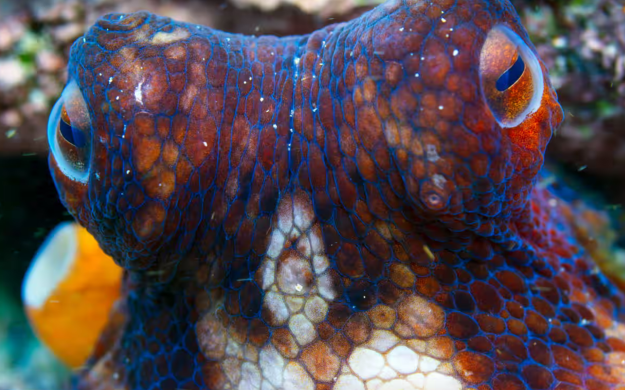
RN: I’ve said this before, but if you were an alien and you came to Earth and you encountered an octopus and a human being, you wouldn’t understand how these two things could be on the same planet. How is this possible? How did you get here and here? It’s an animal where our latest common ancestor is 500 million years ago. A flatworm with some sort of basic visual apparatus, probably can only perceive shadow and light. It’s been evolving separately from us for 500 million years, and in that time, it’s established this big creative brain. This fascinating, quick learning interest in its environment, this creativity. I think that’s what we really recognize in the octopus is creativity. The octopus’s creativity and that similarity with our own curious natures somehow overcome all that physical difference and allows us to engage with and really empathize with this animal. Maybe the most different animal in the aquarium from us in many physical ways, effectively as different from us as a sea slug or a sea urchin. But then the other fascinating thing is you have all that difference, 500 million years of separate evolution, and you end up with eyes that are almost exactly like our own. Camera eyes with basically the same mechanisms that our eyes have, and when you can look at an octopus, you can look an octopus directly in its eyes and it is like looking at a human being.
MB: Because it feels like they’re looking back at you, right? That’s one of the most fascinating things compared to virtually all other animals that are not mammals. Maybe you get it with some birds and lizards to a certain extent, but with an octopus, that level of intelligence seems evident when you see one.
RN: Yeah, you get caught up in its gaze. I have a bird feeder, for example, and birds are interesting when you look at them, when you look at their whole body and the way they move, they are really fascinating animals. I love watching them. Actually, when you look them directly in the eyes they seem quite dead. Something that actually pushes you back from empathy with a bird is when you look them directly in the eye. And that’s the opposite of what an octopus does to you.
MB: Yeah. I suppose that’s the blackened eye. Obviously we know now about the intelligence of crows and how many steps of decision-making they can make, which is that convergent evolution of intelligence that developed after however many millions of years, but it’s just curious because of all those animals the octopus is our most distant cousin, yet, perhaps other than mammals, we can empathize with them the most.
You mentioned looking into things like biosemiotics. What drew you to that symbolic understanding of communication and how animals communicate from that perspective?
RN: So, at the time I was going to university, the study of literature was very dominated by theory, and theory in UC Santa Cruz was very dominated by semiotics and structuralist and post-structuralist theory. I can actually remember reading Kaja Silverman’s book, The Subject of Semiotics and feeling as if someone had just gone and put their fingers into my skull, torn it open and then shoved a whole new world inside it. I remember closing the book and walking around downtown Santa Cruz, feeling as if I was on drugs. All of a sudden everything looked completely different to me and the whole world seemed like a place that I had just not seen until that moment. Semiotics really opened up a whole new way of experiencing meaning for me. I really mean that. It feels like people’s description of a religious experience. I’ve had this a few other times to a lesser or greater degree. I remember when I was in high school reading like Siddhartha and feeling like I “understand the meaning of life!” But this was real. And because semiotics really has this way of explaining these complex ways in which we construct things like our sense of self and our sense of where we stand in society and these kinds of things. I have always been fascinated by it.
Then biosemionics really takes that semiotics to a different level. It applies it to science, it applies it to biology, and its fundamental argument is that life is physical, as we know, and all the things that we scientifically know about the physical facts of life are true, but on its most fundamental level, what life is is an exchange of information being interpreted. This is the fascinating turning of biology on its head. Rather than looking at the physical substrate in which that exchange is taking place, really looking at the ways in which we have both digital and analog meaning making going on at all times in life. What’s interesting about this exchange of information is that it also transcends things like the death of an individual. It binds all life together in a fascinating way. It’s hard to get over the thought that in order for us to be sitting here talking there has to be three and a half billion years of uninterrupted passing of signals from one living being to another, and inside those living beings and between those living beings and their environment, completely unbroken in order for us to have this conversation. All of us are actually a part of a single conversation that began in some clay substrate or pool on Earth three and a half billion years ago. Everything. All of this is just part of this vast exchange. And that’s what biosemiotics sort of does. It forces you to look at life through the lens of communication.
So then you start seeing symbolic communication and human culture and all of these things that we do, not as fundamentally different from what other species do, but as perhaps emergent upon what those other species do. Symbolic communication really enables human beings to talk about futures that don’t exist, like science fiction. Pasts that didn’t exist. To perform all these elaborate communicative acts is an extension of the kind of informational exchange that allows a fox to put one foot in front of another and direct its movement toward a future state. So, instead of human consciousness being completely unlinked from everything else, you have a sense of it as being fully integrated into these consciousnesses and proto-consciousnesses that probably stretch all the way down to bacteria directing its position away from dangerous chemicals and towards sugar sources, for example. And I think that way of looking at the world as a science fiction writer just opens up a thousand doors into how to really look a little bit more deeply at what the act of communication really is and how fundamentally profound it is.
MB: Yeah, I find that fascinating as well. This idea that we’re all linked together by inscriptions of communication. If we’re reading a book from antiquity – even if you’re just considering that amount of time – we’re talking a few thousand years’ worth of ideas being constantly, reflexively changed and developed, and our communication going back and forth through time in this bizarre way. So we have these inscriptions of communcation, which are essentially technologies, and then we have what technology actually means from the perspective of the humans who are making it, which links into the AI theme of the book. But from a more philosophical perspective, do you have any favorite philosophers or people who influenced you in general as a writer? And then specifically in relation to this book, things that you found particularly interesting?
RN: The huge influence that I have, the mountain in the middle of all this, is Charles Sanders Peirce. Probably the first great American philosopher. And I think that he is little understood and appreciated, mostly because he held no academic positions, and he never was able to organize his thought into concrete publications. It’s just collected in these fragments, essays here and there. But his concept of how logic and communication work is really at the core of my thought. So above all, probably Peirce and then Jesper Hoffmeyer, who was in a way the father of biosemionics.
I think Sigmund Freud is important, not because of anything that he actually came to a conclusion on, but the way that he opened up the black box of the human brain. He is a subject of disdain and a target for a lot of people, but I think he needs to be seen in a way like the early astronomers. He blazed a trail. The one thing that he really impressed upon us as a society, and I think that changed everything, was the idea that we do not understand ourselves and we do not know where our thoughts are coming from. That just conceptually changed everything about human existence on the planet. He gave us tools that other people would sharpen and perfect; tools to understand human perspective and its flaws.
Writers, I have Patricia Highsmith, Dorothy B. Hughes, and several other American crime novelists of the mid-20th century. I think there was this time in the mid-20th century when crime novels were probably some of the most amazing prose being written, and some of the most fundamentally sort of experimental and interesting prose.
MB: And did I read somewhere that you started off writing crime fiction?
RN: I did. I started off writing very briefly writing sort of mainstream fiction, and then I very quickly moved to noir and crime fiction. And I wrote that for a long time. And I feel like that was when I was really learning to write. I was building the toolbox that I would exploit later. It was all done during that crime fiction writing phase. So I love those writers, especially their use of perspective and their use of these psychological tricks. The way in which they can merge the narrative voice with the voice of an actual person in the novel so that you are often lulled into thinking that the protagonist is thinking something when really it’s like some interjection from outside and vice versa. I love that slippery way that they have of doing that. In a Lonely Place is a great example of that by Dorothy B. Hughes. She really masters that way in which perspective distorts reality completely. And you’re just caged by seeing the world from one person’s perspective. And then Patricia Highsmith does it masterfully in The Talented Mr. Ripley, which has been made into many, many films of varying quality, but none of them do what the book does. What the book does is it makes you like Mr. Ripley because everyone else is so unlikable. Everyone else is so unlikable because you’re viewing the world through the eyes of Ripley. And so he always seems completely justified and you’re rooting for him the entire time, which is not the case in the films where he is seen from the outside, he seems like a horrible person. Seen from his own headspace everyone else seems truly awful and deserving of what happens to them.
MB: It’s like what people say about Lolita. You’re essentially reading about this horrible character, but from his own perspective, everything is justified.
RN: Yeah, exactly. I love that period in American writing. But I read so widely, especially because I’m often reading for research, so I’m reading history, I’m reading lots of nonfiction, lots of science. I still read a lot of theory because I really feel like theory just makes my brain work in ways that nothing else really does. I have very little time to concentrate on science fiction and fantasy but I read that too. Maybe not fantasy so much, more science fiction, but that’s just a personal taste.
I think there are different ways of being. Different people have very different kinds of intelligence, as we all know, and my particular kind is that I am like a sponge. I pull in all of these external factors and then eventually I’ll give back something that is developed out of that in a different way. If you knew what I was reading, you would be able to see, oh, this book is basically made out of these hundred books! There’s some kind of weird personal process.
MB: I was wondering about that, and I don’t know whether this is just what I was looking into the characters based on my particular interests, but in the character of Evrim, the genderless sexless AI who has this quality that they don’t forget anything. To me that immediately brought to mind the story by Borges, ‘Funes, the Memorius.’ In that story Funes can remember everything in such detail that it becomes such a paradoxical limitation on him that he cannot actually do anything. It’s like Zeno’s paradox where you’re experiencing an infinite number of moments from one moment to the next. Movement and thought become impossibe because you’re stuck in the same moment the whole time. I don’t know how you approached that paradox, but when you were thinking about Evrim as a character how did you get that idea of being able to remember everything across? I was curious where you were going with that.
RN: Yeah, this relates to a theory that I’ve been developing for a few years about the way in which we construct and reconstruct the self. I view the self as a sort of triangle in construct – and keep in mind that anything I say is like a map and not a territory, this is just a model and all models are very basic simplifications – it’s that act of knowing where you were in the past and directing your action toward a future moment, and then having to be between those two moments and determine how to shift your balance or your position. In every animal, you can argue that there is a sense of past, present, and future that’s embedded in bodily movement. I think that consciousness extends out of that bodily movement.
At the level of human sophistication, we have a sense of who we were in the past, which is constantly being read from the position of who we are now. Read and reread. And then we have a concept of who we can be or will be in the future, which is also constantly being reread and revised according to who we are now, and who we were in the past. I think this accounts for some of the reasons why memory is so malleable. From the position of the present time, events in the past appear very differently and our perspective on them is continually changing.
So I realized that the self is structured as a conversation, a three-way conversation between future, present, and past that is mapped upon bodily movement. The placing of the limb, and where we need to go in order to take our next successful step in pursuit of whatever the object is. This seems intuitive to me: that bodily movement becomes our conscious construction of self through this complex emergent process of language and our minds evolving and all of those things.
So, Evrim, to answer that question, would be someone who was locked in a different way, in a conversation with something that was immutable. If you can remember everything, what that really means is you can’t distort the past in order to suit a rewriting of the present moment and a rewriting of the future. Instead, you always have to be basing that present moment in something concrete. When we start processing that as human beings, we realize that that’s horrifying. That if you can’t leave the impression of the present moment on your past memories and somehow work them into that system of the self, it may eventually lead somewhere really bad. It could give you some really superior qualities, but very much like in the Borges story, the end result is probably not great. I did want to leave the reader with a sense of unease about Evrim. It should leave the reader with an uncomfortability about who this being might be in the future. And just to mark the difference between a created mind and a human mind, the limit of our understanding, and the mistakes we might make when trying to create a truly artificial intelligence.
MB: I always thought a good representation of that was one of the early episodes of Black Mirror. In ‘The Entire History of You’ the characters have implants in their head where they can replay memories. I’d always been interested in this idea and when I was watching that episode and thinking what it would be like if you could remember certain events in the past really clearly – things from your childhood, things from any other part of time. What Brooker does excellently in that episode, and what you do well in the book, is show how, if we were capable of perfect recall all the time, it would send us into a sort of negative spiral. For a human to actually have perfect recall would be an almost impossible burden to bear, even if it was selective. You could be exactly recalling all of these memories that your brain has changed and morphed and distorted in particular ways for a reason.
RN: Right. How would an addict, let’s say, be able to move past all the terrible things they had to do in the past to get the substance of their choice and see a future in which they could be a very different person if they were locked in constantly recalling those things in detail?
It reminds me of, I was in a class on the early Pali Canon of Buddhism. One of the things that was brought up was this idea of grief and how grief is related to grasping. One of the things that the teachers said, which I thought was just an extraordinary revelation, was when you’re grieving over someone’s death the thing that you should focus on is that for you this is happening over and over again, but for the person who died, it only happened once. One time. Sometimes what you’re doing when you’re grieving is you’re projecting the pain of that death experience back on them as if it happened to them over and over and over again, as if they’re still suffering, but you’re the one who’s suffering, not them. Understanding that and trying to unlink those things really does help in this process. That storytelling aspect, that conversational aspect of the self becomes a really powerful survival mechanism.
MB: Yeah, necessary.
RN: Necessary.
MB: If we expand this idea of how the past and future link together in this triangle, one of the interesting parts of the book that I think is overlooked is this world that you create, which is this speculative semi-dystopian world that operates in the background of the story. It was curious to me because essentially it’s a world that’s moved away from what we consider in the 21st century to be this normal idea of nation states. I was curious to pick your brain a little bit about that. As somebody who’s lived in various different countries how you came to start exploring and developing this new world which you build the story around. To me it was quite unique in the sense that it’s cyberpunk enough to still exist within the sci-fi realm, but it’s still very close to home.
RN: The interesting thing about human history, and that triad of the self is that it applies to all entities. An entity is anything that is a living system, even if it itself is not alive, and is just composed of conscious living systems. So an entity is also a state, or an institution like the Department of State or the Foreign Office is an entity. It has a life, but that life is composed of other lives. All entities are triadic conversations in a sense. They have ‘this is where we’re going, here is where we came from, and that is what informs our image of where we are today.’ Entities are Russian dolls composed of other entities inside them, and they’re parts of other larger entities. I think what’s interesting about nation states is that nation states are this way of forming a thing out of nothing, or out of materials that are disparate and often contradict any sense of continuity. A nation state is basically a story that we’re telling about why we are together under the system that we have now and why we are headed in the place that we imagine ourselves going.
What’s interesting about the nation state is a few little thought experiments will break its precepts apart, as you said. In Kosovo, we’re working with Albanians and of course the imaginary nation state is supreme in the Balkans. I would say to them, imagine speaking to an Albanian from 1,000 years ago. That person doesn’t have anything in common with you. It’s actually unlikely you’d be able to understand any of the words that came out of their mouth, although technically they’re supposed to speak the same language as you do now. Certainly you would not understand any of their values. Their entire picture of the universe would be completely different from anything you could imagine today. They would have no way to communicate their concepts to you, and you would have very little way to communicate your concepts to them. And now imagine a Serb of your age in Belgrade and trying to speak to that person. Well, they understand pretty much everything that you understand about the world and their values are much the same, the television shows they watch are much the same, and all of these things are similar. So how is it that your concept of what is included is this person who has nothing in common with you but not this person who has almost everything in common with you. And that’s how the nation state really functions to distort this process.
The other way the nation state is interesting is that it arose really recently, and somehow is imagined as having been always there just under the surface waiting to come out. Natural and permanent. I wanted to introduce other concepts for how these things might be organized. One of the inspirations was my own experience in Afghanistan. When I was in Afghanistan, one of the things that I saw with my own eyes is that there is no Afghanistan. One of the things that we’re just fundamentally unable to understand is that if you wanted to have a better model for what Afghanistan is, a really good model would be a honeycomb in which each individual cell is a mountain valley, and that hexagon rises and becomes virtually impenetrable. And within that cell, there’s a culture living out its life, and every once in a while, there’s some tiny act of communication between those mountain valleys, but otherwise those cells just remain completely isolated. And there are hundreds of them. So it’s difficult even when you are trying to organize the Afghan people into a ‘people’. But even, say, Tajiks. Even that is an incredibly abstract concept. There are so many different kinds of Tajiks in Afghanistan, depending on where they come from, including the descendants of the assassins still living up in the mountains and all of these fascinating subgroups.
One of the reasons why I think this country has been such a thorn in the side of the attempts to make it something else is simply that. It just will not fit the pattern. I had suggested a long time ago that maybe the answer with Afghanistan was just to stop treating Afghanistan as if it were something that we want it to be and start treating it as what it is. But that’s incredibly difficult to do in international politics where the nation state is now our supreme way of thinking about things for better or worse.
So, you have these different constructs that I think will one day, inevitably end, because all worlds end, and all ways of ways of life eventually become something else. There will be a world with human beings on it, I’m quite certain, in which we’re not organized in the way that we’re organized today. People might mourn the countries that exist today, but maybe in the same way that someone would vaguely mourn one of the Burgundies!
MB: Yeah, or Prussia, or…
RN: Yeah, like Prussia, or any of those countries that have just ceased to have any relevance to us. And so, it’s more of a thought experiment. I try to get people to focus when reading science fiction on the idea that science fiction is not about prediction, it’s about predication. Predication is the real strength of science fiction. It’s predicating a different world upon some kind of change. Doesn’t have to be technological change. It could be something very different. It could be, as it often is in alternate histories, somebody dies at the wrong time, or someone is never born, and that changes the histories that we have today. I would think of it as an alternate history of the future. It’s one possible way things could be reconstructed after the nation state dies.
I was dealing with the Nagorno-Karabakh conflict and one of the books I was reading said the ethnic tensions in Nagorno-Karabakh extend down through time to the depths… of the 19th century!
MB: That’s it. It only goes back to the 19th century! For so many of these situations.
RN: And that’s exactly it. These things are not immortal. They’re not even that old!
MB: I had that same sort of realization when I read Benedict Anderson’s Imagined Communities a while ago. We project this idea of the nation state into the past, as if it’s an eternal thing that’s always existed and then suddenly realising that actually, all of these ideas are very, very recent. Literally inventions based on the development of the printing press all the way through to this 19th century nationalism which eventually led to the First and Second World Wars. It’s a curious thing how we consider nations.
Bringing it back to your point about how nations and entities operate collectively, I think there’s definitely a parallel there with the octopus. You essentially have these entities that are operating in the book, that are not controlled by the head of the entity, or there are lots of different arms that are going around in different directions, and the head maybe has ultimate control over it, just like how the octopus operates. The other great parallel that you drew was with Altentsetseg and her AI drones. I thought it was amazing how she was making that parallel between her and the octopus: ‘I’m in control of them, they’re an extension of my body, but because they are still AI-driven they’re not absolutely controlled by me.’ Again it’s this reflexive feedback loop between different entities at different levels. Those three parallels I thought were really interesting. Was that something that was intentional or did that just arise as you started writing?
RN: When it arises, you see its potential and it becomes more intentional. You shape it. One thing that readers often forget about a writer’s process, because they’re perceiving this finished product, is that there are things that happen in the rewriting. A lot of foreshadowing is only done after the book has been finished. Once you’ve finished the first draft then you can go back and line things up properly so that they fall into place and put hints toward things that happen. Readers don’t necessarily have that concept that the writer has gone back after having finished their own book, reread it and inserted things in order to lead you in certain ways. It is this very manipulative process. Manipulation not necessarily in a negative way, this has been constructed and reconstructed. It wasn’t just built from beginning to end. It was initially emergent from my thinking and the reading I was doing, and then later I directed it into the channels that I wanted to direct it and tried to give it some more scope.
Now I’m in the process of writing a book. I’ve finished the book. I’ve given it to my agent. My agent’s read it. My publisher’s read it. And now I’m in rewrite. What comes out of the end of rewrite will be significantly different because now I’ve taken on a lot. I’ve had readers and so I know what they missed and didn’t get. Now I’m going to go back to suture and tie up.
MB: Will this be the third book after the Tusks of Extinction?
RN: Yes. So, Tusks of Extinction is a novella, 30,000 words, 200 pages, about half as long as The Mountain in the Sea. This will be a novel that is probably going to fall around 75,000 words. The Mountain in the Sea is about 85,000.
MB: So about Tusks of Extinction. Obviously, having really enjoyed The Mountain in the Sea, I was curious to see if you could give our readers a little bit of the premise about what happens in the story? Maybe a little bit of a teaser?
RN: So The Tusks of Extinction, the premise is this: Moscow has brought back the mammoth, but the project begins to fail because although they can physically bring the mammoth back, they can’t bring back mammoth culture. Elephants and mammoths, especially these animals with big brains, rely on culture to teach them how to be what they are. It’s not just genetic, it’s not all instinct. So what happens is they bring back a scientist. She was an expert in elephant behavior and was instrumental in trying to save the elephant from extinction, but she failed and was murdered. They bring back her stored mind and they put it in the brain of a mammoth in order to lead this mammoth tribe and teach them how to be what they are. So this one’s all about the embodiment of meaning and the way in which form affects thought, along with much else. I think people who like The Mountain in the Sea will really enjoy it.
The third book is going to be much more about geopolitics and the way that individuals and high-level geopolitics interact. So less about consciousness and more about the ways in which we’re constructed by our geopolitical environments.
MB: I suppose that talking about mammoth culture, that ties in exactly what we’re saying about these imagined communities, or the way that we form cultures based on these ideas of the past that we have. If suddenly you were brought into a past where you didn’t know anybody, even though you’re in the same land, and you’re amongst genetically similar types of people, you wouldn’t be able to communicate. What do you think brought you from octopuses to mammoths or to elephants? There’s obviously that connection between the fact that they’re highly intelligent animals, but was there any thought process there?
RN: It’s hard to place it exactly, but the stories that I write are like these little ice cores of whatever my thought process was during that period. A novel is a bit longer, a short story might have fewer layers in there. But toward the end of my research for The Mountain in the Sea, I started to read a book by Eva Jablonka, who is a geneticist. I was trying to make sure that I properly understood epigenetics because epigenetics are very important to octopus evolution. So it’s one of those rabbit holes I went down that ends up being like one sentence in the book, but involves reading 20 books! So sometimes it’s like a few chapters. Sometimes you’re literally like, okay, so I learned all this about epigenetics in order to write one sentence!
MB: It goes in the background somewhere!
RN: Right! And the book was extremely complicated, but the argument that the book made was that a lot of evolution is actually a conversation between analog physical culture and genetics. So these things are affecting one another and without the physical culture you don’t get a lot of evolution. Evolution is not entirely random because the ways animals are using their bodies creates what is successful form or not. That reads back into how genetics evolve and how mutations would be used. I found that really fascinating.
She talks a little bit about these monkeys on this island. It’s a relatively well-known story where the monkeys learn to wash yams. So they were given yams by these Japanese scientists so that they would come down onto the beach. The monkeys would eat the yams, but the yams were not that great because they were always covered in sand. And then one day, one of the monkeys went into the water and washed a yam. And it happened about 50 years ago. So that monkey washed a yam and then the monkeys learned from that monkey how to wash yams. And the monkeys would come and they’ll get the yams, and then they would go into the water and wash the yams. Well, that monkey died a long time ago, but the monkeys on that island all wash yams in the water when they’re given them, because that’s what they’ve learned. And perhaps more interestingly, they swim. Because they got into the water to wash their yams and then they started playing in the water. Now they’re in the water a lot, they swim, they wash their yams, the baby monkeys play in the waves and they have an aquatic culture. Well, an aquatic culture based on one monkey washing a yam! These monkeys are genetically identical to the non yam washing monkeys. And the same thing is happening all over in life. Birds are teaching their young, their songs, bird songs have dialects. Lots of behaviors that we attribute to instinct are learned behaviors. I got fascinated by that concept of de-extinction and you would teach learned behaviors. I was thinking about some of the things I had developed in The Mountain in the Sea, the uploading and downloading of minds, and I thought I’d really like to find a framework within which to explore some of those ideas. I was also thinking: what about an upside-down Jurassic park? Where instead of the animals being the bad guys, it was the other way around. That’s one of the other concepts of the book. It’s about pitting these mammoths against all of the political forces around them as well.
MB: I’m super excited to read it and I think I’ll be keeping up with anything else that you’ve written in the future. I’ll probably delve into the short stories as well. Ray, it’s been an absolute pleasure talking to you today. Do you have a release date for the Tusks of Extinction in the UK?
RN: So Tor.com has the global rights that should make the UK release the same as the US release on January 16th, 2024. And if anyone’s interested in reading my short stories over a dozen of them are available on my website for free. All of the ones that are available on the website were published in professional magazines. They’re not leftovers. They are a record of what I’ve published over the years, so you can certainly read them there. And then other ones are available at Clarkesworld and Lightspeed. Although I still don’t have an English collection. I will have a French collection this fall.
MB: Someone will need to translate it back into English then!
RN: Yeah, exactly! Thank you, Matt. This has been really good.
MB: Thanks a lot. It’s been great speaking to you, Ray.
Ray Nayler is the author of the critically acclaimed, Locus Award winning novel The Mountain in the Sea, published in the US by MCDxFSG and in the UK by Weidenfeld & Nicolson. The Washington Post called Mountain “(a) poignant, mind-expanding debut” and Slate called it “(a) wondrous novel.” David Mitchell, author of Cloud Atlas, said: “I loved this novel’s brain and heart, its hidden traps, sheer propulsion, ingenious world-building and the purity of its commitment to luminous ideas.” Positively reviewed in the New York Times, The New Yorker, The Guardian, Publisher’s Weekly (starred review) and many others, and a best book of the year at Amazon and Slate, The Mountain in the Sea, in addition to winning the Locus Award for Best First Novel, was a finalist for the Nebula Award and for the LA Times Book Awards’ Ray Bradbury Award for Science Fiction, Fantasy, and Speculative Fiction.
 Blue Labyrinths