
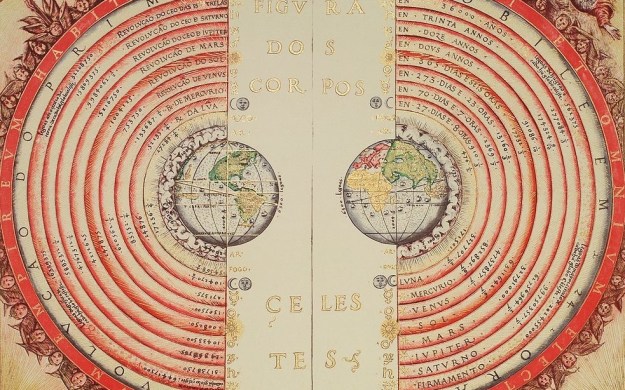
Roughly and historically speaking, Renaissance, Reformation, and the Copernican Revolution are found nearly at the same time in European history. It is only natural to assume that the schema of thinking and feeling of historical figures, such as Boccaccio, Luther, Da Vinci, Copernicus, and others, must have had something in common, which I’d like to delve into here.
Let’s begin with literature. Let’s first compare Dante’s Divine Comedy, which is more medieval, with Boccaccio’s Decameron, a rather modern text; we will find that centeredness is lost and hierarchy is gone. Centeredness here means that the being who owns the central place can scarcely be threatened by other beings and that no two beings can occupy the center simultaneously, making up a hierarchy; there is only one who can dominate the central point. If Christianity is at the center, no other religion can be placed side by side or even catch up with it. No other man may take over or share Jesus’s position. These two ideas, by necessity, set Christianity and Jesus himself right in the middle. Things stand like this in Dante’s Divine Comedy. On the other hand, by the loss of centeredness I mean that whatever sits at the center loses its position and goes somewhere peripheral, but also that the central place that only one occupies is taken over or shared by another, breaking up the structure of hierarchy. This occurred in Boccaccio’s Decameron and, as a result, the hierarchy found in Dante’s Divine Comedy collapsed in Boccaccio’s Decameron.
Dante’s Divine Comedy is hierarchical; no other teaching may compete with Christianity, no other person with Jesus, and no other philosopher with Aristotle. In his magnum opus, Dante is guided by Virgil and leaves for Heaven, but they first have to go through Hell. Before the poets enter Hell, they come to a strange place. It does not at all look like Hell, nor does it seem like Heaven. Virgil tells Dante that people here, including great figures whose names we can find with no difficulty on Wikipedia such as Homer, Caesar, and Hippocrates, and Virgil himself, committed sins that are blameless. That is because:
“[…] baptism was not theirs,
The portal to thy faith. If they before
The Gospel liv’d, they serv’d not God aright;
And among such am I. For these defects,
And for no other evil, we are lost.”
(Canto IV)
According to Dante, only Christians can live happily in Heaven (with some exceptions). It is in this foggy sphere, where Dante, accompanied by Virgil, is now wandering, that Aristotle, who contributed not a little to the Christian way of thinking in the Middle Ages, is deemed the best and brightest. He is called ‘the master’ in the work―in other words, Aristotle is centered among and looked up to by all the other philosophers, including Socrates and Plato; here we find again another hierarchy.
Then when a little more I rais’d my brow,
I spied the master of the sapient throng,
Seated amid the philosophic train.
Him all admire, all pay him rev’rence due.
There Socrates and Plato bottom I mark’d,
Nearest to him in rank.
(ibid.)
The following episode in Divine Comedy shows Christianity’s superiority over Judaism. Virgil, on the way, says that when he was new to this state, where he has now long been without hope, he saw ‘our first parent’, ‘Abel his child’, ‘Noah the righteous man’, ‘Moses lawgiver’, ‘patriarch Abraham’, ‘David King’, and the like, exalted to bliss by ‘a puissant one […] with victorious trophy crown’d.’ You must know who the saver is. Those prophetic and righteous in the Old Testament were saved by him. This clearly and distinctly proves Christianity to be a much better way to go to Heaven than Judaism, according to Dante.
However, when we read Decameron, we find that things are totally upside-down. The famous parable of The Three Rings, reported in Novel III, during the first day, is a case in point. In the story, Saladin asks a wealthy Jew named Melchisedech which of the three religions is the best: Christianity, Judaism, or Islam. His intention is to cheat the merchant out of money because Saladin is deadly in need. Melchisedech, thinking it is a trap and that he will not be able to praise any of the three above another, invents a parable: There was once a rich man who had a very beautiful and priceless ring. He had three sons, all of whom were virtuous and obedient. He loved them all equally. He was old now and had to decide who to leave the ring. In order to satisfy the three, he secretly called a skilful artificer to make two more identical rings. Soon the father was dead and the three sons each had a ring completely the same as the others. Even the maker couldn’t distinguish the true one. Now, what is the answer to Saladin’s question? Melchisedech says:
Each of these peoples deems itself to have the true inheritance, the true law, the true commandments of God; but which of them is justified in so believing, is a question which, like that of the rings, remains pendent.
The merchant is clever enough to evade the trap. Saladin thinks highly of him and comes to be on good terms with him.
Simply put, what the story says is this: we can’t appreciate the true meaning and value of each of the religions, and we can’t tell which is better or which is worse. It’s skepticism because we don’t know; it’s relativism because it is likely that in some cases one might be better than the others and in other cases vice versa; it’s religious tolerance because since we don’t have the foggiest idea which is right or which is wrong, which is better or which is worse, how can we choose one as the only good one and dismiss and discriminate against the others and so how can we not accept the three as equals? Thus, in Decameron, Christianity is no longer at the heart of everything.
When a person dominates the central point and no one else can share it, it is hierarchical. Once the centeredness is lost, two persons can walk side by side, sit face to face, or even share the same night in the same bed, which in a sense is very democratic. In Divine Comedy, when Virgil takes Dante to some place in Heaven, he has to let him go wherever he wills, saying, “I invest thee then with crown and mitre, sovereign o’er thyself,” in order for Dante to see Beatrice by himself. Virgil is not allowed to walk alongside her nor see her. They are of totally different spiritual ranks in terms of Christianity. The centeredness is strictly kept. This is found in Purgatory’s Canto XXVII.
In the meantime, in Decameron, we read a story in which a groom secretly sleeps with the wife of King Agilulf under the cover of darkness, without the wife discovering who he is (she thinks it’s the king), and without the king managing to detect who the cunning guy is. A man of the lower class, ingenious enough, can be in the same bed even with the wife of the king and not caught nor tortured nor executed; an ordinary person, in a sense, equals King. Hail equality! Well, you can read it in Novel II from the third day.
The centeredness is lost, but not only that; motion is gained. Remember what happened when Copernicus advocated the heliocentric theory. When Copernicus picked up the Earth from below, our planet was, according to Galileo in The Starry Messenger, no longer “the sink of all dull refuse of the universe,” which implied that he let it move lightly like a flying angel on the orbit in space; now Mother Earth freed herself and gained motion. Likewise, when Boccaccio wrote Decameron, he emancipated us human beings and allowed us to move, from beginning to end of almost all the stories, as we will without a guide, which Dante gained only when he left Virgil. What I mean by this attainment of motion in Decameron is that a bad person, if fully repentant and purified, can be a good one in a shorter time, people can generally go up and down the ladder, be it social or spiritual, with more ease, and a man and a woman of different ranks can have more chance to go, and stand next to each other, than in Divine Comedy.
(I’m not necessarily writing about this scientifically, as a physicist would do. My point is not science but more or other than science—but that does not mean I’m unscientific. I’m not trying to cover only physics but literature, religion, society, paintings, and music—though superficially and one-sidedly, I admit. In his Copernican Revolution, Thomas Kuhn said that the Copernican Revolution “embraced conceptual changes in cosmology, physics, philosophy, and religion as well,” and I agree, but it may also well be said that the revolution is not only academic but ordinary as well, covering all kinds of thoughts of the people from every walk of life. Now, let me go on a bit more.)
People go up slowly in Dante’s universe. On the way to Heaven, in a certain place, both Dante and Virgil happen to see a mountain along with them tremble and hear people sing a song of praise, before being greeted by a man who begins telling them the following story: The mountain trembles and the people at its summit sing when any one of the persons, lying down because of agonies of remorse, feels purified, rises to her feet, and commences to walk up. He is one of those purified and has been here for as long as 500 years, until at last he determines to go to a higher and better place. Hence this rumbling and singing. This is in Purgatory’s Canto XXI. So, in this man’s case, it took half a century for him to resolve to climb up the spiritual ladder.
On the other hand, in our everyday earthly world described in Decameron, that is way shorter. Here is a story: A lady “met with a brutal outrage at the hands of certain ruffians”; heartbroken and disconsolate, she was just about to make her complaint to the king, when she heard the king was “so spiritless and faineant” that he was unlikely to avenge her harm. Despaired, she decided to vex or mortify him to make the king sensible of his baseness. This is what she said:
Sire, it is not to seek redress of the wrong done me that I come here before you: but only that, so please you, I may learn of you how it is that you suffer patiently the wrongs which, as I understand, are done you; that thus schooled by you in patience I may endure my own, which, God knows, I would gladly, were it possible, transfer to you, seeing that you are so well fitted to bear them.
And the following ensued:
These words aroused the hitherto sluggish and apathetic king as it were from sleep. He redressed the lady’s wrong, and having thus made a beginning, thenceforth meted out the most rigorous justice to all that in any wise offended against the majesty of his crown.
We find the story in Novel II from the second day. As soon as he heard the lady’s words, the king is uplifted. It is much faster for us humans to climb up the ethical ladder in this world than in Purgatory up above. This is what I call the acquisition of mobility. In my opinion, this movability, along with the loss of centeredness, composes modernity; it is lacking in Dante and found in Boccaccio.
As for the loss of centeredness, it can also be found when we see paintings before and after the invention of perspective, for example, when we read Nicholas of Cusa’s theology and Montaigne’s philosophy and when we listen to music before and after Renaissance. I’m planning to write about it later. Hasta la vista!
Bibliography
Boccaccio (1353). Decameron (Trans. J. M. Rigg). Available at:
https://www.telelib.com/authors/B/BoccaccioGiovanni/prose/decamernothe/index.html
Dante (1321). Divine Comedy (Trans. Rev. H. F. Cary). Available at:
https://www.gutenberg.org/files/8800/8800-h/8800-h.htm
Galileo (1610). The Starry Messenger. Available at: https://homepages.hass.rpi.edu/ruiz/AdvancedDigitalImagingSpring2021/ReadingsADI/Galileo%20The%20Starry%20Messenger.pdf
Kuhn, T. S. (1957). The Copernican Revolution. Cambridge, London: Harvard University Press.
Hiroshi Satow is an unknown poet and philosopher, now teaching English and Philosophy to high school kids in Japan.
 Blue Labyrinths